

📌 UPDATE — March 22, 2026
A new illustration shared by aerial observer Joe Tegtmeyer reveals that the Terafab's basic footprint at Giga Texas spans approximately 2 million square feet — offering the first concrete sense of the facility's physical scale. Tegtmeyer notes the total production square footage remains unconfirmed, as the number of floors has yet to be determined. The multi-story nature of the building could push usable production area significantly beyond that 2M sq ft ground footprint. The facility is set to integrate operations across Tesla, SpaceX, and xAI under one roof.
@JoeTegtmeyer · Mar 22, 2026
"The basic footprint of the just announced Tesla/SpaceX/XAI Terafab at Giga Texas looks to be about 2 million Sq Ft, but not sure the number of floors or total Sq Ft available for production."
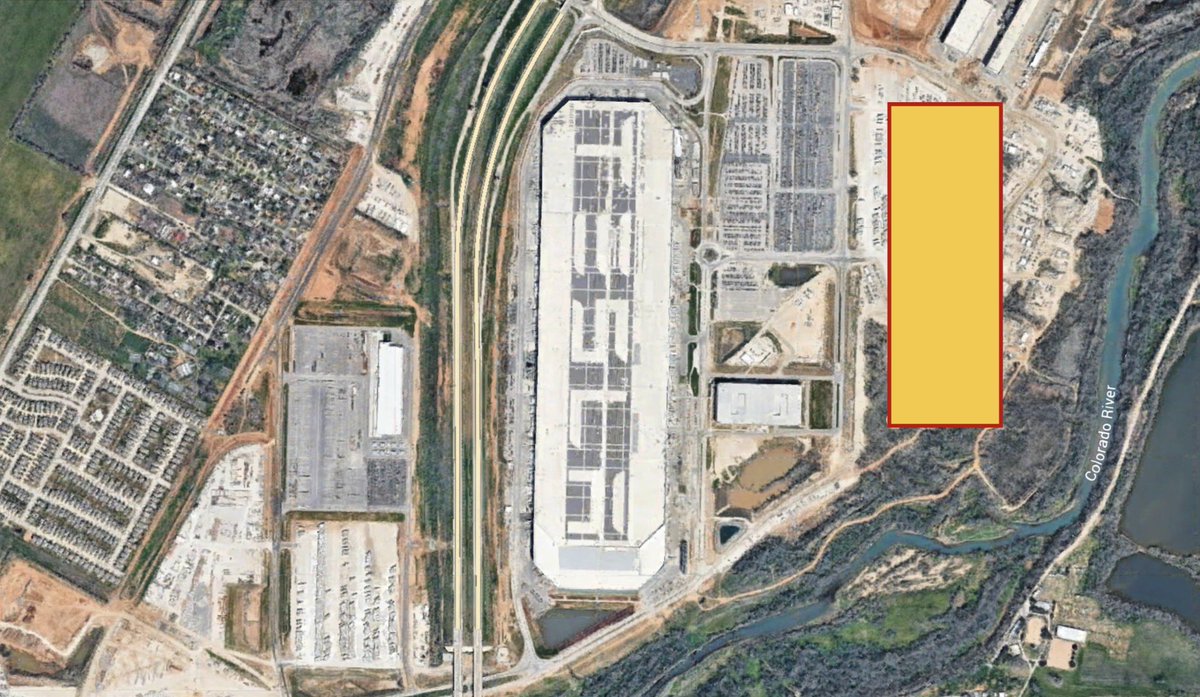
📌 UPDATE — March 22, 2026
Major new details have emerged: Terafab is not a Tesla-only venture — it's a joint facility built by Tesla, SpaceX, and xAI, located near Gigafactory Texas. The headline ambition has also grown dramatically, with the consortium targeting 1 terawatt (1 TW) of compute per year — covering logic, memory, and advanced packaging. Crucially, roughly 80% of that output is earmarked for space-based compute, with only ~20% allocated to Earth-based applications due to terrestrial power constraints. The facility will produce two distinct chip types: one optimized for Tesla vehicles and Optimus robots, and a separate design purpose-built for space applications, likely serving SpaceX's Starlink and future deep-space missions.

📌 UPDATE — March 22, 2026 🔍
Terafab is bigger than Tesla alone. SpaceX and xAI have officially joined the project, with SpaceX announcing TERAFAB as a three-company collaboration targeting 1 terawatt of chips per year — a scale that dwarfs the previously reported 200B chips/year figure. The facility will integrate logic, memory, and advanced packaging under one roof, framed explicitly as infrastructure for "a galactic civilization." Crucially, Tesla's D3 (Dojo 3) chips are already flying inside SpaceX's AI satellites, confirming deep cross-company silicon synergy that predates the formal TERAFAB announcement.


📌 UPDATE — March 22, 2026
The Terafab has now been officially unveiled as a joint Tesla, SpaceX, and xAI venture — confirming cross-company chip production under one roof, a detail not previously disclosed. The facility will be built on the east side of Giga Texas in Austin, with drone footage from Joe Tegtmeyer already showing signs of major new construction activity at the site. Notably, this construction is separate from an additional factory planned for Optimus production, meaning Giga Texas is set for two simultaneous mega-builds. The official Terafab logo — bearing all three company names — has been circulating widely on X, signaling this is a fully formalized multi-entity project rather than a Tesla-only initiative.


📌 UPDATE — March 22, 2026 🔍
TERAFAB is now officially a three-company venture: Tesla, SpaceX, and xAI have jointly announced the project, dramatically expanding its scope beyond what was originally reported. The stated goal has grown to 1 trillion watts of compute per year — and Elon Musk notes that since total US electricity generation is only ~0.5TW, the majority of that compute must go to space. The facility at Giga Texas will integrate logic, memory, and advanced packaging under one roof, capable of producing any chip type end-to-end in a single building.
The space angle is now central to the story: SpaceX is developing AI satellites starting at 100kW and scaling toward the megawatt range, launched via a lunar electromagnetic mass driver that will shoot Tesla-chip-powered satellites into orbit. Musk projects that deploying AI in space will be cheaper than terrestrial deployment within 2–3 years. He called Terafab "the final missing piece of the puzzle."


📌 UPDATE — March 22, 2026
Terafab is bigger than Tesla alone. Just hours after launch, Tesla, SpaceX, and xAI simultaneously announced Terafab as a joint project — framing it as "the next step towards becoming a galactic civilization." This cross-company alignment signals that Terafab's chip output is intended to power not just FSD and Optimus, but SpaceX's autonomous systems and xAI's Grok infrastructure as well. Tesla's AI lead Ashok Elluswamy described the initiative as "extreme AI software – AI hardware – semiconductor fabrication co-design," confirming a level of vertical integration that goes far beyond what was previously reported.


📌 UPDATE — March 21, 2026
Major revision to what we reported: Terafab is not a Tesla-only venture. Elon Musk confirmed tonight that the project is a joint initiative between SpaceX and Tesla, with a formal announcement livestreamed on X around 8pm CT. Critically, the compute allocation flips the script on earlier reporting — roughly 80% of output is earmarked for space applications, with only 20% for ground-based uses like FSD, Cybercab, and Optimus. The stated goal is to produce over one terawatt of compute per year across logic, memory, and packaging. 🔍 The SpaceX co-ownership and the space-first compute split were not previously disclosed in any official capacity.

📌 UPDATE — March 21, 2026
Terafab launch day is officially here. Prominent Tesla watcher Whole Mars Catalog (@wholemars) marked the occasion on X just hours ago, confirming the milestone is being recognized publicly today — March 21 — exactly as previously reported. While Tesla has not yet issued a formal press release, the social acknowledgment from a closely followed community voice adds weight to the launch timeline. Expect more official details and imagery to surface throughout the day as the facility goes live.
@wholemars · March 21, 2026 · 2,360 views
📌 UPDATE — March 21, 2026
Tesla has confirmed Terafab hiring is now actively underway across two locations: Palo Alto, California (Tesla's engineering HQ) and Austin, Texas (Giga Texas) — signaling the project spans both its design and manufacturing nerve centers. The dual-site structure suggests Terafab is not a single facility but a distributed chip production network, potentially larger in scope than previously reported. Today's launch date of March 21 is being confirmed by active job postings going live this morning.

🔍 The dual Palo Alto + Austin hiring structure is not reflected in earlier Terafab reporting and may indicate a larger footprint than the originally announced single-fab model.
📌 UPDATE — March 19, 2026
Just two days before Terafab's scheduled March 21 launch, Elon Musk has spoken publicly about Tesla's Terafab manufacturing strategy, offering fresh insights into how the initiative fits into Tesla's broader production vision. Musk emphasized Terafab's role in revolutionizing vehicle production efficiency and scale through innovative factory design — reinforcing the significance of the launch timing. Sawyer Merritt shared Musk's comments on X, which have already drawn nearly 21,000 views. No major changes to the previously reported specs ($20B investment, 2nm process, 200B chips/year) have been announced, but Musk's direct commentary signals Tesla is actively building public momentum ahead of the debut.

via @SawyerMerritt · March 19, 2026 · 20,871 views
📌 UPDATE — March 19, 2026
Just two days before Terafab's reported March 21 launch, Tesla has begun actively hiring for the project in Austin, Texas — a strong signal that the facility is moving from planning into execution. Job listings spotted by @SawyerMerritt describe roles requiring candidates to "own end-to-end program scoping — including factory design/construction from concept through execution, ramp-up, and production readiness," suggesting Tesla is simultaneously building out both the physical facility and its operational workforce. The hiring push confirms Terafab is a live, active program rather than a distant roadmap item.

📌 UPDATE — March 18, 2026
New industry analysis shared by Tesla watcher Joe Tegtmeyer sheds light on the sheer physical scale of Terafab. Citing a breakdown by semiconductor analyst Phil Beisel (@pbeisel), the analysis estimates that Tesla's 200 billion chips/year output target translates to roughly 1–2 million square feet of cleanroom space based on current industry efficiency benchmarks — before accounting for the surrounding support infrastructure, which typically multiplies total facility footprint several times over. This would make Terafab one of the largest cleanroom environments ever constructed, dwarfing most existing fabs globally. The analysis underscores that the $20B price tag, while staggering, may reflect the extraordinary physical buildout required to hit Tesla's stated production targets.
🔍 Note: The cleanroom square footage figure is an industry-derived estimate, not an officially disclosed Tesla specification.

📌 UPDATE — March 15, 2026
Tesla's Terafab buildout is moving faster than anyone anticipated. Elon Musk posted that a full Terafab facility expansion was completed in just one week — a remarkable construction pace that signals Tesla is treating this as a wartime-speed priority. The rapid expansion aligns directly with projections made during Tesla's Q4 earnings call, where the company flagged that future AI chip demand will be far beyond what current third-party suppliers can provide, making in-house production not just strategic but existential. This week-long buildout suggests Tesla has industrialized the Terafab construction process itself, potentially enabling rapid replication of facilities across multiple sites as demand scales.

📌 UPDATE — March 15, 2026
Tesla's Cortex 2 facility at Giga Texas has hit a major construction milestone: its main structure is now complete, just one year after crews were still doing basic grading and perimeter marking on the site. The speed of this build underscores Tesla's aggressive infrastructure push ahead of Terafab's launch. Drone footage shared by @JoeTegtmeyer shows a striking one-year side-by-side comparison from two angles, revealing how dramatically the campus has transformed. Cortex 2 is expected to serve as a critical AI training and compute hub supporting the broader Terafab ecosystem.

30-Second Brief
The News: Tesla's "Terafab Project" — an in-house chip fabrication facility targeting 2nm process technology — is set to launch March 21, 2026, with construction beginning immediately.
Why It Matters: If successful, Terafab would make Tesla one of the only non-semiconductor companies in the world to manufacture its own cutting-edge AI chips at scale, directly powering FSD, Cybercab, and Optimus — and potentially eliminating a supply bottleneck Musk warns is 3–4 years away.
Source: @wholemars on X
Tesla Terafab: Inside the $20B Chip Factory That Could Change Everything
Whole Mars Catalog — one of the most plugged-in Tesla observers on X — didn't mince words when Elon Musk confirmed the Terafab Project's launch date: "Perhaps Tesla's most ambitious project ever." That's a statement worth sitting with for a moment, coming from someone who watched Tesla build Gigafactories from scratch, develop FSD from the ground up, and launch Optimus into production.

On March 14, 2026, Musk announced that the Terafab Project launches in seven days — March 21 — with construction commencing immediately. This isn't a distant roadmap item anymore. It's happening.
📊 Key Figures
| Metric | Value | Context |
|---|---|---|
| Estimated Cost | $20–25B | Part of Tesla's record 2026 capex plan |
| Annual Chip Output (target) | 100–200B chips | Custom AI + memory chips |
| Initial Wafer Starts | 100K/month | Scaling target: 1M/month |
| Scale Ambition | 1M wafer starts/mo | ~70% of TSMC's total output, from one US facility |
| Process Node | 2nm | Most advanced node in commercial production today |
| Construction Start | March 21, 2026 | Confirmed by Musk on March 14, 2026 |
| AI5 Chip Power | 150W | Projected to match NVIDIA H100 performance at 700W |
What Is Terafab, Exactly?
Terafab is Tesla's bid to become a vertically integrated semiconductor manufacturer — designing and fabricating its own AI chips under one roof. The project was first confirmed on Tesla's January 28, 2026 earnings call, and with Musk's March 14 announcement of a 7-day countdown to launch, it's no longer a concept. It's a construction site.
The facility targets 2 nanometer process technology — the same cutting-edge node being pursued by TSMC and Samsung for their most advanced products. At full scale, Terafab's ambition of 1 million wafer starts per month would represent roughly 70% of TSMC's current total output, from a single US-based facility. That's not a chip factory. That's a chip empire.
The chips produced here are earmarked for Tesla's most critical programs: Full Self-Driving, the Cybercab robotaxi, the Optimus humanoid robot, and xAI's Dojo and Grok training infrastructure. In other words, every major bet Tesla is making on the next decade runs through Terafab.
The AI5 Bridge Strategy
While Terafab is a long-term play, Tesla isn't waiting idly. The design of AI5 — Tesla's fifth-generation AI chip — has already been finalized. It will be produced by both TSMC and Samsung in different versions, engineered for identical software performance across both manufacturers. According to reports, AI5 is projected to operate at just 150W while matching the compute performance of NVIDIA's H100, which runs at 700W. That's a 4.7x efficiency advantage, if the projections hold.
Sample and limited AI5 production is scheduled for 2026, with high-volume manufacturing expected in 2027. Samsung's new Texas fab is reportedly beginning critical equipment testing this month, with AI5 mass production targeting the second half of 2026. AI6, the generation after that, is expected to deliver roughly double AI5's performance.
The picture that emerges: AI5 bridges Tesla through the near term while Terafab is built. AI6 and beyond get manufactured in-house.
🔭 The BASENOR Take
Whole Mars Catalog's framing — "it would be reasonable to expect them to fail" — is the most honest assessment of what Tesla is attempting here. Chip fabrication is genuinely one of the hardest manufacturing challenges in human history. Intel spent decades and tens of billions trying to maintain fab leadership and still fell behind. TSMC's dominance took 30+ years to build. Tesla is proposing to compress that learning curve dramatically.
And yet. The strategic logic is airtight. Musk has identified a chip supply constraint arriving in 3–4 years. At the scale Tesla needs — for millions of FSD-capable vehicles, a Cybercab fleet, and an Optimus production ramp — no external supplier can realistically guarantee the volume and customization required. Terafab isn't ambition for its own sake. It's a calculated response to a foreseeable bottleneck.
For Tesla owners, the near-term impact is indirect but real. A Tesla that controls its own chip supply is a Tesla that can iterate faster on FSD, push more capable hardware into vehicles without waiting on third-party production queues, and potentially keep costs lower over time. The AI5 chip alone — with its projected efficiency advantage over current NVIDIA silicon — suggests Tesla's in-house chip design is already producing results. Terafab is the next logical step: owning the fab, not just the design.
The risk is real. The ambition is extraordinary. But Tesla has a track record of doing things that looked impossible from the outside — and Musk has a specific, documented history of betting on vertical integration when everyone else said it was unnecessary. Don't bet against it.
📰 Deep Dive
What makes Terafab structurally different from Tesla's previous vertical integration moves is the domain it's entering. Building a Gigafactory is hard. Building a 2nm semiconductor fab is a different category of hard — one that requires mastery of photolithography, extreme ultraviolet (EUV) equipment, materials science, and yield management at atomic scales. The handful of companies that operate at this level today — TSMC, Samsung, Intel Foundry — have each spent decades and hundreds of billions developing that expertise.
Tesla's path likely involves aggressive recruitment from those same companies, combined with the kind of first-principles engineering culture that has driven results in other domains. The $20–25 billion price tag is enormous by any standard, but it's worth noting that TSMC's new Arizona fab alone is estimated to cost over $65 billion. Tesla is either finding a dramatically more efficient path, or the initial Terafab footprint is intentionally modest — starting at 100,000 wafer starts per month before scaling — with the full investment coming in phases.
The downstream implications for Tesla's AI ambitions are significant. Right now, every Dojo training cluster, every FSD inference chip in a delivered vehicle, and every Optimus compute module represents a dependency on external suppliers. Terafab, if successful, converts those dependencies into internal capabilities. For a company whose core thesis is that AI and autonomy are the primary value drivers over the next decade, controlling the silicon is controlling the future. The countdown to March 21 just became one of the most important dates in Tesla's history.


