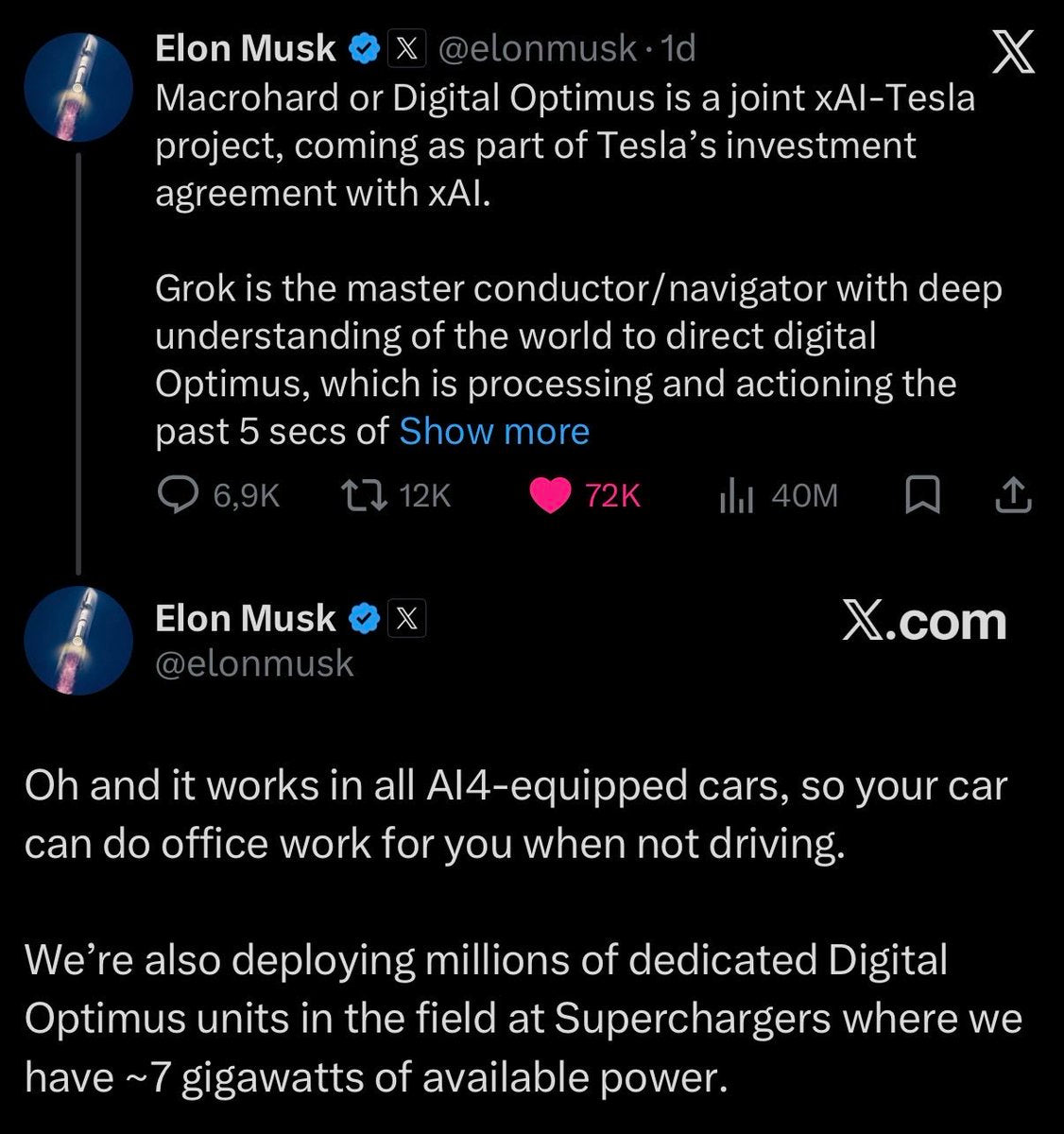
The News: Elon Musk has revealed that Digital Optimus — also called Macrohard — is a joint Tesla/xAI project launching in approximately six months, compatible with all AI4-equipped Tesla vehicles.
Why It Matters: If you own a current-generation Model 3, Y, S, X, or Cybertruck, your car may soon double as an AI-powered office worker when it's parked — no hardware upgrade required.
Source: @TeslaNewswire on X
Elon Musk has pulled back the curtain on one of Tesla and xAI's most ambitious joint projects yet. Digital Optimus — playfully nicknamed Macrohard (a deliberate jab at Microsoft) — is a collaborative AI agent platform built from Tesla's in-vehicle compute and xAI's Grok reasoning engine. The announcement, made on March 11–12, 2026, signals a fundamental shift in how Tesla owners might think about their vehicles: not just as transportation, but as idle compute nodes capable of doing real work.

📊 Key Figures
| Metric | Detail |
|---|---|
| Expected Launch | ~6 months (approx. September 2026) |
| Compatible Hardware | AI4 (Hardware 4.0) — all current-gen Model 3, Y, S, X, Cybertruck |
| AI4 Chip Price | $650 (Tesla in-house) |
| Planned Deployment Scale | Millions of dedicated units at Supercharger stations |
| Power Available at Superchargers | ~7 gigawatts |
| Backing Investment | Tesla's $2 billion investment in xAI |
| Trademark Filed | "Macrohard" — xAI trademark application, August 2025 |
What Is Digital Optimus, Exactly?
Strip away the branding and here's what Digital Optimus actually is: an AI agent that runs on your Tesla's existing AI4 chip and uses xAI's Grok model as its reasoning brain. The architecture is deliberately two-layered:
- Grok (System 2): Handles high-level reasoning, planning, and decision-making — the "what should I do next?" layer.
- Tesla AI Agent (System 1): Manages real-time screen interactions, keyboard and mouse actions — the "actually doing it" layer.
Together, they're designed to autonomously execute complex computer-based tasks. Musk has suggested that by year-end, the system could achieve what he calls "digital human emulation" — meaning the AI could perform virtually any task a human does on a computer screen, from drafting emails to running spreadsheets to handling HR workflows.
The Macrohard name is a deliberate provocation. xAI filed the trademark in August 2025, and the positioning is clear: this is meant to compete directly with Microsoft's enterprise software dominance — except the compute runs on your parked Tesla, not in a corporate data center.
Which Tesla Owners Are Eligible?
The compatibility requirement is straightforward: AI4 hardware (Hardware 4.0). According to background research, AI4 is Tesla's current in-vehicle compute platform and is installed in all new vehicles rolling off the line today — every Model 3, Model Y, Model S, Model X, and Cybertruck built on the current generation qualifies.
Owners of older hardware generations (HW3 and below) are not mentioned as compatible. This is consistent with Tesla's historical pattern of drawing capability lines at hardware generations, and it reinforces the value of current-generation vehicles in the used market.
🚗 Does Your Tesla Have AI4?
AI4 (Hardware 4.0) ships in: Model 3 Highland (2024+), Model Y Juniper (2025+), Model S/X (late 2023+), and all Cybertrucks. Check your vehicle's About screen under Software → Additional Vehicle Information to confirm your hardware version.
The Supercharger Angle: Millions of Dedicated Units
Beyond the in-vehicle use case, Tesla plans to deploy Digital Optimus at scale across its Supercharger network. The vision: millions of dedicated Digital Optimus units stationed at Supercharger locations, leveraging the approximately seven gigawatts of power infrastructure Tesla has built at those sites.
This transforms Supercharger stations from pure charging infrastructure into distributed AI compute hubs. While your car charges, it — or a dedicated unit beside it — could be processing tasks. The economic logic is compelling: Tesla already owns the real estate, the power connections, and the compute hardware. Digital Optimus is the software layer that monetizes idle capacity.
🔭 The BASENOR Take
Timeline: ~6 months from March 2026 → target window September–October 2026
Impact Level: 🔴 High — redefines what a Tesla vehicle is
Confidence: Medium — Musk timelines are directional, not contractual
Owner Relevance: AI4 owners only, no hardware upgrade required
A few things stand out here that the headline numbers don't capture.
First, the Tesla/$2B xAI investment is now bearing concrete product fruit. This isn't a vague partnership announcement — it's a named product with a trademark, an architecture, and a compatibility spec. That level of specificity suggests internal development is well advanced, even if the six-month window carries the usual Musk-timeline caveats.
Second, the Supercharger deployment angle is strategically underappreciated. Tesla has spent years building one of the most valuable charging networks on earth. Digital Optimus at Superchargers means that infrastructure becomes a distributed AI compute grid — a potential revenue stream entirely separate from vehicle sales or energy products. For Tesla's business model, that's significant.
Third, for current AI4 owners, this is a meaningful software-driven value add arriving at no hardware cost. The AI4 chip was already doing FSD inference; Digital Optimus repurposes that same silicon for a completely different category of task. Your car becomes more valuable — on paper, at least — without you doing anything.
The honest caveat: "performs office work" is doing a lot of heavy lifting in that bullet point. The gap between "can interact with a screen" and "reliably completes complex enterprise workflows" is enormous, and Musk's year-end target for "digital human emulation" is ambitious by any measure. Watch for early access announcements and real-world demos before adjusting expectations too sharply. Further deployment details are expected in the coming weeks.
🤖 Tracking Tesla's humanoid robot? See every Optimus production milestone and appearance in our Tesla Optimus Tracker.
Related Gear
Gear up your Tesla with tested, custom-fit BASENOR accessories — shop Tesla accessories →
Sources & reporting notes
The links below identify the material source records used for this report.
- @TeslaNewswire on X (2026-03-12T17:12:46.000Z) — Direct source
Source links are preserved as published or accessed. See our editorial standards and corrections policy.
The BASENOR Editorial Desk covers Tesla, SpaceX, and related technology, curating reporting from primary sources — official accounts, regulatory filings, and software release data. Every article passes source-record and fact-checking review before publication. About the newsroom.
This report was curated by the BASENOR Editorial Desk from the sources listed above. Read our editorial standards or email editorial@basenor.com to report an error.