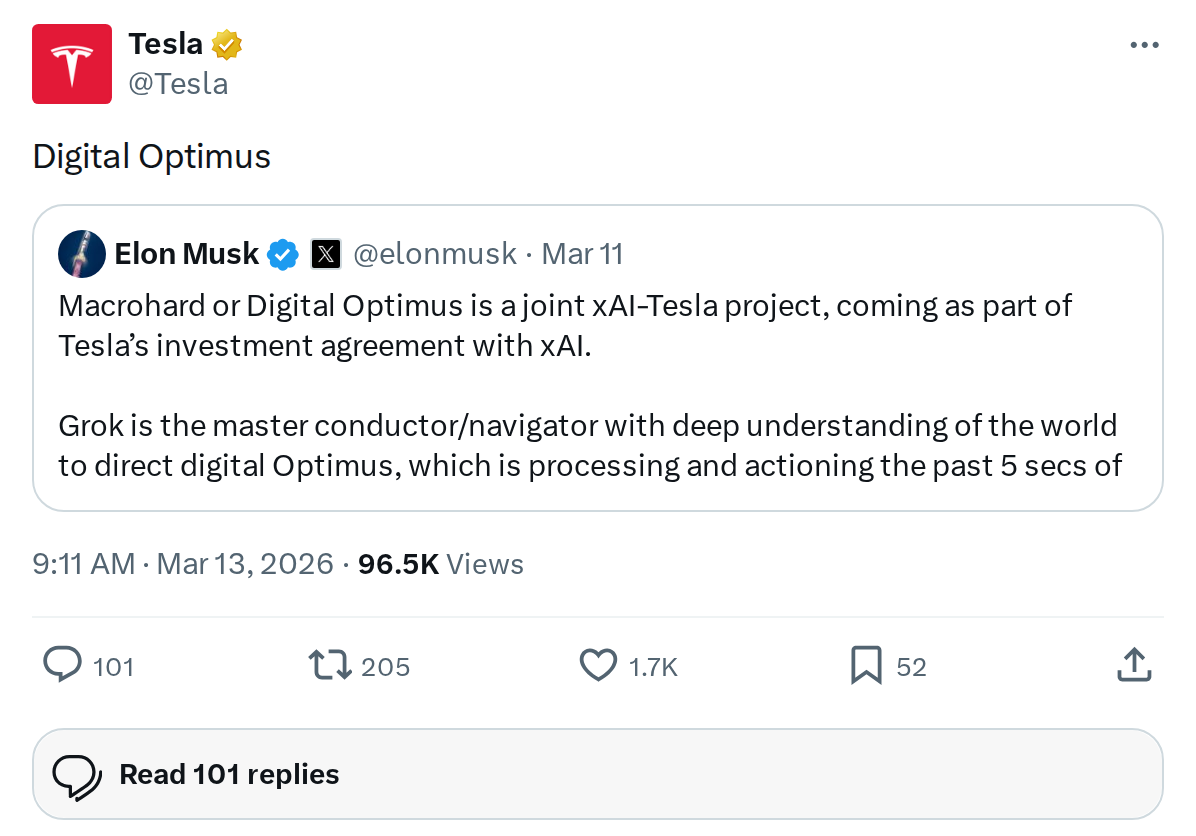
The News: Tesla teased "Digital Optimus" — a joint Tesla/xAI initiative that uses Grok and Tesla's AI4 chip to autonomously operate software, simulate corporate workflows, and handle complex decision-making tasks.
Why It Matters: This isn't just a robot update. Digital Optimus signals Tesla's pivot toward AI agents that can run entire business operations — and it's built on the same AI architecture powering your car's FSD system.
Source: @Tesla on X
What Is Digital Optimus?
Tesla dropped a two-word tease on X — "Digital Optimus" — and the internet filled in the blanks. But the background here is substantial, and it's more significant than a robot demo.

According to reporting around the March 11 unveiling by Elon Musk, Digital Optimus — also referred to internally as "Macrohard" — is a collaborative project between Tesla and xAI. The goal: build an AI agent capable of autonomously operating computer software to complete complex, multi-step tasks on behalf of users and businesses. Think of it as an AI employee that can actually use a computer — not just answer questions about one.
The technology stack is telling. Digital Optimus uses xAI's Grok as the master conductor, orchestrating tasks and decisions, while Tesla's AI4 chip handles the heavy computational lifting — processing continuous data streams and enabling real-time decision-making. That pairing is deliberate: it mirrors the same architecture philosophy behind Tesla's FSD coverage, where a purpose-built chip processes live video to make split-second driving decisions. Here, the "road" is software, and the "driving" is autonomous task completion.
📊 Key Figures
| Metric | Detail |
|---|---|
| Unveiled | March 11, 2026 by Elon Musk |
| Partners | Tesla + xAI (joint project) |
| AI Conductor | xAI Grok |
| Processing Chip | Tesla AI4 |
| Tesla Investment in xAI (2026) | $2 billion |
| Also Known As | "Macrohard" (internal/xAI reference) |
More Than a Robot — A New Software Paradigm
Here's the framing that matters: Digital Optimus isn't just about making the physical Optimus robot smarter. It's about creating a new category of software application — one where AI agents don't just generate text, but actually operate software on your behalf. Coding, scheduling, decision-making, data processing — autonomously, in real time.
This is a meaningful strategic shift. Tesla is no longer just an EV company that happens to be working on a robot. With Digital Optimus, it's positioning itself at the intersection of physical AI (Optimus Gen 3, FSD) and enterprise AI automation. The $2 billion Tesla investment in xAI announced in 2026 makes more sense in this context — it's not just a financial bet, it's a technology integration strategy.
It's also worth noting the timing. xAI's parallel "Macrohard" project reportedly stalled due to management turbulence and a pause in data labeling operations. Resources appear to be consolidating under the Tesla-branded Digital Optimus initiative, which suggests Tesla is now the primary vehicle (no pun intended) for this AI agent ambition.
The Physical Optimus Connection
Digital Optimus doesn't exist in isolation. The physical Optimus Gen 3 robot — reaffirmed for a Q1 2026 debut — is the hardware counterpart to this software-side initiative. Gen 3 brings significant engineering upgrades: 25 actuators per hand (50 total), more than doubling the precision of Gen 2, plus a high-density pressure sensor network in the feet that measures force distribution every millisecond. The robot has also demonstrated stable autonomous movement in crowds, avoiding obstacles without human intervention.
The convergence is intentional. A Digital Optimus AI agent that can operate software autonomously, paired with a Gen 3 robot that can navigate physical environments autonomously — that's the full-stack vision Tesla is building toward. The simulation and digital twin work feeds directly into training the physical robot, and the physical robot's real-world data loops back into improving the simulation.
🔭 The BASENOR Take
Timeline: Digital Optimus unveiled March 11, 2026. Tesla's official X post: March 13, 2026. Physical Optimus Gen 3: Q1 2026 target.
Impact Level: 🔴 High — This redefines Tesla's AI strategy beyond vehicles and robots into enterprise software automation.
Confidence: Medium-High — The Tesla/xAI collaboration and $2B investment are reported facts. Specific deployment timelines for Digital Optimus as a commercial product remain unconfirmed.
Tesla owners should pay attention to this for a reason that's easy to miss: the AI4 chip powering Digital Optimus is the same chip architecture lineage that's been powering Tesla's in-car AI systems. As Tesla deepens its AI infrastructure investment — both in simulation and in xAI collaboration — the downstream benefits for FSD, voice commands, and in-car intelligence are real, even if indirect.
The more interesting question is whether Digital Optimus becomes a product Tesla sells to businesses, or whether it remains an internal tool that makes Tesla itself more efficient. Either path has implications for Tesla's valuation as an AI company, not just an automaker.
What's clear: Tesla is no longer just building cars that drive themselves. It's building AI systems that work by themselves — across software, hardware, and now, apparently, entire corporate operations. That's a much bigger story than a two-word tweet suggests.