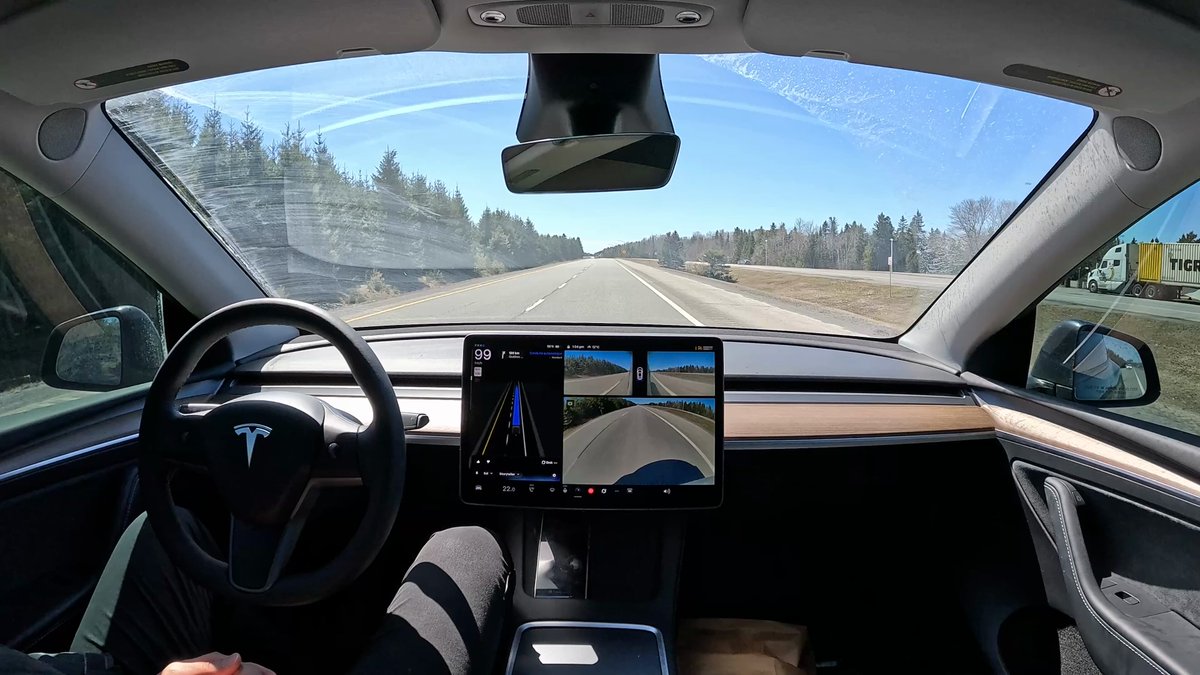
The News: Tesla Autopilot Director Ashok Elluswamy publicly reinforced the company's vision-only autonomous driving strategy, posting a video captioned "The advantage of having eyes all around."
Why It Matters: As Tesla scales its Robotaxi fleet to new cities and targets unsupervised FSD for consumer vehicles by Q4 2026, Elluswamy's signal confirms cameras — not LiDAR or radar — remain the foundation of every Tesla's self-driving stack.
Source: @aelluswamy on X
Tesla's Vision-Only FSD Bet: Why Ashok Elluswamy Says Cameras Are Enough
Tesla's Director of Autopilot doesn't need a press conference to make a statement. On April 27, 2026, Ashok Elluswamy posted a four-word caption — "The advantage of having eyes all around" — alongside a video that encapsulates Tesla's entire autonomous driving philosophy. It's a deliberate, confident signal from the engineer who oversees FSD development: the camera-only bet isn't a compromise. It's the strategy.

📊 Key Figures
| Metric | Value | Context |
|---|---|---|
| External cameras per vehicle | 8 | 360° coverage, no LiDAR |
| Real-time data points processed | ~2 billion | Per trip, camera inputs only |
| FSD collision reduction vs. humans | 7× fewer | Major + minor collisions, as of Apr 2026 |
| Off-highway collision reduction | 5× fewer | vs. average human driver |
| Radar/ultrasonic removal | 2021–2022 | All vehicles post-2022 are vision-only |
| Robotaxi miles (Austin, driverless) | 250,000+ | As of Oct 2025, zero safety driver |
| Consumer unsupervised FSD target | Q4 2026 | Per Elon Musk, April 22, 2026 |
The Bet That the Industry Still Debates
When Tesla stripped radar from its vehicles starting in 2021 and eliminated ultrasonic sensors entirely by 2022, the move was widely criticized. The conventional wisdom in autonomous vehicle development held that redundant sensor modalities — cameras plus LiDAR plus radar — were non-negotiable for safety. Tesla's position, championed by Elluswamy and Musk, was fundamentally different: the problem isn't sensors, it's intelligence.
Elluswamy has framed autonomous driving as an "AI information extraction" problem, not a hardware problem. The argument is straightforward: humans navigate complex, high-speed environments using only two eyes. If the AI is good enough, eight cameras providing full 360-degree coverage should be more than sufficient — and the data flowing through those cameras (an estimated 2 billion data points per trip) gives the neural network everything it needs to make decisions.
End-to-End Neural Networks: The Architecture Behind the Claim
The confidence Elluswamy projects isn't arbitrary. Tesla's FSD system has shifted to an end-to-end neural network architecture that integrates perception, planning, and vehicle control into a single continuously trained system. Rather than a pipeline where separate modules handle object detection, path planning, and actuation independently, Tesla's approach collapses these into one unified model that learns from human driving data at scale.
FSD v14.2, released in April 2026, pushed this further by introducing a higher-resolution neural network vision encoder — essentially giving the AI sharper "sight" from the same eight cameras. The system now processes visual information at a fidelity that earlier versions couldn't achieve, which is directly relevant to the "eyes all around" framing Elluswamy used today.
For owners following our FSD coverage, this architectural shift matters: it means Tesla's performance improvements come primarily from software and training data, not hardware upgrades. Every FSD-equipped Tesla on the road is, in theory, a data collection node feeding the next generation of the model.
Robotaxi Expansion Puts the Theory to the Test
Elluswamy's post lands at a moment when Tesla's vision-only thesis is being stress-tested in the real world at scale. The driverless Robotaxi service that launched in Austin in January 2026 had covered over 250,000 miles without a safety driver as of October 2025. In April 2026, the service expanded to Dallas and Houston, with Phoenix, Miami, Orlando, Tampa, and Las Vegas confirmed for the first half of 2026.
Every one of those miles is logged on a camera-only system. The operational data coming back from these deployments is, arguably, the strongest argument Elluswamy can make — more persuasive than any tweet. The fact that he's publicly highlighting the "advantage" of the approach now, as the Robotaxi network scales aggressively, suggests Tesla has enough real-world evidence to be confident in the architecture.
🔭 The BASENOR Take
Timeline: Vision-only transition began 2021 → radar removed → ultrasonic removed 2022 → end-to-end FSD architecture → Robotaxi driverless launch Jan 2026 → multi-city expansion Apr 2026 → consumer unsupervised FSD targeted Q4 2026
Impact Level: 🔴 High — This is the foundational technical decision that determines what every Tesla built after 2022 is capable of, and whether the Robotaxi network can scale without hardware redesigns.
Confidence: ⬛⬛⬛⬛⬜ — Tesla's internal data (7× fewer collisions, 250,000+ driverless miles) supports the architecture. The open question is edge-case performance at scale across diverse geographies and weather conditions.
What's notable about Elluswamy's framing today is what it isn't saying. He's not defending a cost-cutting decision. He's asserting a genuine technical advantage — that having cameras in all directions, processed by a sufficiently capable AI, is better than a hybrid sensor suite. That's a bold claim, and one Tesla is now in a position to back with operational data from a live commercial service.
The Q4 2026 target for unsupervised FSD on consumer vehicles is the next major milestone. If Tesla hits it, Elluswamy's "eyes all around" post will look like a well-timed preview of a proven system. If the timeline slips, the debate about sensor redundancy will resurface. Either way, the architecture is locked in — every Tesla on the road today is already part of this experiment.

Sarah focuses on Tesla Energy, SpaceX missions, and the broader Musk AI portfolio. Former data analyst in clean energy. Based in San Francisco.
Sources verified at publish time. Spotted an inaccuracy? Email editorial@basenor.com.