📌 UPDATE — March 4, 2026
xAI has revealed additional infrastructure commitments for its Memphis campus beyond the 1.2GW power plant. The company announced plans to build new substations and electrical infrastructure designed to bolster grid stability across the broader Memphis region — not just to serve its own facility. xAI also confirmed it will construct a dedicated water recycling plant aimed at protecting approximately 4.7 billion gallons of the Memphis Aquifer annually, addressing environmental concerns that have surrounded the project's water usage footprint.


📌 UPDATE — March 4, 2026
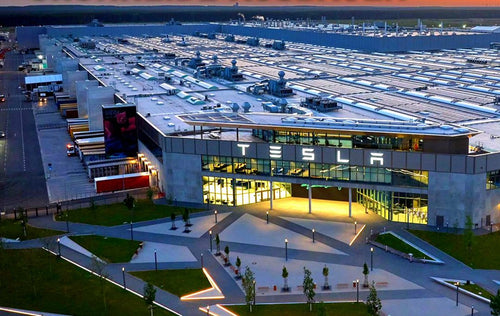
xAI has confirmed it is expanding what is already the world's largest Megapack installation at its Memphis supercomputer site. The expanded Tesla Megapack deployment will deliver enough backup power capacity to supply the entire City of Memphis — and more than enough to cover Southaven, Mississippi. This marks a significant escalation beyond the original 1.2GW power plant commitment, adding a massive grid-scale battery buffer on top of dedicated generation capacity. The move underscores xAI's strategy of building fully self-sufficient energy infrastructure rather than relying on local utility grids for reliability.

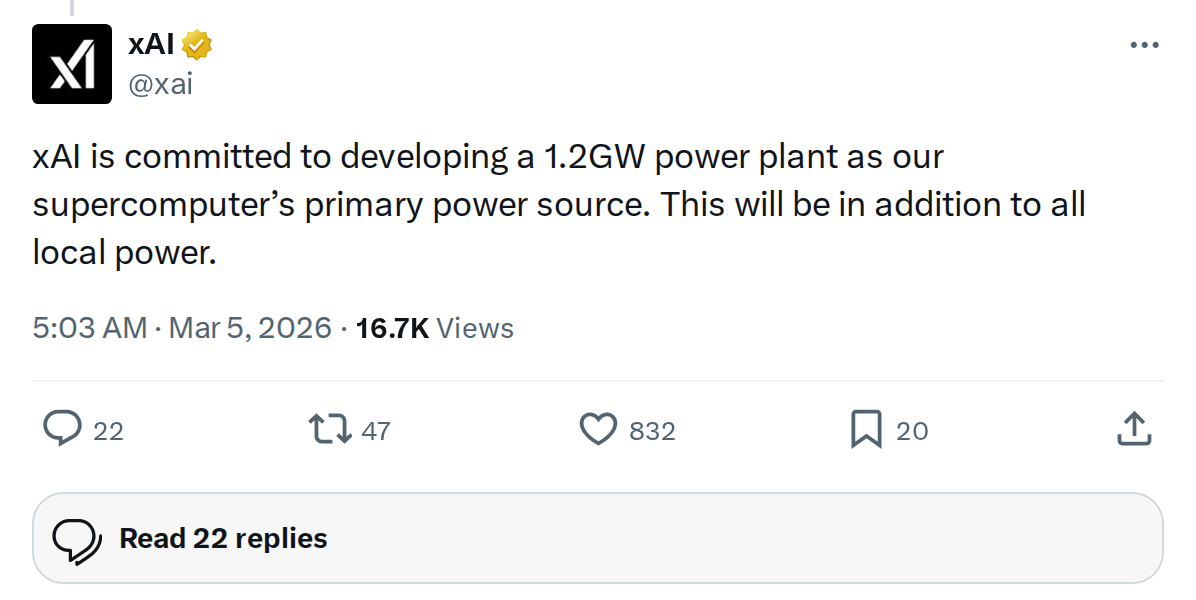
The News: xAI has publicly committed to building a 1.2 gigawatt dedicated power plant as the primary energy source for its AI supercomputer — on top of whatever local grid power is available.
Why It Matters: This is one of the largest single-site power commitments in AI infrastructure history, signaling the sheer compute scale xAI is targeting — and the energy constraints that are now defining the AI arms race.
Source: @xai on X

📊 Key Figures
| Metric | Value | Context |
|---|---|---|
| Planned power plant capacity | 1,200 MW (1.2 GW) | Dedicated, on-site generation |
| Current Colossus power draw | ~300 MW | 200,000 Nvidia Hopper GPUs |
| Existing on-site gas turbines | 420 MW (35 turbines) | Already installed at Memphis site |
| GPU target for next-gen data center | 1,000,000 GPUs | Nvidia Blackwell architecture |
| Estimated total power for 1M GPU build | 1,400–1,960 MW | Incl. CPUs, storage, cooling |
⚡ From 300MW to 1.2GW: The Scale of What xAI Is Building
The single-sentence announcement from xAI understates just how enormous this commitment is. The company's current Colossus supercomputer in Memphis, Tennessee — already one of the most powerful AI training clusters on the planet — runs on roughly 300 megawatts and houses approximately 200,000 Nvidia Hopper GPUs. The 1.2GW plant xAI is committing to represents a 4x increase in dedicated power generation alone, before local grid power is even factored in.
To put 1.2 gigawatts in perspective: that's enough electricity to power roughly 900,000 average American homes. xAI is essentially planning to build a small regional power utility — for a single AI data center.
🌍 Why xAI Is Buying a Power Plant Overseas
According to verified reporting, xAI cannot acquire a new power plant in the U.S. fast enough to meet its timeline. The solution: purchase a power plant overseas and ship it to the United States. While the type, origin country, and import timeline have not been disclosed, this move underscores a critical bottleneck in the AI infrastructure buildout — power availability, not GPU supply, is now the binding constraint.
xAI has already installed 35 gas turbines at the Memphis site capable of producing 420 MW, and uses Tesla Megapack systems for power stabilization. The new 1.2GW plant would be in addition to all of this existing infrastructure, as well as the local utility grid — making the Memphis campus a genuinely self-sufficient AI compute fortress.
⚠️ Regulatory Headwinds
The expansion doesn't come without friction. The EPA has ruled that xAI's existing natural gas generators at the Tennessee site are not exempt from air quality permits. A lawsuit from the NAACP is also pending, calling for the Colossus supercomputer to be shut down over environmental concerns. The addition of a 1.2GW plant — likely also gas-powered — will intensify scrutiny from regulators and community groups.
🔭 The BASENOR Take
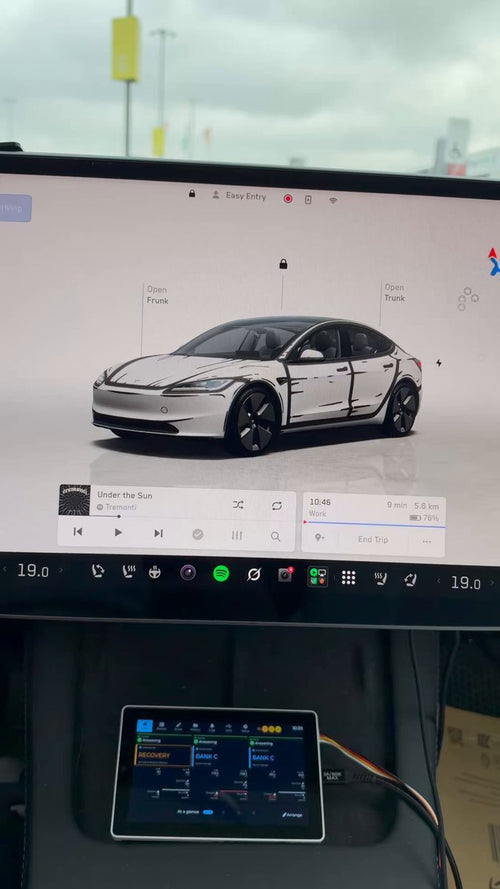
This announcement matters to Tesla owners for a reason that isn't immediately obvious: xAI's Grok AI is deeply integrated into Tesla vehicles. The Grok assistant available in Tesla's infotainment system is powered by the same Colossus infrastructure being expanded here. More compute capacity means faster model iterations, richer in-car AI capabilities, and potentially more responsive voice and vision features down the road.
More broadly, this is a signal of where the AI compute race is heading. The bottleneck is no longer chips — it's electrons. xAI's willingness to ship a power plant across an ocean rather than wait for U.S. grid infrastructure tells you everything about how urgent the timeline is. The company is targeting one million Nvidia Blackwell GPUs by 2026, a build that could require nearly 2 gigawatts of total power. The 1.2GW plant is the foundation that makes that possible.
📰 Deep Dive
The energy math behind modern AI supercomputers is staggering. When xAI scales Colossus from 200,000 to one million GPUs, the power requirement doesn't scale linearly — it balloons to an estimated 1,400 to 1,960 megawatts when you account for CPUs, storage arrays, networking switches, and the massive cooling systems required to keep that much silicon from melting. The 1.2GW dedicated plant, combined with existing on-site turbines and local grid access, is designed to make that headroom available without depending on utility companies that simply can't provision gigawatt-scale connections on a startup timeline.
The decision to purchase a power plant overseas and ship it to the U.S. is a remarkable logistical and regulatory maneuver. It reflects a broader reality in the data center industry: permitting and building new generation capacity in the U.S. can take years, while AI labs are operating on months. By sourcing an existing plant internationally, xAI sidesteps the domestic construction queue — though it introduces its own complexities around import logistics, grid interconnection, and environmental permitting on arrival.
xAI has also committed to building state-of-the-art water recycling plants at the site — a nod to the enormous water consumption that liquid cooling systems require at this scale. Whether these commitments satisfy regulators and community stakeholders in Memphis remains an open question, particularly given the pending EPA air quality permit dispute and the NAACP lawsuit. The regulatory path for the 1.2GW expansion will likely be the most contested element of the entire project.
For Tesla owners tracking the Grok integration in their vehicles, the practical implication is straightforward: every megawatt of additional compute capacity that comes online at Memphis is capacity that can be directed toward making in-car AI smarter, faster, and more capable. The infrastructure being built today is the foundation for the AI features that will appear in your Tesla over the next two to three years.
Related Gear
Gear up your Tesla with tested, custom-fit BASENOR accessories — shop Tesla accessories →
Sources & reporting notes
The links below identify the material source records used for this report.
- @xai on X (2026-03-04T21:03:25.000Z) — Direct source
- @xai on X (2026-03-04T21:03:44.000Z) — Direct source
- @xai on X (2026-03-04T21:05:04.000Z) — Direct source
- @xai on X (2026-03-04T21:04:12.000Z) — Direct source
Source links are preserved as published or accessed. See our editorial standards and corrections policy.
The BASENOR Editorial Desk covers Tesla, SpaceX, and related technology, curating reporting from primary sources — official accounts, regulatory filings, and software release data. Every article passes source-record and fact-checking review before publication. About the newsroom.
This report was curated by the BASENOR Editorial Desk from the sources listed above. Read our editorial standards or email editorial@basenor.com to report an error.