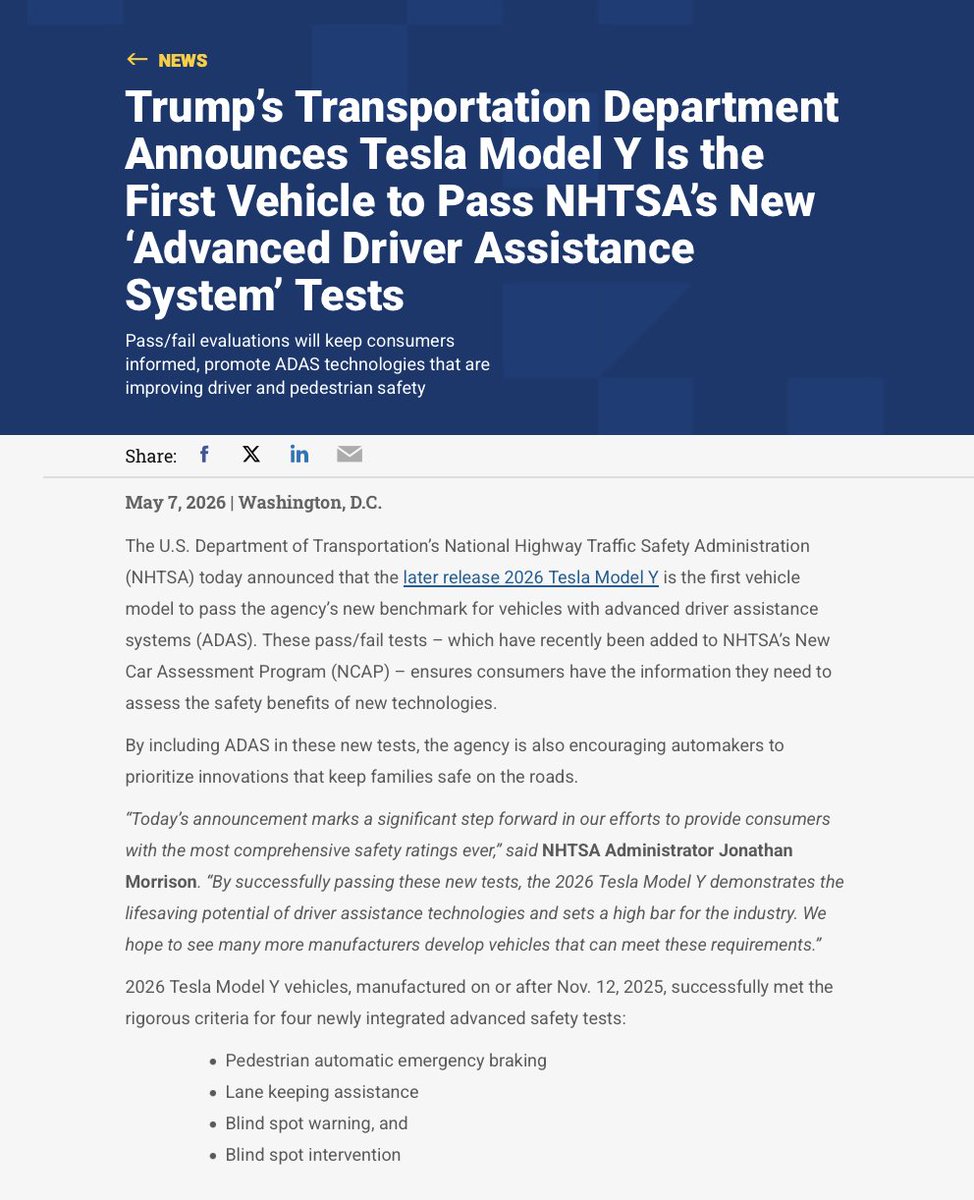
The 2026 Tesla Model Y has made regulatory history. On May 7, 2026, NHTSA officially announced that the Model Y is the first vehicle ever to pass its newly expanded Advanced Driver Assistance System test suite — clearing all eight safety criteria without a single failure. For Tesla owners and the broader EV industry, the implications go well beyond a trophy on the shelf.

The tests apply to 2026 Model Y vehicles manufactured on or after November 12, 2025. Here are the eight criteria the Model Y cleared — and why each one matters.
1. Pedestrian Automatic Emergency Braking
One of four newly added tests in NHTSA's updated New Car Assessment Program (NCAP), pedestrian AEB evaluates whether a vehicle can autonomously detect and brake for people on foot in its path. Pedestrian fatalities remain one of the most persistent road safety problems in the U.S., making this a high-stakes benchmark. The Model Y passed.
2. Lane Keeping Assistance
Also new to the NCAP suite, lane keeping assistance tests whether the vehicle actively steers itself back toward the center of a lane when it begins to drift — a step beyond simply warning the driver. This is the kind of active intervention that separates genuine safety systems from checkbox features, and the Model Y met the criteria.
3. Blind Spot Warning
A newly added passive-alert test, blind spot warning evaluates whether the vehicle reliably detects vehicles in adjacent lanes and alerts the driver before a lane change becomes dangerous. The Model Y's camera-based detection system cleared this benchmark.
4. Blind Spot Intervention
This goes one step further than a warning: blind spot intervention tests whether the vehicle can actively prevent a lane change when another vehicle is detected in the blind zone. Passing both the warning and intervention tests together signals a mature, layered safety architecture — not just a single alert tone.
5. Forward Collision Warning
Part of NHTSA's original four ADAS criteria, forward collision warning tests whether the system alerts the driver with enough lead time to react before a frontal impact. The Model Y has long carried this feature, and it passed the formal benchmark.
6. Crash Imminent Braking
When a collision is unavoidable and the driver hasn't responded, crash imminent braking takes over and applies maximum braking autonomously. This is one of the most consequential safety features on any modern vehicle, and the Model Y's performance here was validated by NHTSA's testing protocol.
7. Dynamic Brake Support
Dynamic brake support augments the driver's own braking input when the system detects the driver is not applying enough force to avoid a collision. It's a subtle but potentially life-saving intervention — and another original NCAP criterion the Model Y cleared.
8. Lane Departure Warning
The fourth of NHTSA's original ADAS tests, lane departure warning alerts the driver when the vehicle crosses lane markings without a turn signal active. Combined with the newer lane keeping assistance test, the Model Y now holds validated performance across the full spectrum of lane-safety technology.

Why This Result Matters Beyond a Rating
NHTSA Administrator Jonathan Morrison called the announcement "a significant step forward in our efforts to provide consumers with the most comprehensive safety ratings ever," adding that the Model Y "sets a high bar for the industry." That framing is deliberate — NHTSA is signaling to every other automaker what the new minimum expectation looks like.
The broader significance, as observers have noted, is what this framework could become. A structured, federally administered test suite that vehicles must pass before their ADAS systems are considered validated is exactly the kind of regulatory scaffolding that would be needed before any federal approval pathway for fully autonomous vehicles could be credible. The Model Y passing all eight criteria — first, and cleanly — puts Tesla in a strong position as that conversation develops in Washington.
If you own a 2026 Model Y built after November 12, 2025, your vehicle is now the only model on the market with a clean sweep of every NHTSA ADAS criterion currently on the books. That's not a marketing claim — it's a federal certification.

Marcus covers Tesla's software releases, FSD rollouts, and OTA changes. Background in automotive engineering. Based in Austin.
Sources verified at publish time. Spotted an inaccuracy? Email editorial@basenor.com.