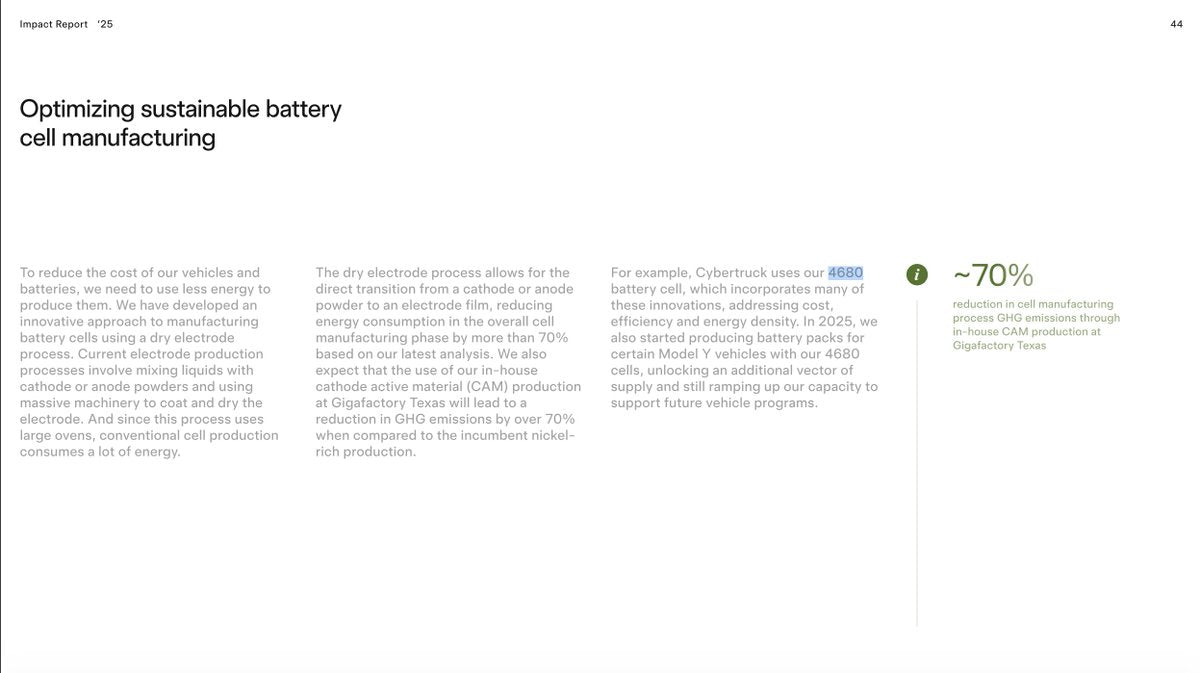
Tesla has confirmed that its dry electrode coating process reduces emissions in battery cell production by approximately 70% compared to the previous wet coating method — and the technology is already in mass production at Gigafactory Texas. Here's what that actually means, broken down into the five things worth understanding.

1. The 70% Emissions Cut Comes From Eliminating Ovens and Toxic Solvents
Traditional wet electrode coating requires massive, energy-intensive drying ovens to bake off the liquid solvent after it's applied to the electrode foil. That solvent — N-Methyl-2-pyrrolidone (NMP) — is both toxic and expensive to recover. Tesla's dry process skips all of it. No ovens, no solvent recovery systems, no NMP. According to Tesla's own estimates, that single process change accounts for the bulk of the 70%+ reduction in energy consumption and associated emissions during cell manufacturing. It's a simpler production line that's also a cleaner one.
2. Tesla Has Been Building Toward This Since Acquiring Maxwell Technologies in 2019
This didn't happen overnight. Tesla acquired Maxwell Technologies in 2019 specifically for its dry electrode coating intellectual property. At the time, the technology existed in lab conditions but hadn't been proven at scale. Scaling dry electrode manufacturing for a high-volume production cell is a genuinely hard engineering problem — electrode uniformity, adhesion, and thickness control all behave differently without a liquid carrier. The fact that Tesla has now confirmed mass production using this process at Gigafactory Texas represents roughly six years of manufacturing development work paying off.
3. These Are the 4680 Cells Already Going Into Model Y
Tesla officially confirmed in its Q4 and Fiscal Year 2025 update letter (released around February 2026) that it is successfully producing 4680 battery cells using a dry electrode process for both the anode and the cathode — a fully dry cell. Those cells are currently being assembled into battery packs for certain Model Y vehicles built at Gigafactory Texas. If you've taken delivery of a Texas-built Model Y recently, there's a real chance the cells in your pack were made with this process. The transition from wet to dry isn't a future roadmap item — it's happening now in production vehicles.
4. The Process Also Produces a Better Cell, Not Just a Greener One
The environmental story is compelling, but the performance story matters too. Dry electrode manufacturing enables thicker, denser electrodes with significantly less binder content — as low as 1.25% by weight according to Tesla's patent documentation, compared to the higher binder ratios typical in wet-coated cells. Less binder means more active material per unit volume, which translates directly to higher energy density. Current production dry-electrode 4680 cells are reported to achieve approximately 260 Wh/kg of usable gravimetric energy density. Tesla's patent data also suggests these cells can maintain roughly 90% of initial capacity after 2,000 charge-discharge cycles — a longevity figure that matters for long-term ownership costs.
5. It's Part of a Broader Emissions Reduction Trend Across Tesla's Fleet
The dry electrode breakthrough sits within a larger picture. According to Tesla's own data, its customers collectively avoided 37 million metric tons of CO₂e in 2025 — a 16% increase over the 32 million metric tons avoided in 2024. Cleaner cell manufacturing compounds that impact: every vehicle produced with lower-emission batteries starts its lifecycle with a smaller carbon debt to pay off through zero-tailpipe operation. For owners who bought a Tesla partly for its environmental credentials, the manufacturing side of the equation is finally catching up to the driving side.
The dry electrode process is one of those manufacturing advances that doesn't show up on a spec sheet but shapes everything from production cost to long-term cell performance. With mass production confirmed and Model Y already receiving these cells, the technology has moved well past proof-of-concept — Tesla is now building it into the foundation of its battery supply chain.
Related Gear
Gear up your Model Y with tested, custom-fit BASENOR accessories — shop Model Y accessories →
Sources & reporting notes
The links below identify the material source records used for this report.
- @wholemars on X (2026-07-07T18:06:37.000Z) — Direct source
Source links are preserved as published or accessed. See our editorial standards and corrections policy.
The BASENOR Editorial Desk covers Tesla, SpaceX, and related technology, curating reporting from primary sources — official accounts, regulatory filings, and software release data. Every article passes source-record and fact-checking review before publication. About the newsroom.
This report was curated by the BASENOR Editorial Desk from the sources listed above. Read our editorial standards or email editorial@basenor.com to report an error.