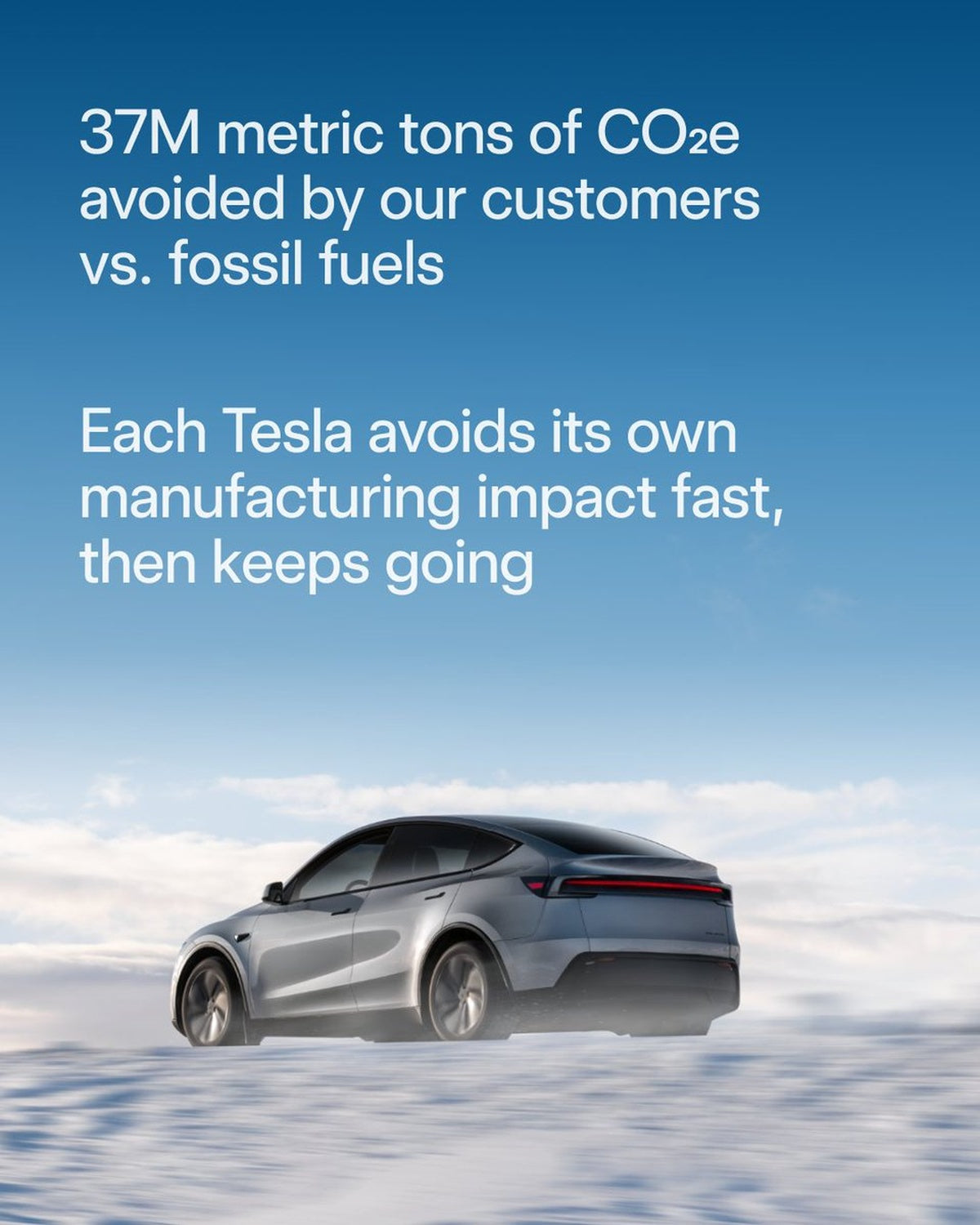
Tesla has published its 2025 environmental impact figures, and the headline number is hard to ignore: its customers collectively kept 37 million metric tons of CO₂e out of the atmosphere in a single year. To put that in human terms, Tesla says that's equivalent to the energy use of nearly 5 million homes. The data, shared directly by Tesla on X, also includes a per-vehicle lifetime estimate that gives individual owners a concrete sense of their own contribution to the shift away of fossil fuels.

The Numbers in Context
The 37 million metric ton figure represents a meaningful jump from Tesla's own prior reporting. According to Tesla's 2024 Impact Report, customers avoided approximately 32 million metric tons of CO₂e that year — meaning the 2025 figure represents roughly a 16% year-over-year increase. That growth tracks with Tesla's expanding global fleet and its energy division, which includes Megapack deployments and solar installations that contribute to the total avoided-emissions calculation.
The per-vehicle lifetime figure Tesla cited — approximately 32 tons of CO₂e avoided over 17 years of US driving — is the number most relevant to individual owners. It's worth noting that Tesla's own prior reporting cited a slightly higher global estimate of around 35 tons per vehicle when accounting for different electricity grid mixes worldwide; the 32-ton figure appears to reflect the US-specific grid context. Either way, the order of magnitude is consistent: over its lifespan, a single Tesla offsets the equivalent of several years of a typical American household's carbon footprint.
2025 Impact Figures at a Glance
| Metric | 2025 | 2024 (prior report) |
|---|---|---|
| Total CO₂e avoided (fleet + energy) | 37M metric tons | ~32M metric tons |
| Home energy-use equivalent | ~5M homes | — |
| CO₂e avoided per vehicle (US, 17-yr lifespan) | ~32 tons | ~35 tons (global avg) |
Sources: @Tesla (2026), Tesla 2024 Impact Report
Why the Energy Division Matters Here
Tesla's avoided-emissions total isn't purely a vehicle story. The figure encompasses the company's full clean-energy footprint — including Megapack grid storage and solar deployments — which have been scaling rapidly. Tesla committed to at least 50% growth in energy storage deployments in 2025, building on a record 31.4 GWh deployed in 2024, according to prior company guidance. As that side of the business grows, its contribution to the annual CO₂e avoidance figure will become increasingly significant alongside the vehicle fleet itself.
That distinction matters for how investors and policymakers interpret these numbers. A company that sells only cars has a ceiling on its annual impact tied to fleet size. A company that also deploys grid-scale storage and solar can compound its avoided-emissions total independently of vehicle sales — which is precisely the long-term thesis Tesla has been building toward.
The Grid Dependency Question
The 32-ton US lifetime figure carries an important caveat that Tesla doesn't always foreground: it's grid-dependent. An EV charged on a coal-heavy grid avoids substantially less CO₂ than one charged on renewables. As the US grid continues to decarbonize — driven partly by Tesla's own Megapack deployments — that per-vehicle lifetime figure will improve automatically for every Tesla already on the road, without any hardware change. Owners who charge primarily on solar, whether via home Powerwall systems or solar canopies, are already realizing the upper end of that range.
The 37 million metric ton milestone is a credible signal that Tesla's clean-energy flywheel is turning faster. The more interesting question heading into 2026 is whether energy storage growth will begin to visibly outpace vehicle fleet growth as the primary driver of that annual number.
Related Gear
Gear up your Tesla with tested, custom-fit BASENOR accessories — shop Tesla accessories →
Sources & reporting notes
The links below identify the material source records used for this report.
- @Tesla on X (2026-07-07T17:11:10.000Z) — Direct source
Source links are preserved as published or accessed. See our editorial standards and corrections policy.
The BASENOR Editorial Desk covers Tesla, SpaceX, and related technology, curating reporting from primary sources — official accounts, regulatory filings, and software release data. Every article passes source-record and fact-checking review before publication. About the newsroom.
This report was curated by the BASENOR Editorial Desk from the sources listed above. Read our editorial standards or email editorial@basenor.com to report an error.