30-Second Brief
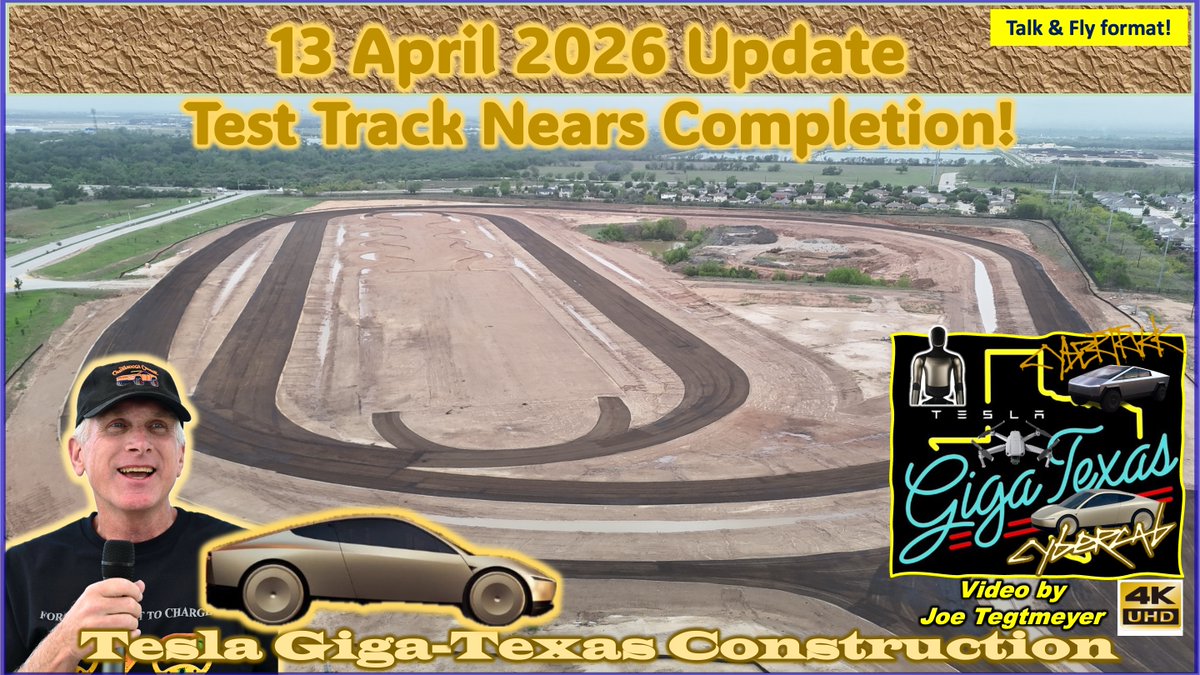
The News: Drone footage from April 13, 2026 shows approximately 53 Cybercabs actively driving in three groups on Giga Texas's outbound lot, with a separate dozen units undergoing crash testing — including one showing signs of a potential rollover.
Why It Matters: The scale and intensity of testing signals that Tesla's Cybercab production ramp is accelerating rapidly, with structural validation now pushing into rollover scenarios — a critical milestone before any commercial robotaxi deployment.
Source: @JoeTegtmeyer on X
53 Cybercabs Spotted Driving at Giga Texas — Plus Active Crash Testing With Potential Rollover
Tesla's Cybercab production ramp just sent a clear signal: this program is moving fast. Drone operator Joe Tegtmeyer captured footage on April 13, 2026 showing approximately 53 Cybercabs split into three groups and actively driving around the outbound lot at Giga Texas — the largest fleet movement observed on a single day. Simultaneously, a separate batch of roughly a dozen units was spotted at the crash testing facility, with at least one vehicle showing signs of a potential rollover test.


📊 Key Figures
| Metric | April 13 (Today) | Prior Reference |
|---|---|---|
| Cybercabs on outbound lot | ~53 | ~60 (Apr 8) |
| Groups driving on lot | 3 | 2 (Apr 8) |
| Units in crash testing | ~12 | 15 (Mar 5) |
| Potential rollover observed | Yes (1 unit) | Not previously reported |
| Production start (mass) | April 2026 | First unit: Feb 2026 |
What the Crash Testing Tells Us
Crash testing at this scale — and now apparently including rollover scenarios — is not routine validation. It's a sign that Tesla is working through the full federal safety certification matrix for the Cybercab. Under current U.S. federal motor vehicle safety standards, any vehicle sold or operated commercially on public roads must meet a comprehensive suite of crash requirements, including roof crush resistance and rollover protection.
The Cybercab's two-seater, steer-wheel-free design presents unique engineering challenges here. Without a traditional steering column, the front-end structure is fundamentally different from any Tesla currently in production. Rollover testing in particular stresses the roof and A-pillar geometry — areas that are redesigned from scratch on the Cybercab. Seeing this test occur with a dedicated batch of vehicles suggests Tesla is not cutting corners on the structural program.
Worth noting: the Cybercabs spotted on the outbound lot — including those driving in formation — still appear to feature steering wheels, consistent with earlier observations in March and April 2026. These are almost certainly early validation builds used for hardware and software development, and to comply with current regulations while Tesla works through any potential exemption process with federal regulators.
🔭 The BASENOR Take
Timeline: First unit off the line February 2026 → Mass production begins April 2026 → 53 units active on lot + 12 in crash testing by April 13
Impact Level: 🟠 High — The pace of validation testing directly determines when Cybercab commercial robotaxi service can launch
Confidence: 🟢 High — Drone footage is direct visual evidence; background data from multiple prior observations corroborates the trend
The cadence here is striking. Five days ago (April 8), Tegtmeyer spotted roughly 60 Cybercabs in two groups. Today it's 53 in three groups — suggesting Tesla is actively rotating vehicles through different stages of the outbound process rather than simply parking a growing inventory. The simultaneous crash testing program running in parallel with lot-level driving validation means both the structural and dynamic sides of certification are being pursued at the same time. That's an aggressive parallel-path approach, not a sequential one.
For prospective Cybercab robotaxi riders and Tesla investors, the key question has always been regulatory timeline, not production capability. Today's footage suggests the structural certification work is well underway. Whether Tesla has formally engaged NHTSA on a steering-wheel exemption for commercial deployment remains an open question — as of late February 2026, no formal exemption application had been filed. That regulatory step, not factory output, is likely the binding constraint on when you'll actually be able to hail a Cybercab.
📰 Deep Dive
Tesla's approach to the Cybercab ramp mirrors — but accelerates — the pattern seen with the Cybertruck. Early validation builds with legacy controls (steering wheels, pedals) run through the full safety certification gauntlet while the production-intent autonomous hardware is refined in parallel. The difference with the Cybercab is that the regulatory pathway itself is uncharted: no major automaker has yet received federal approval to sell a vehicle without a steering wheel for general consumer use in the U.S.
The rollover observation is particularly significant. Rollover tests are among the most destructive in the federal certification suite and are typically conducted late in the validation cycle — after basic frontal and side impact performance is confirmed. If Tesla is already at rollover testing with a dedicated batch of units, it suggests the earlier crash phases have been completed or are running concurrently. That would place the Cybercab further along the structural certification timeline than many outside observers have assumed.
Production targets of hundreds of units per week from April 2026 onward — if achieved — would mean Tesla could accumulate a meaningful commercial fleet quickly once regulatory approval is secured. The outbound lot activity, with vehicles actively driving rather than sitting static, also hints that software validation miles are being accumulated at scale on private property, building the dataset needed for any future autonomous deployment approval.
The next milestone to watch: a formal NHTSA exemption filing, which would be a public document and would signal Tesla's confidence that the hardware and software are ready for steering-wheel-free operation. Until that filing appears, the steering wheels on these test units aren't just a regulatory formality — they're the clearest indicator of where the program actually stands on the road to commercial robotaxi service.

Marcus covers Tesla's software releases, FSD rollouts, and OTA changes. Background in automotive engineering. Based in Austin.
Sources verified at publish time. Spotted an inaccuracy? Email editorial@basenor.com.