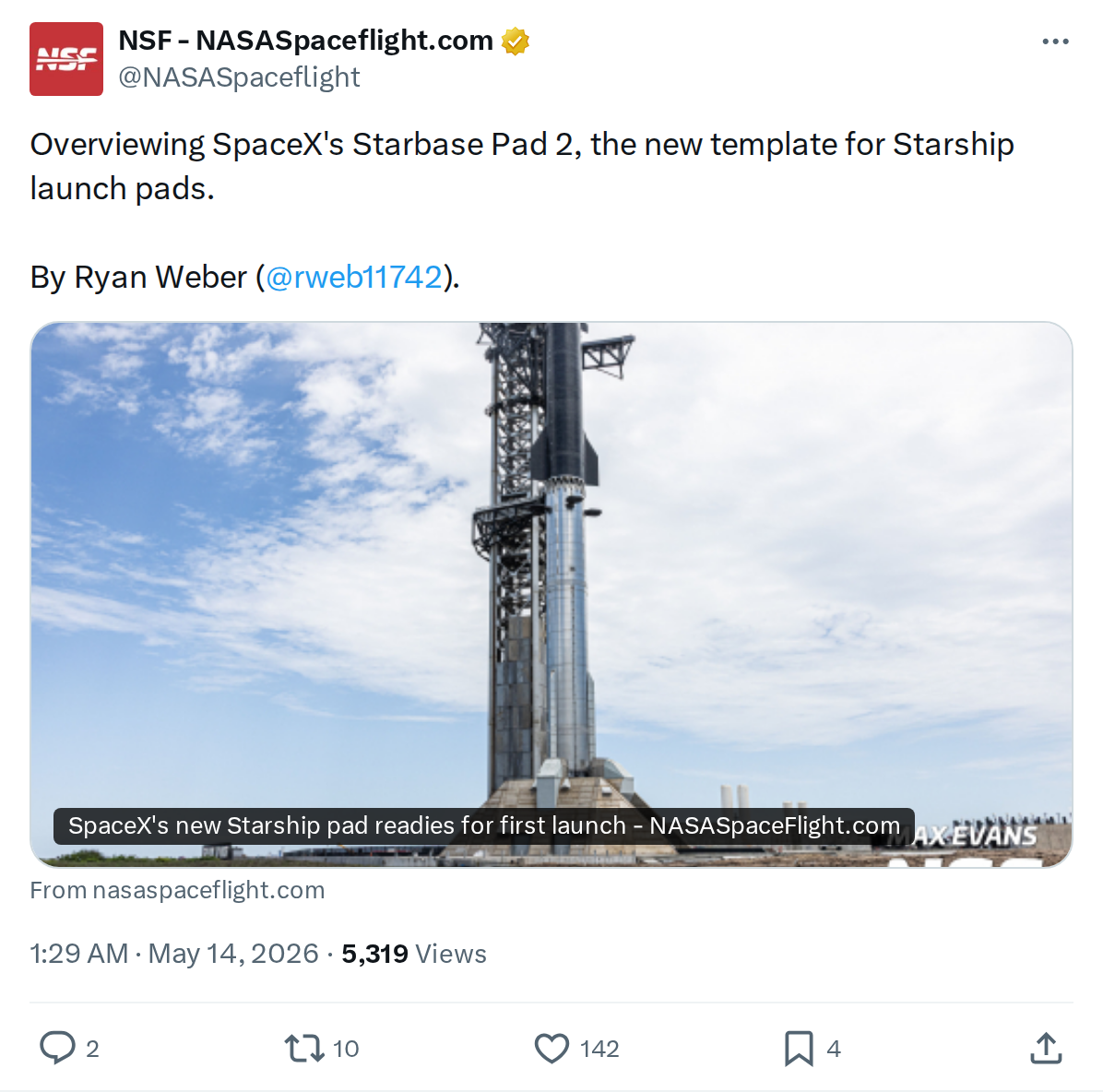
SpaceX has quietly set a new standard for how it launches the world's largest rocket. Starbase Pad 2 — the facility that will debut with Starship Flight 12 on May 19, 2026 — isn't just a second launch site. According to NASASpaceflight.com, it's the new template that every future Starship launch pad will be built from.
The engineering changes packed into Pad 2 reflect years of hard lessons from Pad A operations. From the flame trench to the chopsticks, almost nothing carries over unchanged. Here are the seven upgrades that define what a modern Starship launch pad looks like.

1. A Flame Management System Built to Never Need Refurbishment
This is the headline upgrade. Pad A relied on a water-cooled steel plate that required significant refurbishment after each launch — a direct bottleneck to rapid reuse. Pad 2 replaces it entirely with a large, integrated water-cooled flame trench featuring a new bidirectional flame diverter and a top-deck flame deflector. The design goal, according to verified sources, is to eliminate ablation entirely. No ablation means no post-launch pad repairs, which is a prerequisite for the launch cadence SpaceX is targeting.
2. Electromechanical Chopsticks Replace Hydraulics
The mechanical arms on the launch tower — used to catch returning Super Heavy boosters — have been redesigned in two important ways. First, they're shorter, which allows faster range of motion during catch operations. Second, and more significantly, the main actuators have been switched from hydraulic to electromechanical systems. Electromechanical actuators offer faster response, better redundancy, and higher reliability than hydraulics, all of which matter enormously when you're trying to catch a 70-meter rocket descending at speed.
3. A Stronger, Smarter Quick Disconnect Arm
The quick disconnect arm — responsible for loading propellant into the Starship upper stage — has been completely repackaged and structurally reinforced. Critically, it now rotates farther away from the rocket during launch, reducing the risk of damage from the vehicle's exhaust plume and improving clearance during fly-out. It's a detail that sounds minor until you consider that a damaged QD arm on a pad grounded for repairs is a pad that isn't launching.
4. A Completely Redesigned Launch Mount
The launch mount structure and hold-down system have been rebuilt from scratch. The focus was on three specific failure modes from previous operations: load sharing, throwback reliability, and protection during vehicle fly-out. The redesigned mount distributes forces more evenly across the structure, which extends its service life and reduces the chance of damage during the violent first seconds of ignition.
5. Separated and Hardened Propellant Systems
On Pad A, the Super Heavy booster's propellant quick disconnects were co-located. On Pad 2, they've been split into separate methane and oxygen mechanisms and moved to the opposite side of the mount. Beyond that, the associated vent valves, isolation valves, and filters have been relocated into a hardened bunker built into the side of the launch mount. The dual benefit: shorter propellant line distances to the rocket, and physical separation of oxygen and methane systems for a meaningful safety improvement.
6. A Faster, Higher-Capacity Propellant Farm
The propellant farm feeding Pad 2 has been upgraded with greater storage capacity and significantly more pumps. The practical result is faster vehicle filling ahead of launch — a direct contributor to tighter turnaround times. When SpaceX talks about launching Starship at airline-like frequency, the propellant infrastructure is one of the less glamorous but most important variables in that equation.
7. A Construction Timeline That Moved Fast
Foundation work on Pad 2's flame trench began January 13, 2025. The Orbital Launch Mount was installed May 12, 2025 — just under five months later. Water deluge system testing began in September 2025, with the first full-scale test completed successfully in February 2026. That's roughly 13 months from groundbreaking to launch-ready — a pace that reflects how much SpaceX has standardized its own construction processes alongside the pad design itself.
What Comes Next
Pad 2's debut on Flight 12 is the immediate milestone, but the longer-term signal is what happens to Pad 1. According to verified reports, Pad 1 is already undergoing a complete overhaul to match the Block 3 standard established by Pad 2. The target: two fully operational, standardized Starship launch pads at Starbase by late 2026. If that timeline holds, SpaceX will have doubled its Starship launch capacity — and done it using a pad design explicitly built for rapid reuse. For our SpaceX coverage, that's the number to watch.

Sarah focuses on Tesla Energy, SpaceX missions, and the broader Musk AI portfolio. Former data analyst in clean energy. Based in San Francisco.
Sources verified at publish time. Spotted an inaccuracy? Email editorial@basenor.com.