📌 UPDATE — March 11, 2026
The head of the FCC has now formally responded to Amazon's petition against SpaceX's proposed 1 million-satellite AI constellation, escalating what was a one-sided regulatory filing into a full regulatory dialogue. The FCC chair's response signals that the commission is actively engaging with the controversy rather than letting Amazon's challenge sit unanswered — a notable development given the scale and novelty of SpaceX's proposal. The nature of the response suggests the FCC is not simply deferring to Amazon's objections, though the full implications for SpaceX's orbital data center ambitions remain to be seen. This marks a significant next step in what could become a protracted regulatory battle over the future of satellite-based AI infrastructure.

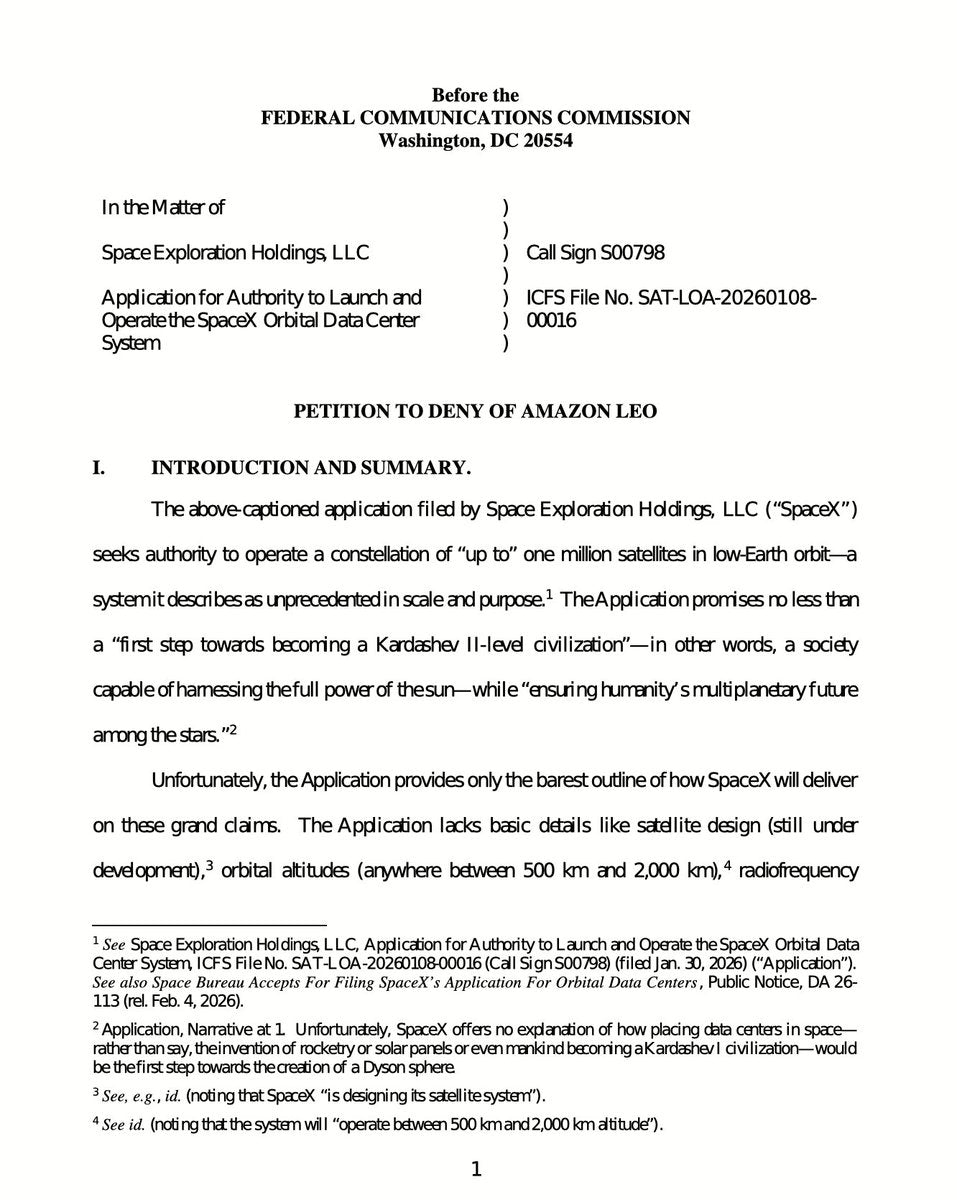
The News: Amazon has filed a formal 17-page petition urging the FCC to deny SpaceX's application to deploy a one-million-satellite constellation intended to serve as orbiting data centers.
Why It Matters: This is a direct corporate challenge to Elon Musk's most ambitious orbital computing vision — one he has tied to xAI — and it could shape the future of both Starlink and AI infrastructure in space.
Source: @SawyerMerritt on X

📊 Key Figures
| Metric | Value | Context |
|---|---|---|
| Proposed satellite count | 1,000,000 | vs. ~7,000 current Starlink satellites |
| Annual replacements needed (5-yr lifespan) | 200,000 | 44× total global launches in 2025 |
| Claimed AI compute capacity | 100 GW | At 1M tonnes of satellite mass |
| Orbital altitude range | 500–2,000 km | Low Earth Orbit shells, 50 km thick |
| Amazon petition length | 17 pages | Filed March 6, 2026 — FCC comment deadline |
| Total FCC public comments received | 1,200+ | Far exceeds typical satellite applications |
What SpaceX Actually Proposed
SpaceX filed its FCC application on January 30–31, 2026, requesting authorization for up to one million satellites designed to function as orbital data centers. The pitch is ambitious: a constellation of satellites running AI, machine learning, and edge computing workloads — in orbit, powered by direct solar energy, and linked by laser inter-satellite communications. Ka-band radio would serve as a backup link.
The proposed orbits sit between 500 km and 2,000 km altitude, within narrow 50 km-thick shells optimized for solar collection using 30-degree and sun-synchronous inclinations. SpaceX claims that at full scale — one million tonnes of satellite hardware — the system could deliver 100 gigawatts of AI compute capacity. Elon Musk has publicly linked the concept to his xAI company, and SpaceX has indicated pilot testing of on-orbit compute nodes on Starlink V3 hardware is planned for 2026.
Amazon's Argument: 'Centuries,' Not Years
Amazon's Project Kuiper division — now operating under the Amazon Leo brand — didn't hold back in its 17-page filing. The core argument: sustaining a one-million-satellite constellation with a five-year satellite lifespan would require replacing 200,000 satellites per year. To put that in perspective, the entire global satellite launch output in 2025 was less than 4,600 satellites. Amazon's math puts the required launch cadence at over 44 times current global capacity.
Amazon's language in the filing is pointed. It characterizes SpaceX's application as a 'lofty ambition rather than a real plan' and a 'speculative placeholder rather than a complete application.' The concern isn't just skepticism about feasibility — Amazon argues that approving the proposal would force every other LEO operator to plan their own constellations around a system that may never actually exist. In Amazon's view, the filing may be less about genuine deployment intent and more about staking a priority claim over a vast swath of orbital spectrum and slots.
Space safety and orbital clutter concerns also feature prominently. The American Astronomical Society and satellite operator Viasat filed separate comments also urging denial. Astronomers and dark-sky advocacy groups have raised alarms about light pollution and atmospheric contamination at this scale.
🔭 The BASENOR Take
Timeline: FCC comment period closed March 6, 2026. No ruling timeline has been announced — satellite constellation approvals typically take months to years.
Impact Level: 🟡 Medium-term — no immediate effect on Starlink service or Tesla owners, but significant for the future of AI infrastructure and SpaceX's orbital ambitions.
Confidence: High — petition is a matter of public record; Amazon's math on launch cadence is independently verifiable.
The real story here isn't whether SpaceX can build a million-satellite constellation — it almost certainly cannot on any near-term timeline. The story is what SpaceX is trying to accomplish by filing. Securing FCC authorization, even speculatively, locks in orbital priority. In the satellite industry, spectrum and orbital slot rights are finite resources governed by international treaty. Getting there first — even on paper — matters enormously.
Amazon knows this, which is why its own Project Kuiper constellation is racing toward deployment. Amazon is not filing this petition out of altruism or genuine concern for dark skies. It's protecting its own orbital real estate. The FCC is now sitting on over 1,200 public comments on a single satellite application — an extraordinary level of scrutiny that signals just how high the stakes are.
For Tesla and SpaceX followers, the xAI connection is the thread worth watching. Musk has been explicit that this orbital compute vision is linked to xAI's infrastructure ambitions. If approved and eventually built — even partially — it would represent a fundamentally different model for AI compute: not data centers in Texas or Nevada, but processing happening in orbit, powered by the sun, beaming results back to Earth. That's a long way from reality today. But the regulatory groundwork being laid right now will determine whether it ever gets a chance.
SpaceX has not responded to requests for comment. The FCC's decision timeline remains open. For more on SpaceX's broader activities, see our SpaceX coverage.
Sources & reporting notes
The links below identify the material source records used for this report.
- @SawyerMerritt on X (2026-03-07T16:17:19.000Z) — Direct source
- @SawyerMerritt on X (2026-03-11T15:24:44.000Z) — Direct source
Source links are preserved as published or accessed. See our editorial standards and corrections policy.
The BASENOR Editorial Desk covers Tesla, SpaceX, and related technology, curating reporting from primary sources — official accounts, regulatory filings, and software release data. Every article passes source-record and fact-checking review before publication. About the newsroom.
This report was curated by the BASENOR Editorial Desk from the sources listed above. Read our editorial standards or email editorial@basenor.com to report an error.