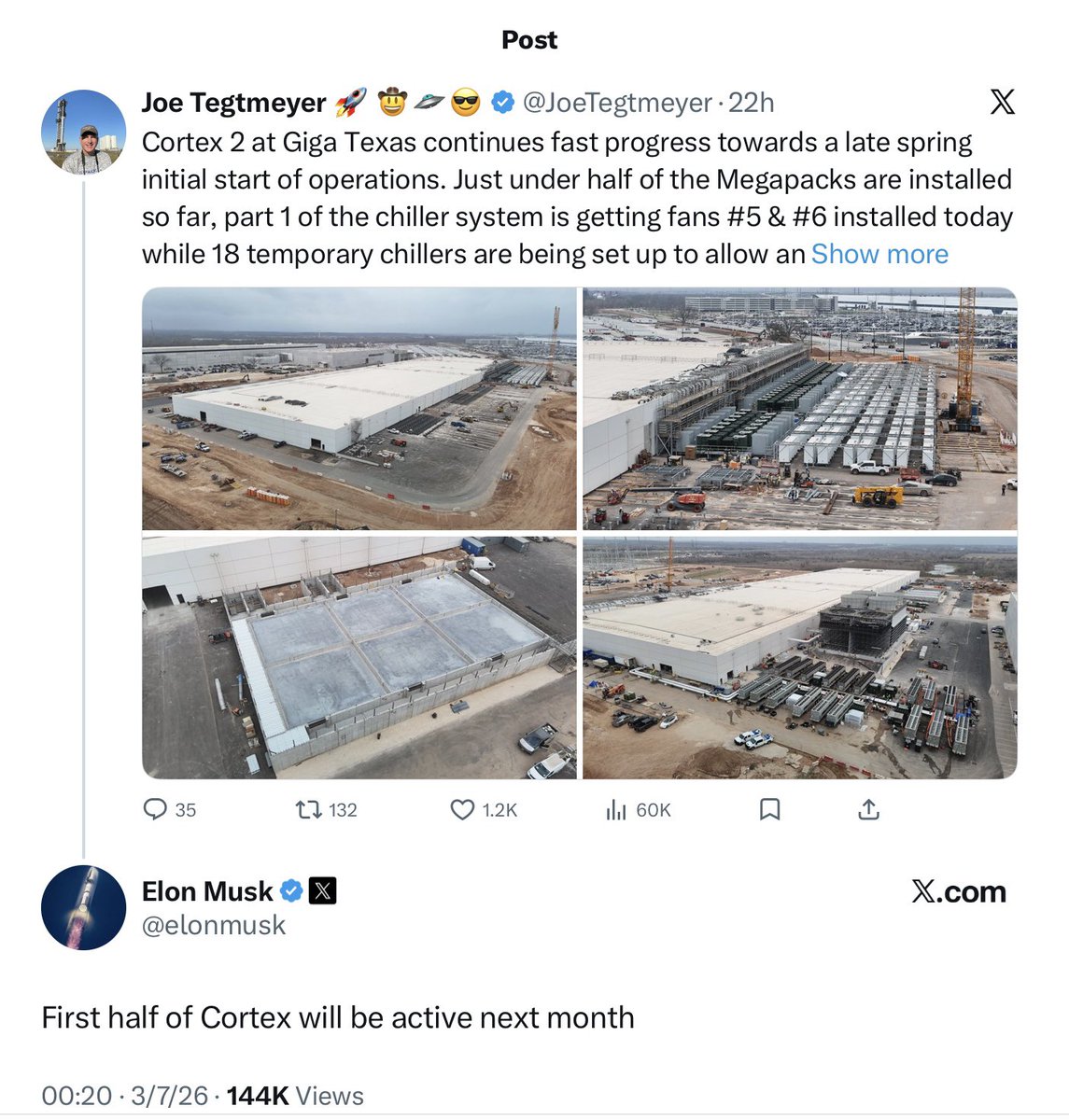
The News: Elon Musk has confirmed timelines and progress on Cortex 2 at Giga Texas, with 2026 positioned as a major stepping stone into Tesla's autonomous and physical AI future.
Why It Matters: This signals accelerating infrastructure build-out directly tied to FSD, Robotaxi, and Optimus — the three pillars that could fundamentally change what your Tesla is worth and what it can do.
Source: @JoeTegtmeyer on X
Cortex 2 Is Real — and It's Moving Fast
If you've been watching Giga Texas from the outside, the scale of what's happening on-site is hard to miss. Tesla watcher Joe Tegtmeyer, who has documented the factory's growth from the ground up, reports that Elon Musk has directly confirmed both the timelines and the progress of Cortex 2 — Tesla's next-generation AI supercomputing cluster — with significant construction activity visible across the Giga Texas site.

Cortex — Tesla's on-site AI training supercomputer at Giga Texas — was first revealed in 2024 as a cluster of tens of thousands of Nvidia H100 GPUs dedicated to training the neural networks that power FSD. Cortex 2 represents the next phase of that build-out, and confirmation of its timeline from Musk himself is a meaningful signal: Tesla isn't slowing down on the infrastructure side.
For Tesla owners, this matters more than it might seem. The speed at which FSD improves is directly tied to how fast Tesla can train its models — and that's a function of raw compute power. More Cortex means faster iteration, which means faster improvements to the car in your driveway.
Why 2026 Is Different
Tegtmeyer's framing is pointed: 2026 is a "big stepping stone into an autonomous and physical AI future." That language maps directly onto Tesla's three most consequential programs right now:
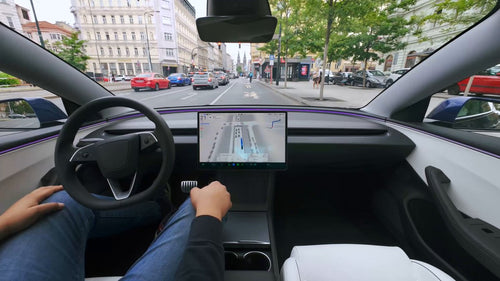
- Full Self-Driving (FSD): Tesla is actively expanding FSD globally in 2026. Public road testing with a right-hand drive Model Y launched in Japan in March 2026, targeting approximately 40,000 existing Tesla vehicles in that market pending certification. FSD (Supervised) is already available across the U.S., Canada, Mexico, China, Australia, New Zealand, and South Korea — with the UAE and additional markets in the pipeline.
- Robotaxi / Cybercab: The autonomous ride-hailing service remains one of Tesla's most anticipated launches. The compute infrastructure being built at Giga Texas is foundational to the AI systems that will need to operate at fleet scale.
- Optimus: Tesla's humanoid robot program — the "physical AI" half of Tegtmeyer's description — is advancing in parallel. Optimus represents Tesla's bet that the same AI stack powering FSD can be adapted to general-purpose robotic tasks.
These aren't separate bets. They share a common AI foundation, and Cortex 2 feeds all three.
📊 Key Figures
| Metric | Value | Context |
|---|---|---|
| FSD Japan Target Vehicles | ~40,000 | Existing Tesla owners in Japan |
| FSD Japan Public Testing Start | March 2026 | RHD Model Y on public roads |
| FSD Subscription Price (US) | $99/month | Subscription-only as of Feb 2026 |
| FSD Active Markets | 7 countries | US, Canada, Mexico, China, AU, NZ, South Korea |
🔭 The BASENOR Take
Timeline: Active — Cortex 2 construction underway at Giga Texas as of March 2026
Impact Level: 🔴 High — affects FSD capability trajectory, Robotaxi launch readiness, and Optimus development pace
Confidence: High — confirmed directly by Elon Musk per on-site reporting from @JoeTegtmeyer
What makes this moment significant isn't any single announcement — it's the convergence. Tesla is simultaneously expanding FSD to new international markets, building out the compute infrastructure to train faster, and advancing Optimus toward production. These programs reinforce each other: every FSD mile driven generates training data, every training cycle improves the model, and the same neural network architecture is being adapted for humanoid robotics.
The Cortex 2 confirmation matters because it tells you Tesla is investing in the ceiling of what's possible, not just the current product. Owners who have FSD today are essentially early participants in a system that gets meaningfully better as this infrastructure comes online. For those on the fence about the $99/month subscription, the trajectory of improvement in 2026 is the strongest argument for staying engaged with the technology.
On the physical AI side, Optimus remains the longer-duration bet — but the Giga Texas site activity suggests Tesla is treating it with the same operational urgency as its vehicle programs. The phrase "autonomous and physical AI future" isn't marketing language at this point. It's a description of where Tesla's capital and engineering hours are actually going. For our full ongoing coverage of FSD and autonomous driving developments, bookmark that page — 2026 is going to move fast.
📰 Deep Dive
The Cortex supercomputer cluster at Giga Texas was always intended to be expandable, and Cortex 2 represents that expansion executing on schedule. What Musk's confirmation adds is certainty: the timelines are holding, and the physical build-out visible on-site matches the internal roadmap. For a company that has sometimes faced skepticism about its AI infrastructure ambitions, this is a meaningful data point.
The global FSD expansion story is also worth watching closely. Japan is a technically demanding market — right-hand drive, dense urban environments, complex intersection rules — and Tesla choosing it as a 2026 target signals confidence in the underlying technology. If FSD can be certified in Japan, the certification pathway for other complex markets becomes clearer.
Finally, the shift to a subscription-only FSD model (at $99/month in the US as of February 2026) changes the economics of Tesla ownership in a subtle but important way. It lowers the barrier to entry for new owners while creating a recurring revenue stream that funds exactly the kind of infrastructure investment — Cortex 2, neural network training centers — that makes the product better over time. The flywheel is intentional.
🚕 Following the Robotaxi rollout? See every operating city, launch date and announced market in our Tesla Robotaxi Tracker.
🤖 Tracking Tesla's humanoid robot? See every Optimus production milestone and appearance in our Tesla Optimus Tracker.
Related Gear
Gear up your Tesla with tested, custom-fit BASENOR accessories — shop Tesla accessories →
Sources & reporting notes
The links below identify the material source records used for this report.
- @JoeTegtmeyer on X (2026-03-07T13:45:10.000Z) — Direct source
Source links are preserved as published or accessed. See our editorial standards and corrections policy.
The BASENOR Editorial Desk covers Tesla, SpaceX, and related technology, curating reporting from primary sources — official accounts, regulatory filings, and software release data. Every article passes source-record and fact-checking review before publication. About the newsroom.
This report was curated by the BASENOR Editorial Desk from the sources listed above. Read our editorial standards or email editorial@basenor.com to report an error.