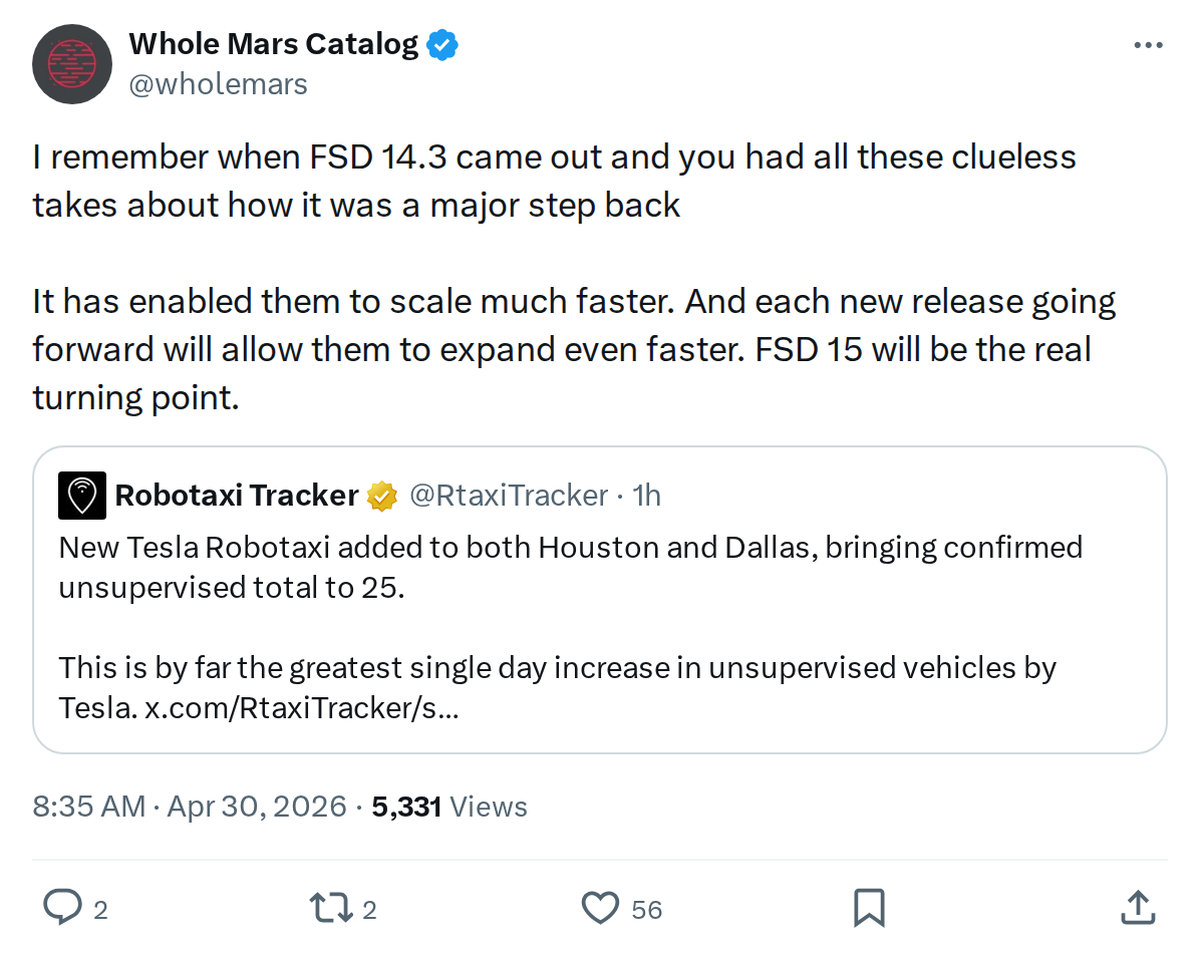
The Tesla community's most-watched independent voice just laid out a clear-eyed view of where FSD is headed — and the short version is that the rapid phase hasn't even started yet. Whole Mars Catalog, whose track record on FSD commentary has earned a large following among owners and investors, posted a two-part thread on April 30 arguing that FSD 14.3 was misread by critics and that version 15 will mark the technology's real inflection point.

What FSD 14.3 Actually Did
When FSD 14.3 launched in April 2026, a vocal segment of the community called it a step backward. The criticism centered on behavioral changes that felt unfamiliar compared to prior versions. But that framing missed the point of what 14.3 was engineered to do.
According to verified technical details, v14.3 introduced an upgraded Reinforcement Learning stage, a new neural network vision encoder, and a rewritten AI compiler — collectively delivering up to 20% faster inference latency. That's not a comfort improvement for drivers. It's an infrastructure upgrade that allows Tesla's engineering team to iterate and retrain models significantly faster than before. Whole Mars Catalog's argument is essentially that the critics were grading a foundation pour as if it were the finished building.
The practical result: Tesla can now push meaningful improvements with each subsequent release at a pace that wasn't achievable under the prior architecture. That compounding effect is what makes the next few versions consequential.

The "Slowly, Then All at Once" Thesis
The second post in the thread is the more striking one. Whole Mars Catalog framed the current FSD rollout as still being in the "slowly" phase — and said the "all at once" phase begins later this year.
That framing maps directly onto what Elon Musk has confirmed publicly. FSD v15 is targeted for late 2026 or early 2027. It represents a total architectural overhaul rather than an incremental update — a model with 10 times more parameters (10 billion, up from roughly 1 billion in the current architecture). Musk has described it as capable of exceeding human driving safety by a significant margin, including handling edge cases like anticipating pedestrians hidden behind large trucks and navigating chaotic multi-lane roundabouts without hesitation.
Critically, Musk confirmed during the Q1 2026 Earnings Call that FSD v15 will run on current Hardware 4 (AI4) systems — meaning owners who already have HW4 vehicles won't need a hardware upgrade to access it. That removes one of the most common objections to the timeline.
The BASENOR Take
The pattern here is worth recognizing. FSD has a consistent history of releases that get criticized on first contact, then quietly become the foundation for the next leap. Version 12 faced similar skepticism before it became the baseline for everything that followed. The 14.3 story looks like the same dynamic.
What's different this time is the scale context. Tesla reported 8.3 billion miles accumulated under FSD (Supervised) as of February 2026, with approximately 5.3 million miles between accidents for FSD users — versus 660,000 miles per accident for the average US human driver. That data set is what trains the 10-billion-parameter model in v15. The more miles, the better the edge case coverage.
The Robotaxi fleet rollout is also aligned with the v15 timeline. Tesla has explicitly tied broader unsupervised FSD deployment to finishing training and validation on v15 — so this isn't just a software update, it's the gate that determines when the commercial autonomy story actually begins.
If Whole Mars Catalog's read is right, owners watching FSD progress right now are watching the calm before a very fast acceleration. The question isn't whether v15 will be significant — the architecture alone guarantees it will be different in kind, not just degree. The question is whether the late 2026 timeline holds, and whether the 10x model delivers on its theoretical ceiling when it meets real-world edge cases at scale.
📋 Tracking Tesla software? See every firmware, FSD and app version in one place in our Tesla Software Update Tracker.
Related Gear
Gear up your Tesla with tested, custom-fit BASENOR accessories — shop Tesla accessories →
Sources & reporting notes
The links below identify the material source records used for this report.
- @wholemars on X (2026-04-30T00:35:07.000Z) — Direct source
- @wholemars on X (2026-04-30T00:35:06.000Z) — Direct source
Source links are preserved as published or accessed. See our editorial standards and corrections policy.
The BASENOR Editorial Desk covers Tesla, SpaceX, and related technology, curating reporting from primary sources — official accounts, regulatory filings, and software release data. Every article passes source-record and fact-checking review before publication. About the newsroom.
This report was curated by the BASENOR Editorial Desk from the sources listed above. Read our editorial standards or email editorial@basenor.com to report an error.