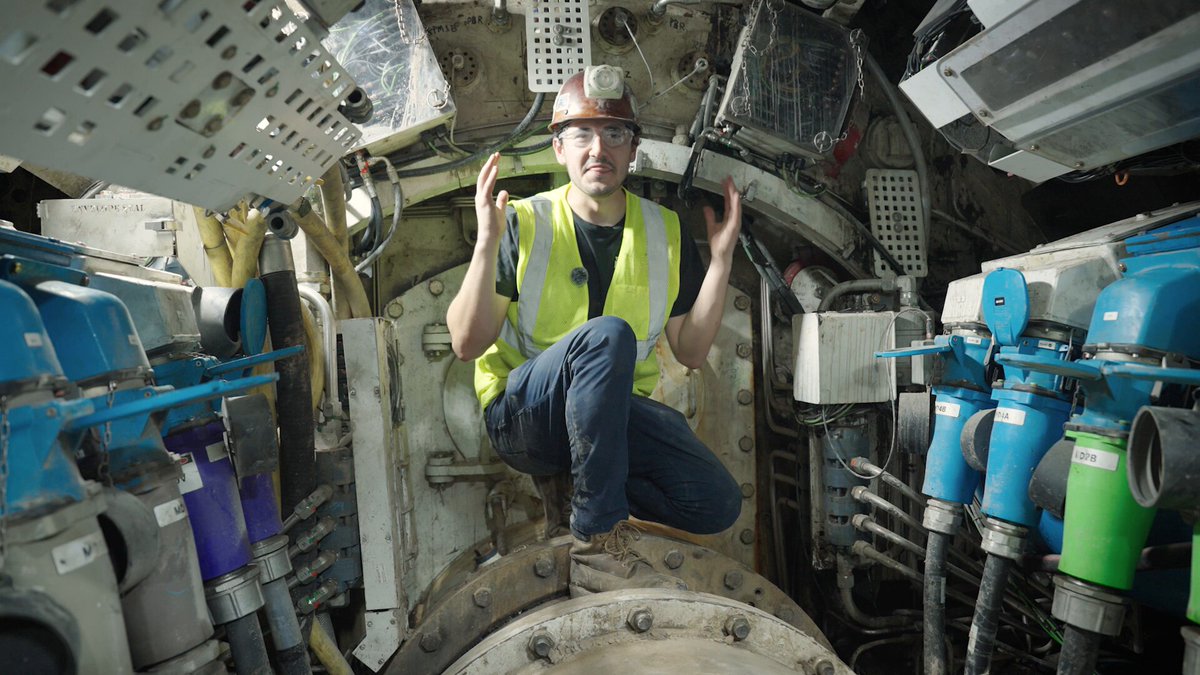
The Boring Company just pulled back the curtain on how its Prufrock tunnel boring machines actually work at scale — and the operational picture is more sophisticated than most people realize. Prufrock doesn't stop to install tunnel liners; it pushes and builds simultaneously, and every machine from Las Vegas to Dubai is directed from a single Operations Control Center in Bastrop, Texas.

What Continuous Mining Actually Means
Traditional tunnel boring machines operate in cycles: excavate a section, stop, install the concrete liner ring, then resume. That stop-start rhythm is the primary bottleneck in conventional tunneling — machines can sit idle for a significant portion of their operating time.
Prufrock eliminates that cycle entirely. The machine excavates and installs tunnel liners in a single continuous motion, meaning the only thing slowing it down is geology, not process. According to TBC's published targets, Prufrock is designed to exceed one mile per week — roughly six times faster than TBC's previous-generation machine, Godot+. The medium-term goal for the Prufrock-3 variant is an ambitious 7 miles per day.
Prufrock-2 demonstrated real-world progress in March 2026, completing a record 2.28-mile single tunnel drive for the Vegas Loop — moving approximately 68,000 cubic yards of dirt via a 4.8-mile continuous conveyor system powered by six motors totaling 825 horsepower.
One Control Room, Multiple Continents
The remote operations angle is arguably the more strategically significant detail in today's update. Running a global tunneling operation from a single facility in Bastrop, Texas, is only possible because Prufrock machines are engineered for Zero-People-In-Tunnel (ZPIT) operation — fully automated boring with no workers inside the tunnel during normal operations. The Prufrock-4 implements this system fully.
This isn't just a safety feature. It fundamentally changes the economics of scaling a tunneling company. You don't need to staff an experienced underground crew at every project site simultaneously — the expertise centralizes, the machines decentralize. That model looks a lot more like running a software fleet than running a traditional construction operation.
Where the Machines Are Working
The Las Vegas deployment remains TBC's most mature market. The Vegas Loop master plan calls for a 68-mile network with 93 stations, and the LVCC Loop segment alone transported roughly 82,000 passengers during CONEXPO-CON/AGG 2026 in early March. A 4.54-mile tunnel length was announced for the Westgate portion of the project as of March 9, 2026.
Dubai represents TBC's first international deployment at scale. In February 2026, TBC signed a partnership agreement with Dubai's Roads and Transport Authority for the Dubai Loop — a first phase covering a 6.4-kilometer pilot route connecting Dubai International Financial Centre to Dubai Mall, with an estimated cost of AED 565 million (approximately USD 154 million) and a one-year build schedule. The full vision extends to 22 kilometers with 19 stations, targeting 30,000 passengers per day.
Nashville is next in the pipeline. The Music City Loop — connecting downtown to Nashville International Airport — is under construction, with Prufrock-4 slated for the project and an operational target in the first half of 2027.
The Fleet Is Still Growing
TBC isn't standing still on the hardware side. Prufrock-5 left the Bastrop factory in November 2025, with tunneling expected to begin almost immediately. Prufrock-6 and Prufrock-7 are reported to be in development at The Boring Factory in Texas. Each successive machine typically receives upgrades between launches — Prufrock-1 alone has completed six tunnels.
The cost target TBC is working toward: under $8 million per mile for a Loop Transportation tunnel, all-in. At that price point, combined with continuous mining speeds and centralized remote operations, the economics of underground urban transit start to look genuinely different from what cities have historically been quoted by conventional contractors.
Today's video is a reminder that TBC's ambitions aren't theoretical anymore — there are machines in the ground on two continents, operated from a single room in Texas, boring without stopping. The question now is how fast the fleet can scale to match the demand TBC is signing up.

Sarah focuses on Tesla Energy, SpaceX missions, and the broader Musk AI portfolio. Former data analyst in clean energy. Based in San Francisco.
Sources verified at publish time. Spotted an inaccuracy? Email editorial@basenor.com.