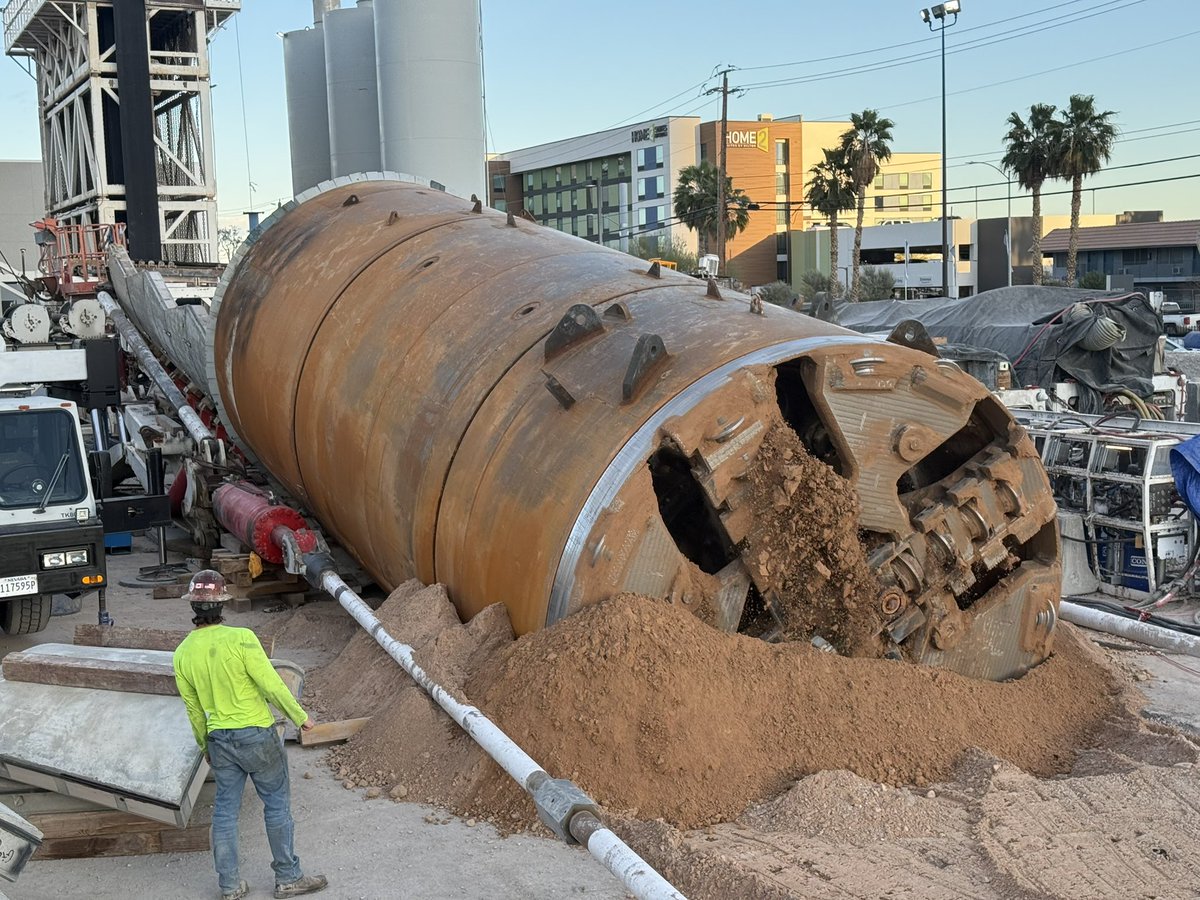
The News: The Boring Company has launched its Prufrock-3 tunnel boring machine using a new system called 'The Monster,' which allows the machine to drill directly into a parking lot surface — no pit, no shaft, no excavation required.
Why It Matters: This is a step-change in how underground tunnels get built. Faster, cheaper deployments mean The Boring Company's Loop network — and the underground connections it builds for Tesla Gigafactories — can scale at a pace previously impossible.
Source: @boringcompany on X
What Is 'The Monster' — And Why Does It Matter?
Tunnel boring has always had a dirty secret: before any machine drills an inch of rock, crews spend weeks — sometimes months — digging a massive launch pit just to get the boring machine into the ground. It's expensive, it's disruptive, and it's slow. The Boring Company just made that problem disappear.
Prufrock-3's new launch system, officially nicknamed 'The Monster,' tilts the boring machine downward at an angle, allowing it to bite directly into the surface of a parking lot and begin tunneling without any prior excavation. No pit. No shaft. No weeks of groundwork. According to The Boring Company, this system enables Prufrock-3 to begin tunneling within 24 hours of arriving on-site.

📊 Key Figures
| Metric | Value | Context |
|---|---|---|
| Time to begin tunneling (on-site) | 24 hours | vs. weeks with traditional pit prep |
| Target tunneling speed | >1 mile/week | 6× faster than predecessor Godot |
| Medium-term speed goal | 7 miles/day | 1/10 of human walking speed |
| Target cost per mile (Loop tunnel) | <$8M | All-in, per mile |
| Prufrock-4 weight (next gen) | 797,000 lbs | Up to 4.7M lbs of thrust |
From Giga Texas to Las Vegas: Where Prufrock Has Already Drilled
This isn't Prufrock-3's debut project — the machine has already proven itself at two high-profile sites. At Tesla Giga Texas, Prufrock-3 was used to bore the 'Cybertunnel,' a dedicated underground passage that shuttles finished Cybertrucks from the factory floor in 60 seconds flat — bypassing a 12-minute surface drive. That kind of efficiency compounds directly into Tesla's production throughput.
In Las Vegas, a Prufrock-series machine completed the Westgate-LVCC Connector, which opened in 2024 as part of the expanding Vegas Loop network. The machine famously 'porpoised' back up through the ground at the tunnel exit — a visual demonstration of the same directional flexibility that 'The Monster' now automates at launch.
What's new today is the launch mechanism itself. By eliminating the excavation phase entirely, The Boring Company has removed one of the last major friction points in rapid tunnel deployment.
How Prufrock-3 Is Engineered for Speed
Beyond 'The Monster,' Prufrock-3 incorporates several design principles that separate it from conventional TBMs:
- Continuous mining: Tunnel liner installation happens simultaneously with excavation — no stop-start cycles.
- Zero-People-In-Tunnel (ZPIT): Fully automated operations reduce both safety risk and the logistical overhead of managing crews underground.
- Rapid site entry: The Monster's tilting launch system means the machine can be deployed to a new site and operational within a single day.
The next-generation Prufrock-4 is already in development, reportedly weighing 797,000 pounds and capable of generating up to 4.7 million pounds of thrust — suggesting The Boring Company is building toward significantly larger-diameter tunnels or harder geological conditions.
🔭 The BASENOR Take
Timeline: Prufrock-3 active now | Prufrock-4 & 5 in development
Impact Level: 🟠 High — infrastructure-level change with direct Tesla ecosystem implications
Confidence: ✅ High — confirmed by @boringcompany official account, corroborated by multiple verified sources
The tunnel boring industry has been largely unchanged for decades. Launch pits are expensive, time-consuming, and require significant land disruption — exactly the kind of friction that makes underground transit uneconomical at scale. 'The Monster' attacks that problem directly.
For Tesla owners, the implications are tangible. The Boring Company operates in close orbit around Tesla's infrastructure ambitions — the Cybertunnel at Giga Texas is a working example of how faster, cheaper tunneling translates into real factory efficiency gains. As Loop networks expand to more cities, the speed of deployment becomes the key variable. A machine that can go from parking lot to active tunnel in 24 hours is a fundamentally different competitive proposition than anything that existed before.
The Prufrock-4 figures are also worth watching. At nearly 400 tons and 4.7 million pounds of thrust, the next generation appears engineered for a meaningfully different scale of project — potentially larger-diameter tunnels capable of handling more than just Tesla vehicles. Whether that points toward freight, public transit integration, or something else entirely remains to be seen, but the engineering trajectory is clearly pointing upward.
📰 Deep Dive
The naming of 'The Monster' is characteristically Boring Company — understated branding for what is, in engineering terms, a genuinely novel solution. Traditional tunnel boring machine launches require construction crews to excavate a pit deep enough to lower the TBM to the correct angle and depth before it can begin cutting. That process involves heavy equipment, significant concrete work, and weeks of preparation. 'The Monster' replaces all of that with a single tilting cradle mechanism that angles the machine downward from surface level.
The 24-hour deployment claim is the number that should get attention. In infrastructure terms, the difference between a weeks-long site prep and a same-day launch is not incremental — it's a category shift. It means The Boring Company can respond to project opportunities faster, reduce mobilization costs, and potentially run multiple machines across more sites simultaneously without the traditional bottleneck of launch pit construction.
It's also worth noting the broader Prufrock roadmap. With Prufrock-4 and Prufrock-5 reportedly in development, The Boring Company appears to be iterating on its TBM platform at a pace more reminiscent of software development than traditional heavy engineering. Each generation targets meaningful performance improvements — speed, thrust, and now launch logistics. If that cadence holds, the tunneling economics that make Loop networks viable in a handful of cities today could look very different within a few years.

Sarah focuses on Tesla Energy, SpaceX missions, and the broader Musk AI portfolio. Former data analyst in clean energy. Based in San Francisco.
Sources verified at publish time. Spotted an inaccuracy? Email editorial@basenor.com.