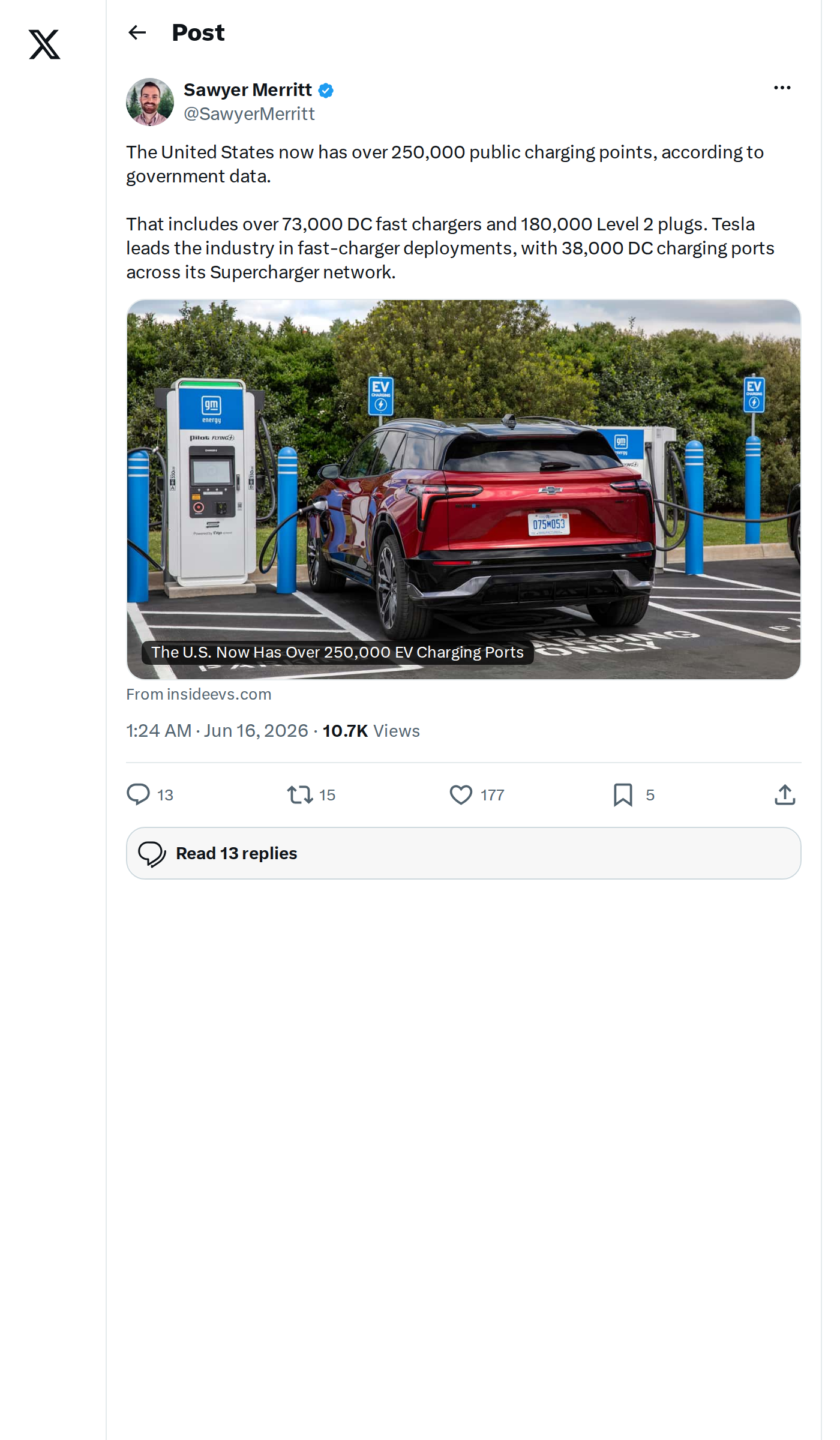
The United States has crossed 250,000 public EV charging ports, according to government data cited by industry analyst Sawyer Merritt — and Tesla's Supercharger network is responsible for more than half of every fast-charge capable plug in the country. That's not a marketing claim. It's a structural reality baked into the nation's charging infrastructure.

The Numbers Behind the Milestone
Of the 250,000+ public charging ports now active across the US, roughly 73,000 are DC fast chargers — the kind that can meaningfully top up a battery in 20-30 minutes rather than overnight. The remaining 180,000 are Level 2 plugs, which are useful for destination charging but not the backbone of long-distance EV travel.
Tesla's contribution to that fast-charging total is striking. According to verified data from June 2026, Tesla operates 3,112 Supercharger stations in the US housing approximately 37,736 individual ports. That puts the Supercharger network at roughly 51-52% of all DC fast charging ports in the country — a majority stake in the infrastructure layer that matters most for EV adoption.
US Public Charging Snapshot — June 2026
| Metric | Figure |
|---|---|
| Total public charging ports | 250,000+ |
| DC fast chargers (all networks) | 73,951 |
| Level 2 chargers | ~180,000 |
| Tesla Supercharger stations (US) | 3,112 |
| Tesla Supercharger ports (US) | ~37,736 |
| Tesla's share of DC fast charging | ~52% |
Sources: government data via @SawyerMerritt; InsideEVs; CleanTechnica — as of June 2026
How Tesla Built This Lead
Tesla didn't inherit this position — it built it over more than a decade while competitors were still debating standards. The Supercharger network grew 25% in stations and 30% in ports between January 2025 and mid-2026 alone, according to industry tracking data. The broader US fast-charging market also expanded roughly 30% in 2025, meaning Tesla grew at pace with — or faster than — the overall market while already holding the dominant share.
Hardware is also advancing. Gigafactory New York completed production of V3 Supercharger cabinets in early 2026 and is now scaling the V4 line, which supports charging speeds up to 500 kW per stall for compatible vehicles. The first operational 500 kW V4 Supercharger on the East Coast opened in Kissimmee, Florida, earlier this year — a preview of where the network's ceiling is heading.
The Open Network Shift
The competitive picture has changed meaningfully in the past 18 months. As of March 2026, over 27,500 Supercharger stalls globally are accessible to non-Tesla EVs, including vehicles from Ford, GM, Rivian, Hyundai, and Stellantis. The accelerating adoption of the North American Charging Standard (NACS) — originally Tesla's proprietary connector — means the Supercharger network is increasingly functioning as shared public infrastructure, not a Tesla-exclusive perk.
That's a strategic pivot with real implications. A network that serves all EVs generates more revenue per stall, justifies faster expansion, and cements Tesla's position as the de facto standard rather than one option among many.
What Federal Funding Actually Contributed
One number worth sitting with: despite a $5 billion federal commitment through the NEVI Formula Program since 2021, fewer than 1,000 operational charging ports had been installed under federal programs as of February 2026. NEVI-funded sites accounted for roughly 3% of DC fast-charging additions in 2025. Private investment — led overwhelmingly by Tesla — drove the other 97%.
That gap between government ambition and on-the-ground delivery is a recurring theme in EV infrastructure policy. Tesla's network, built entirely on private capital, now serves as the empirical benchmark against which publicly funded programs are measured — and currently found wanting.
With the Supercharger network still expanding month-over-month (507 new stalls added in May 2026 alone) and V4 hardware rolling out at scale, Tesla's majority position in US DC fast charging looks durable for the foreseeable future. The real question is whether any competitor can close a gap that's been widening for years.
Related Gear
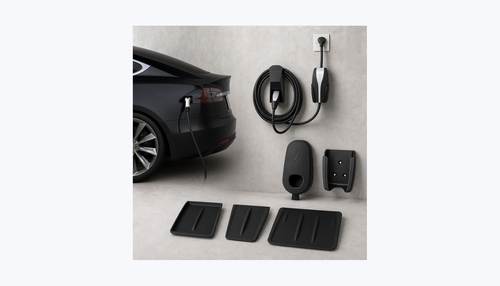
Gear up your Tesla with tested, custom-fit BASENOR accessories — shop Tesla accessories →
Sources & reporting notes
The links below identify the material source records used for this report.
- @SawyerMerritt on X (2026-06-16T01:24:54.000Z) — Direct source
Source links are preserved as published or accessed. See our editorial standards and corrections policy.
The BASENOR Editorial Desk covers Tesla, SpaceX, and related technology, curating reporting from primary sources — official accounts, regulatory filings, and software release data. Every article passes source-record and fact-checking review before publication. About the newsroom.
This report was curated by the BASENOR Editorial Desk from the sources listed above. Read our editorial standards or email editorial@basenor.com to report an error.