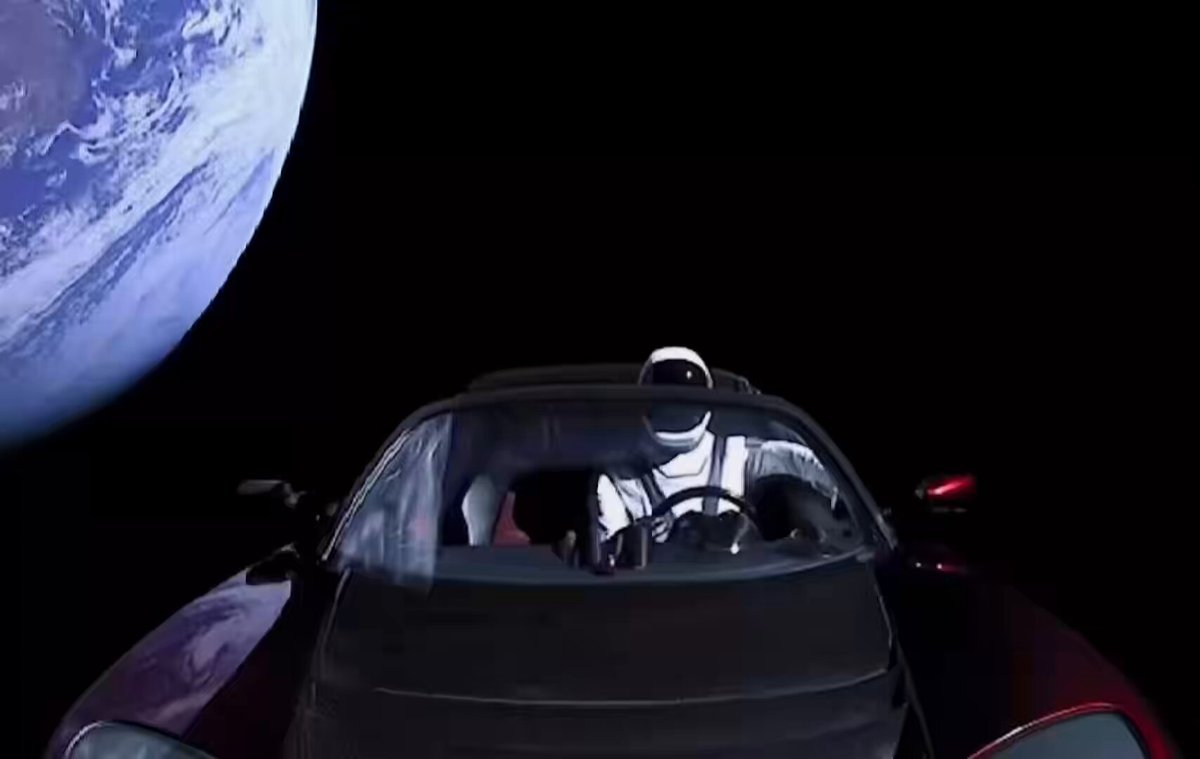
Eight and a half years after it left Earth, Elon Musk's personal cherry-red Tesla Roadster is still out there — silently looping the Sun somewhere between Earth's orbit and the asteroid belt. Musk confirmed as much this week in a post on X, reminding the internet that the car he drove for three years before strapping it to a rocket is now one of the most unusual objects in the solar system.

How It Got There
On February 6, 2018, SpaceX used the maiden flight of its Falcon Heavy rocket — then the most powerful operational launch vehicle in the world — to send a test payload into space. Rather than use a conventional mass simulator, Musk chose his own 2008 first-generation Roadster, complete with a spacesuit-clad mannequin named Starman in the driver's seat and David Bowie's Space Oddity on the stereo. The car was never meant to come back. It remains permanently attached to the Falcon Heavy's upper stage.
The mission achieved more than a successful rocket debut. It turned a piece of automotive history into an artificial heliocentric satellite — and gave the world one of the most surreal images in the history of spaceflight.
Where It Is Right Now
The Roadster travels an elliptical orbit around the Sun, crossing the orbit of Mars at its farthest point. According to tracking data from Whereisroadster.com, which draws on NASA/JPL HORIZONS system data, the car's aphelion sits at approximately 1.66 astronomical units from the Sun. It completes one full orbit roughly every 557 days — meaning it has now completed approximately 5.5 laps around the Sun since launch.
The cumulative distance is staggering. As of early 2025, the Roadster had logged an estimated 3.5 trillion miles (about 5.6 trillion kilometers). To put that in context: the car has exceeded its original 36,000-mile warranty by more than 96,000 times over.
Roadster by the Numbers
| Launch date | February 6, 2018 |
| Orbital period | ~557 days |
| Orbits completed (as of July 2026) | ~5.54 |
| Aphelion (farthest from Sun) | ~1.66 AU |
| Distance traveled (as of Feb 2025) | ~3.5 trillion miles |
| Next close Earth approach | 2047 (~5M km away) |
| Probability of Earth collision (3M-year sim) | ~6% |
Sources: Whereisroadster.com / NASA JPL HORIZONS / Wikipedia
A Brief Moment of Bureaucratic Confusion
The Roadster's journey has not been without its odd footnotes. In January 2025, the International Astronomical Union's Minor Planet Center briefly classified the car as a newly discovered near-Earth object, assigning it the designation 2018 CN41 — before quickly realizing it had catalogued Musk's Tesla and deleting the entry. It is, by any measure, the only vehicle to have been mistaken for an asteroid.
What Happens Next
The Roadster is not coming home anytime soon. The next predicted close approach to Earth is in 2047, when it will pass at roughly 5 million kilometers — about 13 times the Earth-Moon distance, close enough to observe but nowhere near a retrieval scenario. A second close encounter is projected for 2091. Long-range simulations over a three-million-year timespan put the probability of an eventual Earth collision at around 6%, with a 2.5% chance of hitting Venus.
In the meantime, cosmic radiation and solar exposure are slowly degrading the car's materials — the paint, rubber, and carbon fiber components are all breaking down in ways no automotive engineer ever had to plan for. Starman, for his part, keeps his eyes on the road.
Musk mentioned in 2019 that SpaceX might one day send a spacecraft to photograph or retrieve the Roadster. Given how much SpaceX's capabilities have grown since then, it is no longer an entirely implausible idea — though no mission has been announced. For now, you can track the car's exact position in real time at whereisroadster.com, which updates continuously using NASA/JPL orbital data.
Related Gear
Gear up your Tesla with tested, custom-fit BASENOR accessories — shop Tesla accessories →
Sources & reporting notes
The links below identify the material source records used for this report.
- @elonmusk on X (2026-07-31T05:46:37.000Z) — Direct source
Source links are preserved as published or accessed. See our editorial standards and corrections policy.
The BASENOR Editorial Desk covers Tesla, SpaceX, and related technology, curating reporting from primary sources — official accounts, regulatory filings, and software release data. Every article passes source-record and fact-checking review before publication. About the newsroom.
This report was curated by the BASENOR Editorial Desk from the sources listed above. Read our editorial standards or email editorial@basenor.com to report an error.