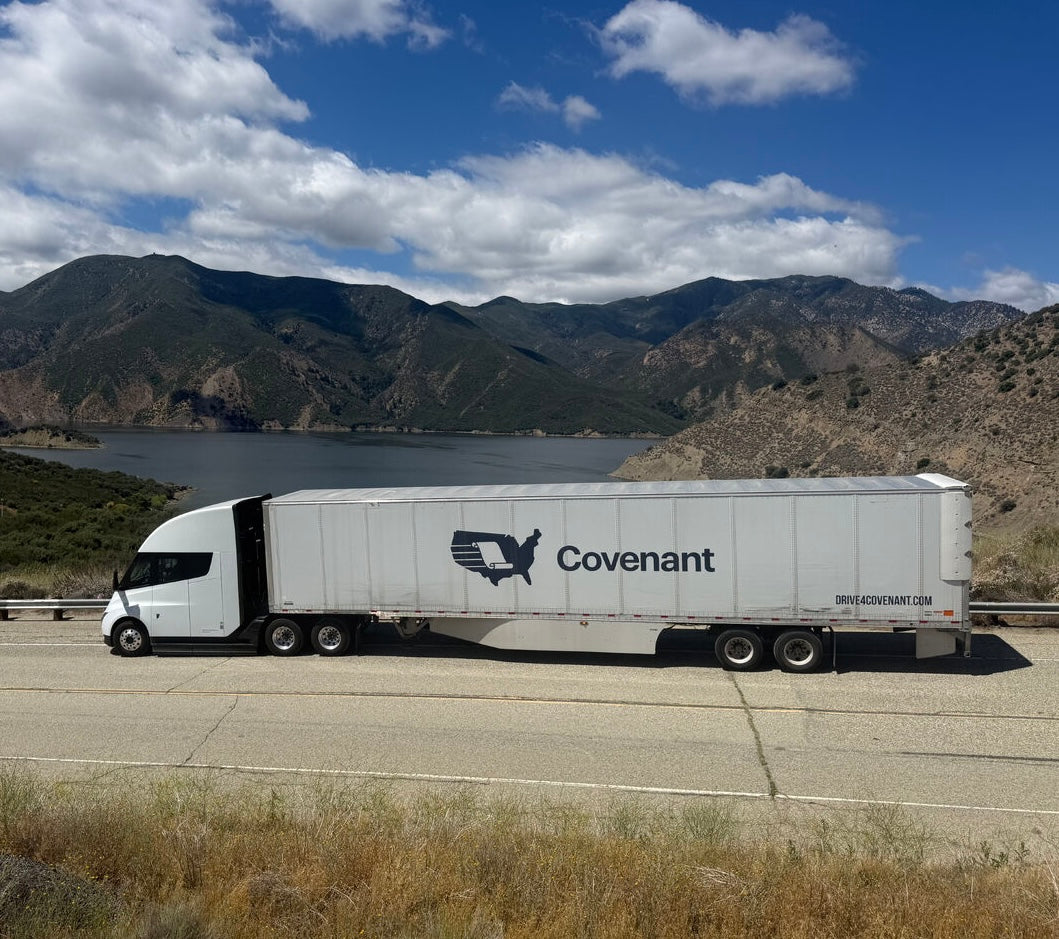
Another major logistics operator has put the Tesla Semi through its paces — and come away a convert. Covenant Logistics, one of the largest trucking companies in the United States, wrapped up a two-week evaluation of the 500-mile long-range Tesla Semi in California, and their verdict was unambiguous: the electric truck delivered a level of driver confidence that diesel simply couldn't match.

"We were amazed at the performance of the Tesla Semi and felt a level of confidence that was hard to match in a diesel truck," the company stated, according to reporting by Sawyer Merritt. The evaluation — part of a three-week program that kicked off May 13 in California — had the Semi hauling full freight loads on a 200-mile round trip route under real commercial operating conditions.
What Covenant Logistics Was Actually Testing
This wasn't a controlled-environment showcase. Covenant put the 500-mile long-range Semi to work the way fleets actually operate: loaded to commercial weight, running repeatable routes, across full working days. The evaluation focused on load handling, energy consumption under weight, driver ergonomics, and operational reliability — the metrics that actually determine whether a truck earns a permanent spot in a fleet.
The Semi they tested is rated for 82,000 lbs gross combination weight and draws from an 822 kWh battery pack, with three independent rear motors producing over 1,000 horsepower. Real-world energy consumption figures from similar pilot programs have come in around 1.64–1.72 kWh per mile at full load — numbers that translate directly into predictable operating costs for fleet managers.
A Pattern Forming Across the Industry
Covenant's results aren't an isolated data point. Since Tesla began volume production of the Semi on April 29, 2026, at its Nevada Gigafactory, a wave of logistics operators has run structured evaluations — and the feedback has been consistently strong:
- ArcBest averaged 1.55 kWh per mile over 4,494 miles during a three-week real-world test.
- DHL Supply Chain reported 1.72 kWh per mile on a fully loaded 390-mile route and has already taken delivery of its first Semi, with more planned for 2026.
- CEVA Logistics completed a West Coast trial and avoided an estimated 4.38 metric tons of CO₂ emissions in the process.
- AiLO Logistics and MDB Transportation both launched their own three-week pilots in late April 2026, focusing on energy efficiency and route reliability.
The consistency across operators — different routes, different cargo, different company cultures — is what makes this accumulating evidence compelling. These aren't marketing partnerships. They're procurement evaluations, and the Semi keeps passing them.
The Driver Confidence Factor
One detail in Covenant's feedback stands out beyond the efficiency numbers: the mention of driver confidence. Fleet adoption of new truck technology often stalls not on economics, but on driver resistance. A truck that drivers actively prefer removes one of the biggest friction points in transitioning a commercial fleet. If the Semi is genuinely easier and more confidence-inspiring to operate than a diesel counterpart — particularly on demanding routes — that's a commercial advantage that doesn't show up in a kWh-per-mile spreadsheet but matters enormously to fleet operators.
Tesla's Nevada Gigafactory is currently ramping toward a projected annual output of up to 50,000 Semi units. With evaluations like Covenant's stacking up across the industry, the question is shifting from whether the Semi can perform to whether Tesla can build them fast enough to meet the demand that these pilots are generating.

David covers the EV industry, regulatory developments, and accessory ecosystem. 15+ years writing about consumer tech. Based in London.
Sources verified at publish time. Spotted an inaccuracy? Email editorial@basenor.com.