30-Second Brief
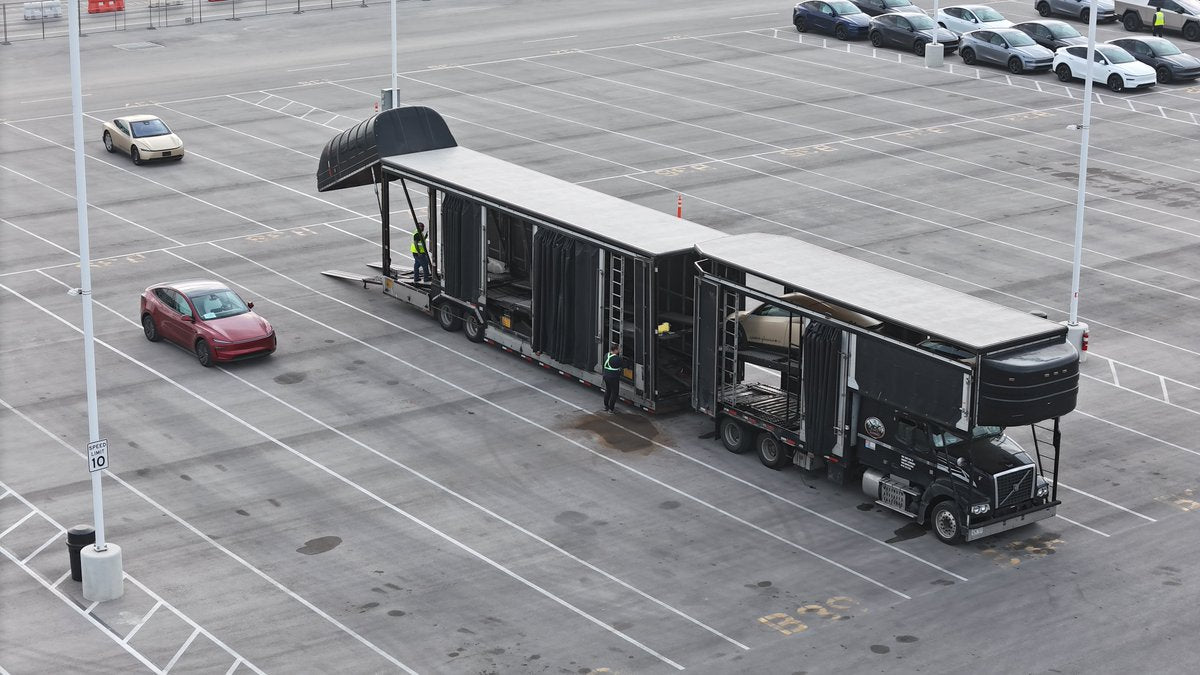
The News: Drone observer Joe Tegtmeyer spotted 25 Cybercab units at Giga Texas on March 5, 2026 — 15 actively undergoing crash testing, 4 staged at the factory exit, and the remainder loaded onto covered transport vehicles, potentially heading to Robotaxi deployment sites.
Why It Matters: Active crash testing at this scale signals Tesla is on track for volume Cybercab production in April 2026, and the transport activity suggests pre-deployment logistics are already in motion.
Source: @JoeTegtmeyer on X
25 Cybercabs, Multiple Missions — What Tegtmeyer Found
Tesla's Cybercab program is moving fast. On a rainy Thursday morning at Gigafactory Texas, drone journalist Joe Tegtmeyer captured the most operationally diverse Cybercab sighting yet: 25 units spread across the facility in distinct stages of activity — crash testing, exit staging, and covered transport loading.

This isn't a static parking lot snapshot. Each cluster of Cybercabs represents a different phase of Tesla's pre-production validation pipeline — and seeing all three happening simultaneously on the same day is a meaningful signal.
📊 Key Figures
| Metric | Value | Context |
|---|---|---|
| Total Cybercabs on site | 25 | Largest single-day sighting to date |
| Units in crash testing | 15 | Active structural/safety validation |
| Units at factory exit | 4 | Staged for departure |
| Units loaded for transport | 6 | Covered carriers — destination unconfirmed |
| First production unit rolled out | Mid-Feb 2026 | Weeks ahead of original April target |
| Volume production target | April 2026 | Confirmed by Elon Musk |
| First batch completed | 100 units | No steering wheel or pedals |
| Retail price target | Under $30,000 | Before end of 2026, per Musk |
What Each Cluster Tells Us
The 15 in crash testing are the most significant data point here. Crash testing isn't something you do casually — it's a federally mandated, resource-intensive process that destroys vehicles. Running 15 units through simultaneously suggests Tesla has enough production output to sacrifice a meaningful number of cars for safety validation, which is exactly what you'd expect from a program approaching volume ramp. According to background research, Tesla had already been running six units simultaneously through crash testing in earlier weeks — going to 15 is a substantial step up.
The covered transport loading is equally telling. Covered carriers are typically used when a manufacturer doesn't want the public or competitors seeing the vehicles in transit — standard practice for pre-production units heading to testing facilities, regulatory inspection sites, or early deployment zones. Tegtmeyer noted these could be headed out for more Robotaxi activity, which aligns with Tesla's known strategy of expanding its supervised and unsupervised FSD testing footprint ahead of commercial launch.

Tegtmeyer's second flyover also captured significant construction activity across three major Giga Texas projects: the North Campus expansion, a River Road extension, and what appears to be a new test track. That last item is particularly relevant — a dedicated on-site test track would allow Tesla to run Cybercab dynamic testing without relying on public roads or off-site facilities, accelerating the validation timeline considerably.
🔭 The BASENOR Take
Timeline: First production unit — Mid-February 2026 | Current activity — March 5, 2026 | Volume production target — April 2026
Impact Level: 🔴 High — This directly affects when Robotaxi service expands and when retail Cybercabs become available
Confidence: ⬛⬛⬛⬜ High — Drone footage is primary evidence; transport destination is unconfirmed
Here's the honest read: Tesla is executing faster than its own published schedule. The first production Cybercab rolled off the Giga Texas line in mid-February — weeks ahead of the originally anticipated April start date. Now, just a few weeks later, we're seeing 25 units in active use across multiple validation stages. That's not a slow trickle — that's a program in controlled acceleration.
The regulatory picture remains the biggest wildcard. The Cybercab has no steering wheel and no pedals, which puts it outside current U.S. federal motor vehicle safety standards written for human-operated vehicles. Tesla will need exemptions or regulatory updates before these units can legally operate on public roads at scale. That process is underway, but it's not on Tesla's timeline — it's on the federal government's. The crash testing happening right now is partly about satisfying those regulatory requirements, so the pace of testing directly influences when commercial deployment can begin.
For owners watching the Robotaxi rollout, the covered transport activity is the most actionable signal. Tesla has been running unsupervised Robotaxi service in Austin using modified Model Y vehicles since mid-2025. The Cybercab units being loaded onto carriers could be heading to expand that footprint — or to new cities entirely. We'll be watching closely for any Cybercab sightings outside of Austin in the coming weeks. For those interested in following the broader self-driving story, this is a chapter that's moving fast.
One more thing worth noting: Tegtmeyer's footage shows Giga Texas simultaneously advancing three major construction projects alongside this Cybercab activity. That's a factory running at high operational tempo across multiple fronts. Tesla isn't pacing itself toward April — it's already there in everything but name.
🚕 Following the Robotaxi rollout? See every operating city, launch date and announced market in our Tesla Robotaxi Tracker.
Related Gear
Gear up your Tesla with tested, custom-fit BASENOR accessories — shop Tesla accessories →
Sources & reporting notes
The links below identify the material source records used for this report.
- @JoeTegtmeyer on X (2026-03-05T15:34:15.000Z) — Direct source
- @JoeTegtmeyer on X (2026-03-05T15:27:27.000Z) — Direct source
Source links are preserved as published or accessed. See our editorial standards and corrections policy.
The BASENOR Editorial Desk covers Tesla, SpaceX, and related technology, curating reporting from primary sources — official accounts, regulatory filings, and software release data. Every article passes source-record and fact-checking review before publication. About the newsroom.
This report was curated by the BASENOR Editorial Desk from the sources listed above. Read our editorial standards or email editorial@basenor.com to report an error.