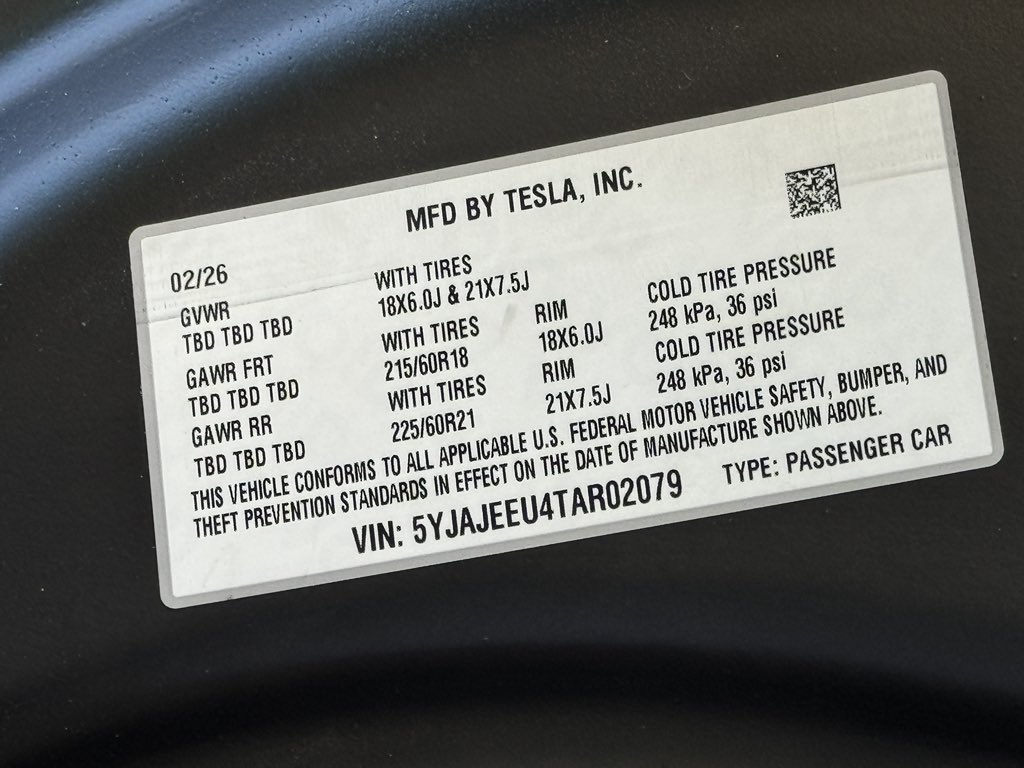
The News: A Tesla Cybercab was spotted carrying an official sticker stating it conforms to all applicable U.S. federal safety, bumper, and theft prevention standards — the same language found on every street-legal vehicle sold in America.
Why It Matters: If the Cybercab genuinely meets all Federal Motor Vehicle Safety Standards (FMVSS), Tesla may not need an NHTSA exemption — and therefore would not be subject to the 2,500-vehicle annual production cap that has loomed over the Cybercab rollout.
Source: @SawyerMerritt on X
A small sticker. A very large implication. A Cybercab spotted today carries the standard federal compliance label found on every road-legal vehicle in the United States — and if that label is accurate, it could fundamentally change the timeline and scale of Tesla's robotaxi rollout.

Why the 2,500-Vehicle Cap Matters
The Cybercab's regulatory path has been one of the most-watched storylines in the EV industry. The vehicle's design — no steering wheel, no pedals, no side mirrors — puts it in direct conflict with Federal Motor Vehicle Safety Standards (FMVSS), which were written with traditional human-operated vehicles in mind.
Under current NHTSA rules, manufacturers can apply for an exemption to produce vehicles that don't meet all FMVSS requirements. The catch: that exemption caps production at 2,500 vehicles per year. For a company planning to manufacture hundreds of Cybercabs weekly at Giga Texas, that cap would be a serious bottleneck — essentially a ceiling on the entire commercial launch.
According to reporting from multiple sources, Tesla had not yet filed for such an exemption as of early March 2026, despite mass production reportedly set to begin in April. NHTSA has publicly stated it looks forward to working with Tesla if the company seeks an exemption — but the operative word there is "if."
What the Sticker Actually Says
The compliance label spotted on the Cybercab reads: "This vehicle conforms to all applicable U.S. federal safety, bumper, and theft prevention standards."
This is not a generic or informal label. In the U.S., this specific certification statement is a legal requirement under 49 CFR Part 567 — every manufacturer must affix it to vehicles that fully comply with FMVSS. It is distinct from the documentation used in an exemption scenario, where a vehicle is explicitly acknowledged as non-compliant with certain standards.
The presence of this label on a Cybercab suggests one of two things: either Tesla has engineered the Cybercab to meet all applicable FMVSS requirements as written — a significant technical and regulatory achievement — or the vehicle in question is a pre-production unit carrying provisional documentation. The distinction matters enormously.
⚠️ Important context: As of this writing, NHTSA has not publicly confirmed that the Cybercab meets all FMVSS requirements. The sticker is a significant data point, but not yet official regulatory confirmation. Sawyer Merritt himself noted: "We'll see."
How Tesla Could Have Achieved Full Compliance
The conventional assumption has been that a vehicle without a steering wheel or pedals simply cannot meet FMVSS — standards that include requirements for things like steering column protection and brake pedal force. But NHTSA did announce in June 2025 that it was streamlining its approach to automated driving system (ADS) vehicles, recognizing that existing rules were designed for traditional vehicles.
There are a few plausible paths to full compliance:
- Design workarounds: Tesla may have engineered solutions that technically satisfy FMVSS language without traditional controls — for example, meeting steering column impact requirements through structural design rather than an actual column.
- Updated FMVSS interpretations: NHTSA may have issued guidance or interpretations that allow ADS vehicles to meet standards through alternative means — a process that would not necessarily be public-facing.
- Selective applicability: Not all FMVSS standards apply to all vehicle types. The label says "all applicable" standards — NHTSA may have determined that certain standards simply don't apply to a vehicle with this design.
🔭 The BASENOR Take
| Timeline | Mass production reportedly targeting April 2026 at Giga Texas |
| Impact Level | 🔴 High — removes the single biggest regulatory obstacle to scale |
| Confidence | ⚠️ Moderate — sticker is real; regulatory interpretation is still unconfirmed |
| What to Watch | Official NHTSA statement or Tesla regulatory filing in coming weeks |
This is the most consequential Cybercab development since the vehicle's reveal. The 2,500-unit cap has been the regulatory sword of Damocles hanging over the entire robotaxi business model. If Tesla has genuinely achieved full FMVSS compliance — rather than pursuing an exemption — it changes everything: production scale, deployment speed, and the economics of the Cybercab program.
The skeptical read: this could be a pre-production vehicle with documentation that doesn't reflect final regulatory status. Tesla has not made any public announcement, and NHTSA has not confirmed compliance. A single sticker spotted in the wild is not the same as a regulatory green light.
The bullish read: Tesla doesn't put federal compliance labels on vehicles casually. These labels carry legal weight. If the Cybercab is wearing this sticker, Tesla's legal and regulatory teams have almost certainly signed off on it. The company has been quietly working through FMVSS requirements for years, and NHTSA's June 2025 streamlining efforts may have created a pathway that wasn't publicly visible.
Either way, watch for an official statement from NHTSA or Tesla in the coming days. If compliance is confirmed, the Cybercab's commercial rollout timeline just got a lot more credible — and a lot more imminent. For anyone following Tesla's autonomous driving ambitions, this is the detail to track. For more on the Cybercab's regulatory journey, see our FSD coverage.
🚕 Following the Robotaxi rollout? See every operating city, launch date and announced market in our Tesla Robotaxi Tracker.
Related Gear
Gear up your Tesla with tested, custom-fit BASENOR accessories — shop Tesla accessories →
Sources & reporting notes
The links below identify the material source records used for this report.
- @SawyerMerritt on X (2026-03-13T14:57:28.000Z) — Direct source
Source links are preserved as published or accessed. See our editorial standards and corrections policy.
The BASENOR Editorial Desk covers Tesla, SpaceX, and related technology, curating reporting from primary sources — official accounts, regulatory filings, and software release data. Every article passes source-record and fact-checking review before publication. About the newsroom.
This report was curated by the BASENOR Editorial Desk from the sources listed above. Read our editorial standards or email editorial@basenor.com to report an error.