📌 UPDATE — March 11, 2026
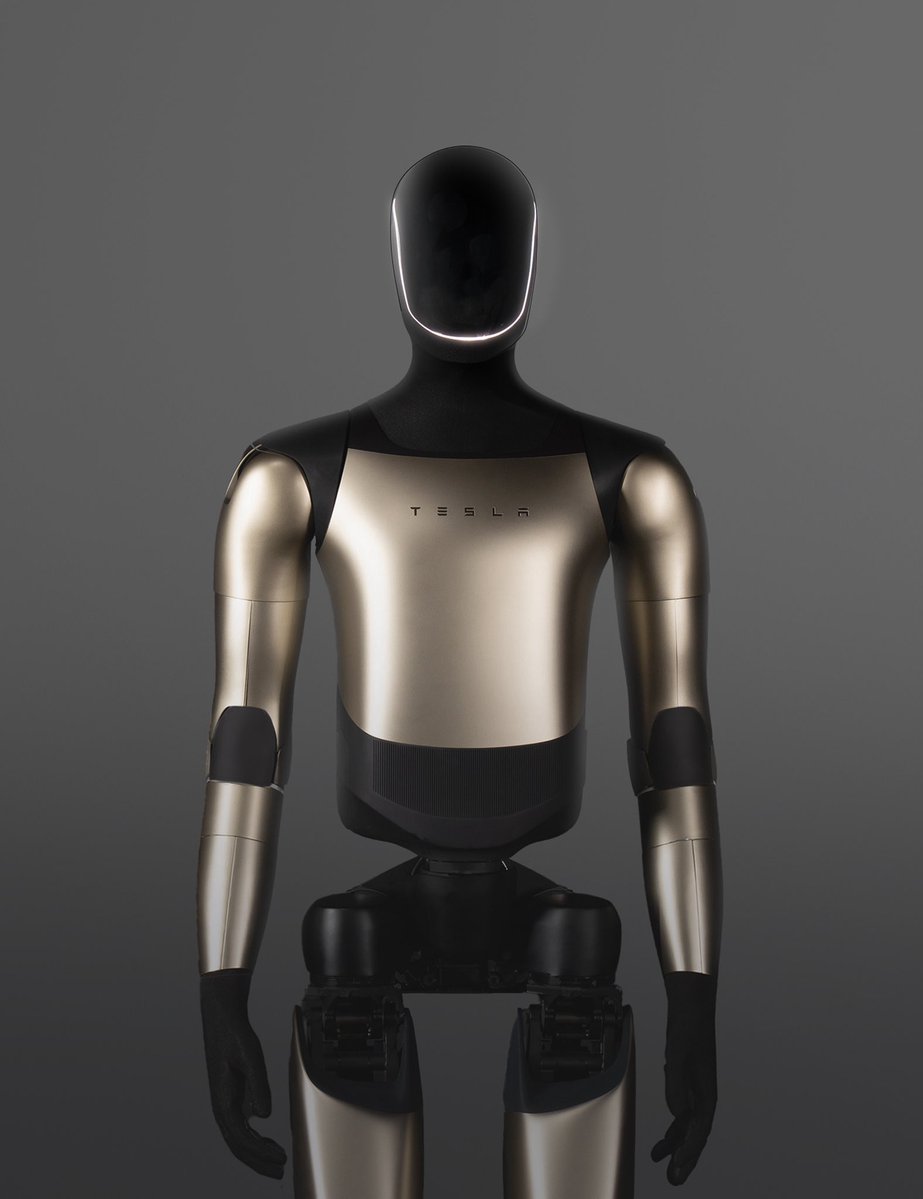
🔍 Tesla China briefly published — then quietly deleted — photos of a "Golden Optimus" robot on social media, including a close-up of its next-generation hands featuring 22 degrees of freedom (DoF). The rapid deletion suggests the images may have been posted prematurely, hinting at an unannounced milestone in Optimus's dexterity development. The upgraded 22-DoF hands represent a significant leap over earlier prototypes and would give Optimus far more human-like manipulation capabilities — a critical requirement for real-world physical AGI tasks Musk has described. The fleeting post was spotted and archived by @TeslaNewswire before removal.
@TeslaNewswire · Mar 11, 2026
"Tesla China posted two photos of the Golden Optimus with a close-up of its next-gen 22-DoF hands on social media, but deleted them shortly after."
The News: Elon Musk stated on X that Tesla will achieve AGI and is likely to be the first company to realize it in humanoid, 'atom-shaping' physical form through the Optimus robot.
Why It Matters: This reframes Optimus from a factory automation tool into Tesla's most ambitious long-term bet — a self-learning, physically capable AGI that could reshape manufacturing, labor, and Tesla's valuation.

Two Types of Intelligence — and Why the Physical One Is Bigger
Musk's statement draws a sharp line between two categories of AI work. The first is digital intelligence — AI that manipulates information, writes code, drafts documents, and handles white-collar cognitive tasks. This is the domain of large language models and tools like Grok. The second, and in Musk's view the more consequential, is physical intelligence — AI that can manipulate atoms, not just bits.
That second category is where Optimus lives. And according to Musk, Tesla is positioned to be the first company to deliver AGI in that form. His exact words on X: 'Tesla will be one of the companies to make AGI and probably the first to make it in humanoid/atom-shaping form.'
The distinction matters because physical AGI doesn't just answer questions — it builds things, assembles components, operates machinery, and potentially replicates itself. Musk has previously described Optimus as a potential 'von Neumann probe,' a machine theoretically capable of self-replication using available planetary resources. That's a long-range vision, but it signals how seriously Tesla is treating this program.
📊 Key Figures
| Metric | Value | Context |
|---|---|---|
| Target production cost | $20,000–$30,000 | At mass production scale |
| Annual production target | 1,000,000 units | Initial target, Fremont pilot line |
| Public sale target | End of 2027 | Consumer availability |
| Optimus Gen 3 debut | Q1 2026 | Production-ready design |
| Gen 3 height / weight | 173 cm / 57 kg | 5'8", 125 lbs |
| Hand degrees of freedom | 22 DOF | Tendon-driven system |
Where Optimus Stands Right Now
This isn't a concept announcement. Optimus has been deployed inside Tesla factories since 2024, performing tasks like sorting batteries and moving components. Those are modest jobs by design — the point is supervised learning at scale, accumulating real-world training data that no simulation can replicate.
Optimus Gen 3, which debuted in Q1 2026, marks the transition from demonstrative hardware to a unit built for actual production work. The specs reflect that shift: at 173 cm and 57 kg, with 22 degrees of freedom in its hands using a tendon-driven system, it's engineered for dexterity in constrained factory environments. According to Tesla's roadmap, more complex task capabilities are expected by the end of 2026.
To scale production, Tesla is converting its Model S and Model X lines at the Fremont facility into a dedicated Optimus pilot line — a significant capital commitment that signals this program is no longer speculative. The initial annual production target is 1 million units, with a manufacturing cost of $20,000–$30,000 per unit at scale.
🔭 The BASENOR Take
Timeline: Factory deployment ongoing (2024–present) → Gen 3 production (Q1 2026) → Complex task capability (end of 2026) → Consumer sales (end of 2027)
Impact Level: 🔴 High — This redefines Tesla's long-term business model beyond vehicles
Confidence Rating: Medium-High — Hardware milestones are confirmed; AGI timeline is Musk's stated belief, not a technical guarantee
For Tesla owners, the immediate implication is indirect but real. Every Optimus unit working inside a Tesla factory is, in theory, compressing labor costs and accelerating production throughput. If that plays out at scale, it feeds directly into Tesla's ability to lower vehicle prices — the same dynamic Musk used to justify the long-term investment in vertical manufacturing.
The AGI framing is bolder and harder to evaluate on a short timeline. What Musk is describing — a machine that can reason, learn, and physically act on that reasoning across arbitrary tasks — is the robotics industry's hardest unsolved problem. Tesla's advantage, if it has one, is the same data flywheel that powers FSD: millions of hours of real-world operational data feeding back into model training. No lab-based competitor has that at scale.
The 'atom-shaping' framing is also a deliberate contrast to the current AI race. While every major tech company is competing on digital intelligence — faster inference, cheaper tokens, better reasoning benchmarks — Musk is arguing that the decisive frontier is physical. A robot that can build a factory, assemble a car, or wire a house is economically more transformative than one that can write better emails. Whether Optimus gets there first is an open question. That Tesla is seriously trying is no longer in doubt.
🤖 Tracking Tesla's humanoid robot? See every Optimus production milestone and appearance in our Tesla Optimus Tracker.
Related Gear
Gear up your Tesla with tested, custom-fit BASENOR accessories — shop Tesla accessories →
Sources & reporting notes
The links below identify the material source records used for this report.
- @TeslaNewswire on X (2026-03-04T15:58:02.000Z) — Direct source
- @TeslaNewswire on X (2026-03-11T05:49:28.000Z) — Direct source
Source links are preserved as published or accessed. See our editorial standards and corrections policy.
The BASENOR Editorial Desk covers Tesla, SpaceX, and related technology, curating reporting from primary sources — official accounts, regulatory filings, and software release data. Every article passes source-record and fact-checking review before publication. About the newsroom.
This report was curated by the BASENOR Editorial Desk from the sources listed above. Read our editorial standards or email editorial@basenor.com to report an error.