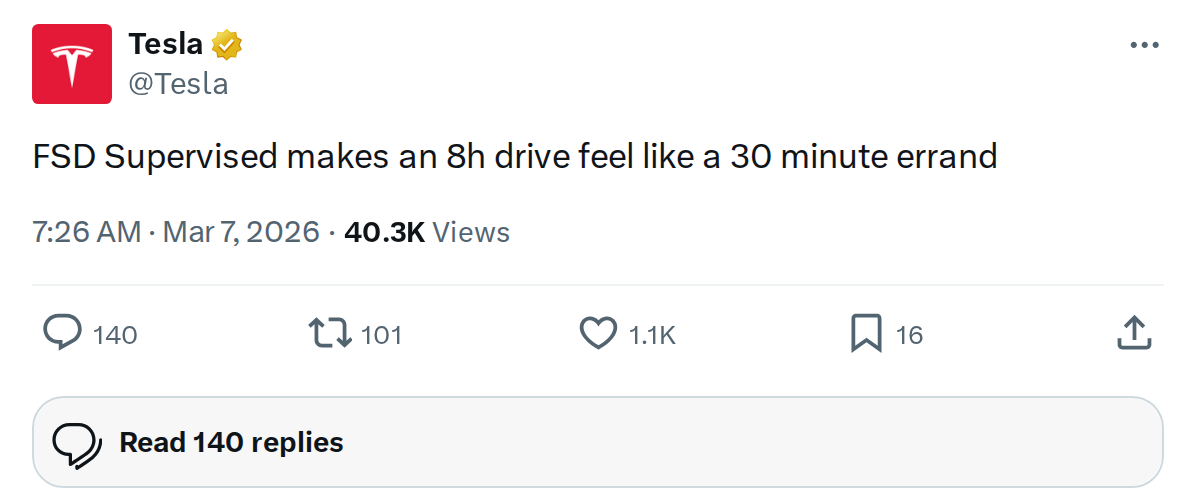
The News: Tesla's official account says FSD Supervised makes an 8-hour drive feel like a 30-minute errand — a direct signal that long-distance capability is now a headline use case for the system.
Why It Matters: For Tesla owners planning road trips or frequent long-haul drives, FSD Supervised is increasingly positioned as a fatigue-reduction tool, not just a city-driving feature.
Source: @Tesla on X
If you've ever white-knuckled a 500-mile interstate drive, Tesla's latest message is aimed squarely at you. The company's official account just made one of its boldest statements yet about FSD Supervised and long-distance driving — and it's worth unpacking what that actually means for owners on the road today.

What Tesla Is Actually Claiming
The tweet is short, but the implication is significant. Tesla isn't just saying FSD Supervised handles highways — it's saying the system fundamentally changes the experience of long drives. An 8-hour journey reduced to the mental effort of a quick errand. That's a fatigue and stress argument, not just a convenience one.
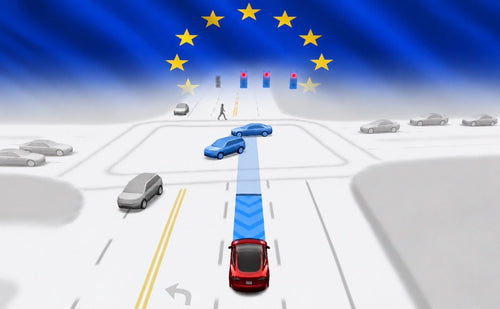
It's worth being precise about what FSD Supervised is and isn't. As a Level 2 advanced driver-assistance system (ADAS), it requires your continuous attention and active supervision at all times. The vehicle does not drive itself. What it does do — and increasingly well — is handle the repetitive, physically demanding tasks: maintaining speed, steering through curves, executing lane changes, navigating highway interchanges, and managing following distance in traffic. Those are exactly the tasks that accumulate fatigue over an 8-hour drive.
📊 What FSD Supervised Does on a Long Drive
| Driving Task | Without FSD | With FSD Supervised |
|---|---|---|
| Highway lane keeping | Constant manual input | Handled automatically |
| Lane changes | Manual, requires mirror checks | Automatic with 360° camera coverage |
| Speed management in traffic | Manual throttle/brake adjustments | Adaptive, handled by system |
| Highway interchanges | Full driver attention required | Navigated via route guidance |
| Arrival options | Manual parking search | Curbside, parking lot, or driveway (v14.1.3+) |
| Driver fatigue over 8 hours | High — cumulative physical and cognitive load | Significantly reduced — supervisory role only |
🚦 Owner's Action Plan
Verdict: Recommended for all FSD subscribers planning long drives
Step 1 — Confirm your FSD version before your next road trip. Tap Controls → Software to check your current version. Features like the "Mad Max" speed profile and updated arrival options were introduced in v14.1.3 (October 2025). If you're behind, check for pending updates.
Step 2 — Set your speed profile to match your driving style. FSD Supervised now offers multiple speed profiles. "Chill" and "Average" suit relaxed highway cruising. "Hurry" increases pace and lane-change aggression. The newer "Mad Max" profile (v14.1.3+) allows higher speeds and more assertive maneuvers — useful on open interstates, but review it before a first use.
Step 3 — Use Navigate on Autopilot for the full long-drive experience. Before departure, enter your destination in the navigation app. This enables end-to-end route management including Supercharger stops, highway transitions, and on-ramp/off-ramp handling. FSD Supervised works best when it has a full route to work with.
Step 4 — Configure arrival preferences. In your FSD settings, select your preferred arrival behavior — curbside drop-off, parking lot, or driveway approach. This removes one more decision point at the end of a long drive.
Step 5 — Stay engaged. This is non-negotiable. FSD Supervised requires active driver supervision at all times. The system will prompt you to apply torque to the wheel periodically. Ignoring these prompts will disable the feature. The fatigue reduction comes from reduced physical input — not from checking out.
Known Considerations
A few things worth knowing before your next long haul:
- Weather and road conditions affect performance. Heavy rain, snow, faded lane markings, and construction zones can cause FSD to disengage or request driver takeover. Always be ready to take control.
- FSD Supervised is a subscription or purchase. If you don't currently have access, check the Tesla app under Upgrades to see current pricing for your vehicle.
- Not all vehicles support all features. Some advanced FSD capabilities require Hardware 3 or Hardware 4. Your vehicle's capability tier is listed under Controls → Autopilot.
📰 Deep Dive
Tesla's framing here is deliberate. Saying an 8-hour drive "feels like a 30-minute errand" isn't a technical specification — it's an experiential claim. It targets the single biggest barrier to long-distance EV adoption that isn't about charging: driver fatigue. Range anxiety has largely been addressed by the Supercharger network. The next frontier is mental load, and that's exactly what FSD Supervised is designed to reduce.
The progression of FSD's long-distance capability has been notable. Earlier versions required frequent interventions on highways and struggled with complex interchanges. Recent versions — particularly the v13 and v14 generations — have significantly reduced disengagement rates on interstates. The addition of configurable speed profiles, including the "Mad Max" option in v14.1.3, signals that Tesla is now tuning FSD not just for safety margins but for driver preference and trip efficiency. That's a meaningful shift in product philosophy.
For owners who already subscribe to FSD, the message is: use it on your next long drive. The system has matured enough that Tesla is comfortable making headline-level claims about 8-hour journeys. For owners who haven't tried it since early versions, the current experience is substantially different. The gap between what FSD Supervised could do two years ago and what it does today on a highway is significant — and worth re-evaluating. For our full coverage of FSD and self-driving developments, see our FSD coverage.
📋 Tracking Tesla software? See every firmware, FSD and app version in one place in our Tesla Software Update Tracker.
Related Gear
Gear up your Tesla with tested, custom-fit BASENOR accessories — shop Tesla accessories →
Sources & reporting notes
The links below identify the material source records used for this report.
- @Tesla on X (2026-03-06T23:26:28.000Z) — Direct source
Source links are preserved as published or accessed. See our editorial standards and corrections policy.
The BASENOR Editorial Desk covers Tesla, SpaceX, and related technology, curating reporting from primary sources — official accounts, regulatory filings, and software release data. Every article passes source-record and fact-checking review before publication. About the newsroom.
This report was curated by the BASENOR Editorial Desk from the sources listed above. Read our editorial standards or email editorial@basenor.com to report an error.