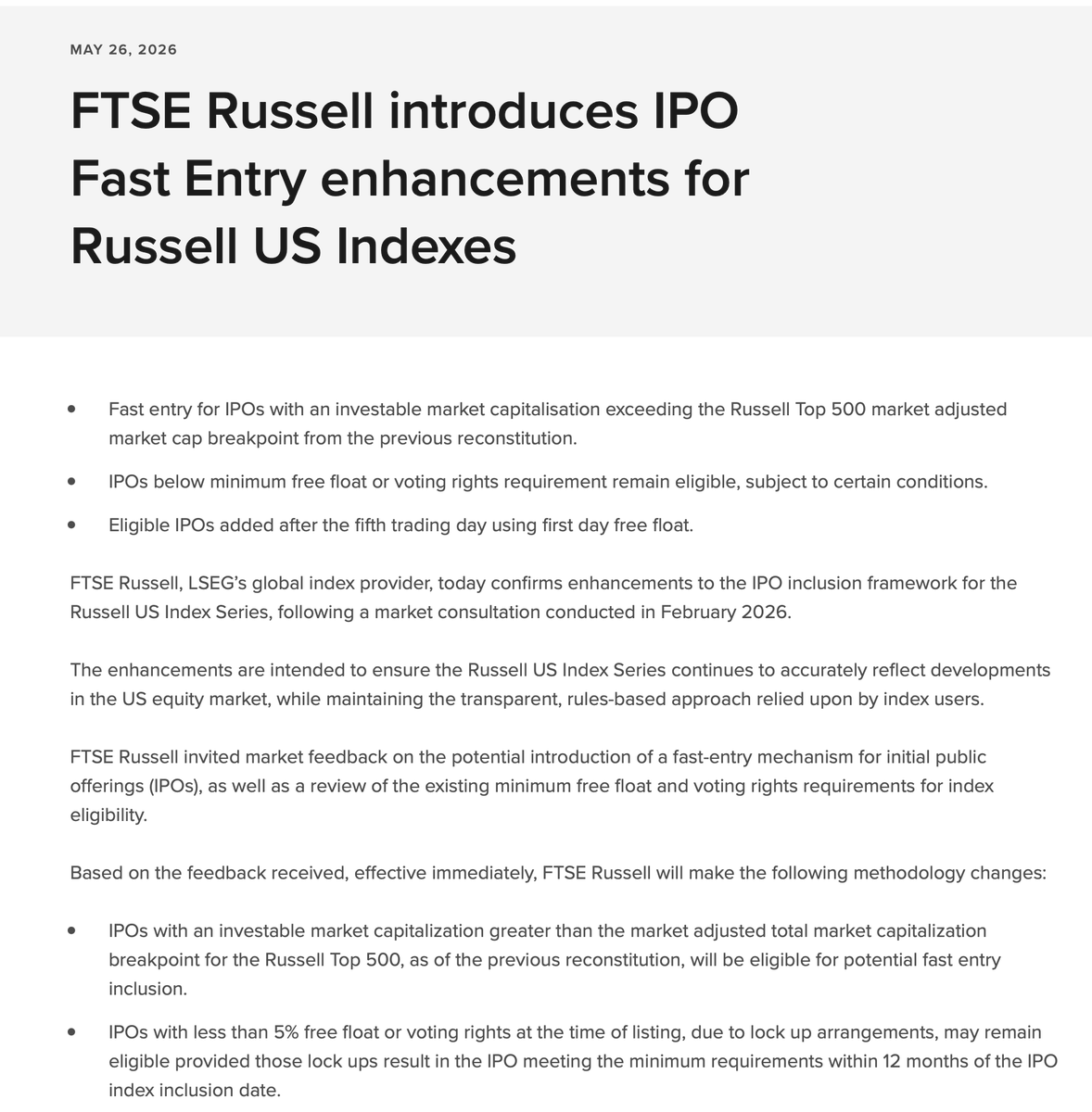
FTSE Russell has officially approved a new 'Fast Entry' rule that could fast-track SpaceX — and any other mega-cap IPO — into major Russell indexes within just five trading days of going public. The change is a significant structural shift from the previous system, where newly listed companies had to wait for quarterly index reviews before being considered for inclusion.

What the Rule Actually Changes
Under the old framework, even the largest IPOs had to sit on the sidelines until FTSE Russell's scheduled quarterly reconstitution dates. That meant index funds tracking the Russell 1000 or Russell Top 200 couldn't hold shares in a newly public company for months — regardless of how large it was on day one.
The new Fast Entry mechanism flips that logic. Any IPO with an investable market capitalization large enough to qualify for the Russell Top 500 becomes eligible for inclusion after just the fifth trading day post-listing. According to FTSE Russell, the market-adjusted breakpoint for Russell Top 500 inclusion currently sits at $17.5 billion, with a separate FTSE Global Equity Index Series (GEIS) fast-entry threshold set at $13.5 billion. At the June 2025 reconstitution, the Russell Top 500 breakpoint was $14.1 billion.
Arne Noack, Head of Americas Equity and Multi-Asset Indexes at FTSE Russell, stated that the mechanism allows the index to more promptly reflect significant market developments — an acknowledgment that the old quarterly cadence was increasingly out of step with how fast capital markets move.
FTSE Russell is also reportedly considering relaxing the minimum 5% free float and minimum 5% public voting rights requirements for sizable IPOs, which would further reduce friction for non-traditional listing structures.
Why SpaceX Is the Obvious Candidate
The timing of this rule change is hard to separate from SpaceX's anticipated IPO. SpaceX is estimated to carry an investable market capitalization of approximately $70 billion — more than four times the Russell Top 500 breakpoint and roughly five times the FTSE GEIS fast-entry threshold. By any measure, SpaceX would qualify for immediate fast-track consideration.
According to reporting, SpaceX is targeting a roadshow launch as early as June 4, with a share sale by June 11 and a potential listing date of June 12. If that timeline holds, the Fast Entry rule — approved just days before — would apply from the moment SpaceX begins trading.
The indexes SpaceX is expected to enter include the Russell Top 50, Russell Top 200, and Russell 1000, as well as FTSE GEIS' Global All Series, FTSE All-World, FTSE World Index, and FTSE Global Total Cap. That's a broad sweep of passive investment vehicles, meaning index funds tracking any of those benchmarks would be compelled to buy SpaceX shares within days of the IPO — creating substantial and near-immediate institutional demand.

What It Means for the IPO
Index inclusion has historically been one of the most reliable demand catalysts for large-cap stocks. When a company enters a major index, every passive fund tracking that benchmark must purchase shares proportional to the company's weight — regardless of price. For a company the size of SpaceX, that forced buying could represent tens of billions of dollars in inflows compressed into a very short window.
Under the old rules, that wave of passive demand would have been delayed by months. The Fast Entry rule effectively pulls it forward to the first week of trading, which could meaningfully support the IPO price and reduce post-listing volatility — or amplify it, depending on how supply and demand balance out in those first five days.
It's worth noting that FTSE Russell's assessment of SpaceX's eligibility is based on the current S-1 filing and publicly available information, and remains subject to reassessment with subsequent filings. The rule change is confirmed; SpaceX's actual inclusion would still depend on the final structure of its listing.
Whether SpaceX's IPO lands on schedule or slips, the Fast Entry rule itself is now permanent infrastructure — and it will apply to every mega-cap IPO that follows. The index industry just quietly rewired how it handles the biggest listings in the market.

Sarah focuses on Tesla Energy, SpaceX missions, and the broader Musk AI portfolio. Former data analyst in clean energy. Based in San Francisco.
Sources verified at publish time. Spotted an inaccuracy? Email editorial@basenor.com.