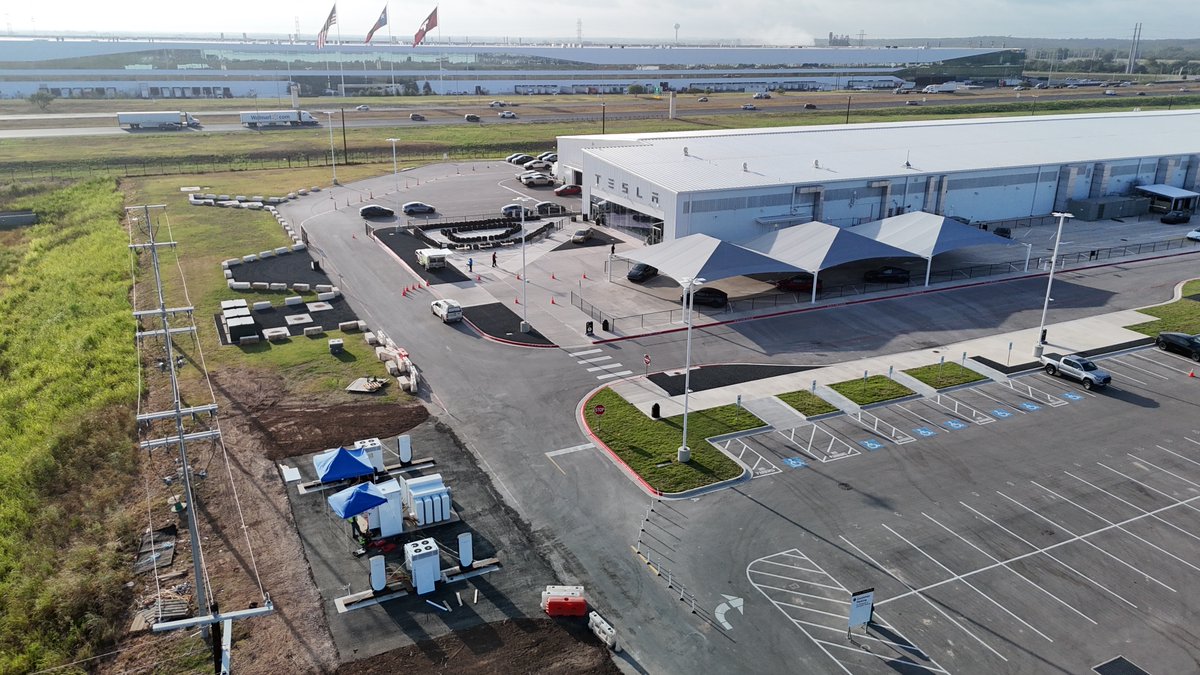
Tesla's Gigafactory Texas has quietly but meaningfully upgraded its on-site charging infrastructure, going from a single legacy Megacharger to a row of four units capable of delivering up to 1.2 MW each. The timing lines up with accelerating Semi production at the facility — and aerial observer Joe Tegtmeyer spotted something else on the same visit that adds another layer to the story.

From One Unit to Four
The original Megacharger at Giga Texas was a single, older-generation unit — functional, but clearly not built to support a growing commercial fleet. The new installation, positioned in the area where Tesla's Semi fleet stages before departure, now comprises a full row of four Megachargers running the current Megawatt Charging System (MCS) standard.
The practical difference is substantial. Each unit delivers up to 1.2 MW through liquid-cooled cables, enough to restore roughly 60–70% of a Semi's range in around 30 minutes, according to Tesla's published specifications. With four bays operating simultaneously, Giga Texas can now turn around multiple trucks in a single charging window — a prerequisite for running a logistics operation at any real scale.
A Refreshed Semi in the Background
Tegtmeyer's flyover caught more than just charging hardware. He also spotted what appears to be a refreshed Tesla Semi undergoing testing at the facility's crash test area. He stopped short of confirming specifics — the tweet trails off mid-sentence — but the presence of a next-iteration Semi alongside expanded charging infrastructure suggests these two developments are connected rather than coincidental.
Tesla has been quietly iterating on the Semi since commercial deliveries began. A refreshed variant entering crash testing would be a normal step in the certification pipeline before any production or delivery changes, so this sighting fits the pattern of a program that's maturing rather than stalling.
The Broader Megacharger Buildout
The Giga Texas expansion doesn't exist in isolation. As of early 2026, Texas had the highest concentration of planned Megacharger sites in the US — 19 locations identified as of February and March — according to Tesla's network planning data. That density makes sense: Texas is both a major logistics corridor and home to Tesla's primary Semi production hub.
The Megacharger network is the Semi's equivalent of the Supercharger network for passenger cars — without it, commercial operators can't commit to routes. Every new site, including internal factory installations like this one, adds to the operational case that Tesla is building for fleet customers evaluating the Semi against diesel alternatives.
What It Signals
Factory-level infrastructure investments tend to precede production ramp-ups, not follow them. Tesla doesn't install four Megachargers at a staging area because current volume demands it — they install them because anticipated volume will. Combined with a refreshed Semi in crash testing, the picture at Giga Texas right now looks less like steady-state operations and more like preparation for a step change in Semi output and deployment.
How quickly that step change materializes is the open question. But the hardware is getting ahead of the headlines, which is usually how Tesla operates when something significant is approaching.
Related Gear
Gear up your Tesla with tested, custom-fit BASENOR accessories — shop Tesla accessories →
Sources & reporting notes
The links below identify the material source records used for this report.
- @JoeTegtmeyer on X (2026-07-29T20:58:19.000Z) — Direct source
Source links are preserved as published or accessed. See our editorial standards and corrections policy.
The BASENOR Editorial Desk covers Tesla, SpaceX, and related technology, curating reporting from primary sources — official accounts, regulatory filings, and software release data. Every article passes source-record and fact-checking review before publication. About the newsroom.
This report was curated by the BASENOR Editorial Desk from the sources listed above. Read our editorial standards or email editorial@basenor.com to report an error.