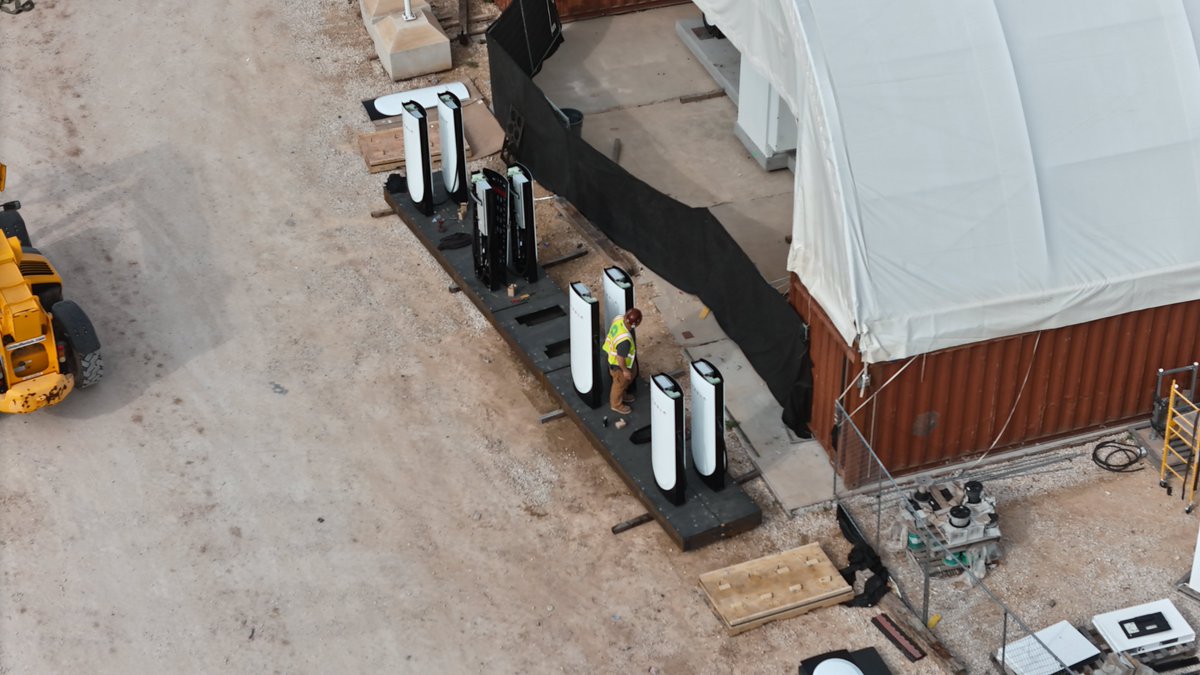
Tesla's Supercharger expansion is getting a major manufacturing upgrade — and Giga Texas is at the center of it. Aerial observer Joe Tegtmeyer confirmed this week that the Tesla Energy Supercharger workshop on the southwest corner of the Austin campus has been running at full tilt for roughly six months, now actively assembling the new 'Folding Unit' versions of V4 Superchargers on innovative steel bases.

What the Folding Unit Actually Is
The Folding Unit (FU) Supercharger is Tesla's most significant rethink of how charging stations are built and shipped. Rather than assembling components on-site, each unit arrives largely pre-built around V4 Supercharger cabinets — the same hardware capable of delivering up to 500 kW per stall for passenger vehicles like the Cybertruck, and up to 1.2 MW for the Tesla Semi.
Each Folding Unit contains eight charging posts. The foldable steel base design is the key logistics breakthrough: two complete units — 16 posts total — can now be loaded onto a single truck. That's a 33% improvement over the previous maximum of 12 posts per shipment, which meaningfully reduces the number of deliveries needed to stand up a new site.
Tesla's Senior Director of Charging, Max de Zegher, has confirmed the headline numbers publicly: the FU design saves 20% or more on installation costs by cutting civil work, electrical complexity, and logistics overhead. Deployment speed doubles compared to conventional methods. The current production version is designated Rev1, with Rev3 improvements planned for Q2 2026.
Why Giga Texas Makes Sense as the Assembly Hub
The division of labor between Tesla's factories is deliberate. Gigafactory New York pivoted entirely to V4 Supercharger cabinet production in March 2026, focusing on the core charging hardware. Giga Texas takes those cabinets and integrates them into complete Folding Unit assemblies — the steel bases, cabling, and structural components that make the units deployable as a single pre-built package.
Six months of continuous operation at the Giga Texas workshop suggests this isn't a pilot program anymore. The volume being produced there aligns with Tesla's broader push to accelerate Supercharger network expansion after a turbulent 2024 that saw significant layoffs in the charging team. Early pilot installations are already live — an 8-stall site in Columbia, South Carolina, and locations in Tilburg, Netherlands, have received FU Superchargers.
What This Means for the Network
For Tesla owners, the practical upshot is straightforward: more Supercharger locations, built faster, at lower cost per site. The 2x deployment speed advantage compounds quickly across hundreds of planned installations. A network that previously took weeks of civil and electrical work per location can now be stood up in roughly half the time, which matters most in underserved corridors where charging gaps still exist.
The Rev3 upgrade cycle planned for later this quarter suggests Tesla is still optimizing the design — likely targeting further reductions in on-site labor and potentially higher power configurations. The Giga Texas workshop running 'all kinds' of units in parallel, as Tegtmeyer noted, indicates Tesla is building institutional manufacturing knowledge around this format rather than treating it as a one-off product.
For a company that built its charging network advantage through vertical integration, manufacturing the Folding Units in-house at Giga Texas is a natural extension of that philosophy — and a signal that the Supercharger buildout is accelerating again.
Related Gear
Gear up your Tesla with tested, custom-fit BASENOR accessories — shop Tesla accessories →
Sources & reporting notes
The links below identify the material source records used for this report.
- @JoeTegtmeyer on X (2026-05-08T17:21:09.000Z) — Direct source
Source links are preserved as published or accessed. See our editorial standards and corrections policy.
The BASENOR Editorial Desk covers Tesla, SpaceX, and related technology, curating reporting from primary sources — official accounts, regulatory filings, and software release data. Every article passes source-record and fact-checking review before publication. About the newsroom.
This report was curated by the BASENOR Editorial Desk from the sources listed above. Read our editorial standards or email editorial@basenor.com to report an error.