📌 UPDATE — July 17, 2026
Elon Musk has narrowed in on coding as a standout use case for Grok's value proposition, stating directly that "Grok has the best value for coding." This adds a more specific dimension to the broader token-efficiency claims covered in this article — developers and programmers may find Grok's cost-per-output particularly compelling compared to rival frontier models. Musk's tweet linked to supporting data, reinforcing the claim beyond a simple assertion. If you're evaluating AI tools for software development workflows, this positions Grok as a top contender worth benchmarking against alternatives like Claude and GPT-4o.

Elon Musk weighed in on Grok's competitive position this week, telling followers that xAI's token efficiency now leads every major frontier model — and that the team sees significant room to push it further. With Grok 4.5 just days old, the claim invites scrutiny. Here's what we know, broken down into the questions that actually matter.

What exactly did Musk claim?
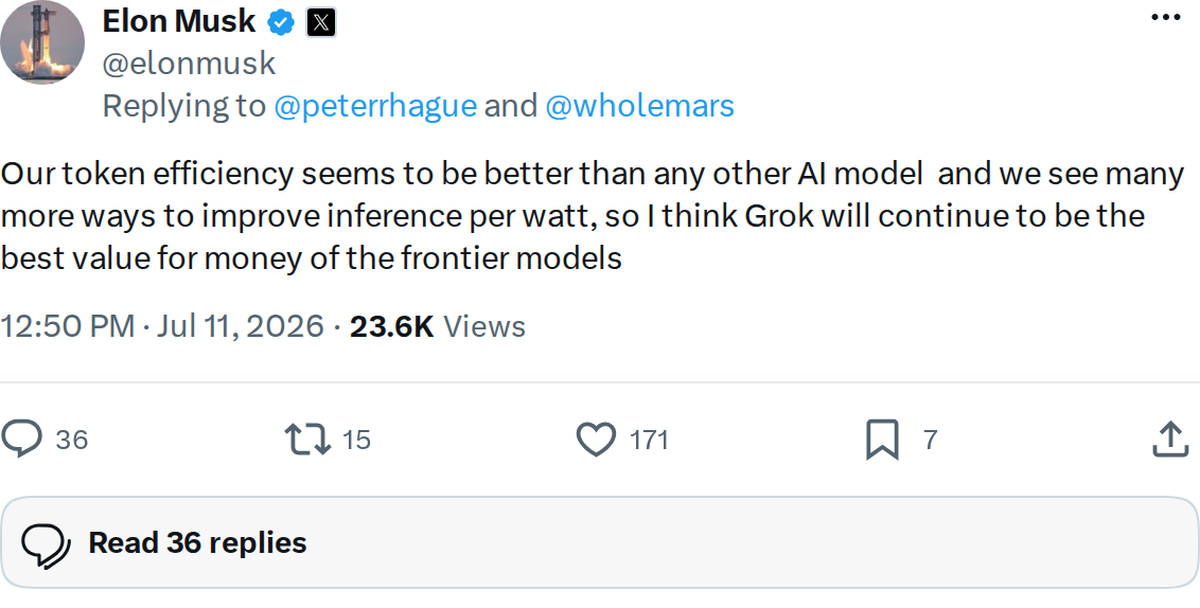
In a reply on X, Musk stated that Grok's token efficiency "seems to be better than any other AI model" and that xAI sees "many more ways to improve inference per watt." His conclusion: Grok will continue to be the best value for money among frontier models. The comment was directed at a conversation about AI model economics — not a formal product announcement — but it aligns with positioning xAI has been building since Grok 4.5 launched on July 8, 2026.
What does token efficiency actually mean in practice?
Token efficiency refers to how many output tokens a model consumes to complete a given task. A more token-efficient model solves the same problem in fewer steps, which directly reduces cost and latency for anyone using the API. According to xAI, Grok 4.5 achieves roughly twice the token efficiency of comparable leading models. On the SWE Bench Pro coding benchmark, Grok 4.5 resolved tasks using an average of 15,954 output tokens — approximately 4.2 times fewer than a competing top-tier model that required 67,020 tokens for the same tasks. Fewer tokens consumed means a smaller bill and faster responses, which compounds quickly at scale.
How does the pricing stack up against competitors?
The API pricing for Grok 4.5 is $2 per million input tokens and $6 per million output tokens, according to xAI's official pricing. For context, Anthropic's comparable flagship is priced at $5 per million input tokens and $25 per million output tokens. On per-task benchmarks, Grok 4.5 has been estimated at $2.49 per coding task versus $5.07 for a competing OpenAI model in a similar agentic coding setup. The combination of lower per-token pricing and higher token efficiency creates a compounding cost advantage for high-volume users.
What is Grok 4.5, and how capable is it?
Grok 4.5 launched on July 8, 2026, built on a 1.5 trillion-parameter V9 foundation model with a 500,000-token context window. It runs at 80 tokens per second. Musk has described it as "Opus-class, but faster, more token-efficient and lower cost" — positioning it as roughly comparable in intelligence to top-tier competing models, but with a structural cost and speed advantage. xAI's stated goal is the highest intelligence per unit of time and cost, making token efficiency a core design priority rather than a secondary metric.
What does "inference per watt" mean, and why is Musk talking about it?
Inference per watt measures how much useful computation a model delivers for each unit of energy consumed in the data center. It matters for two reasons: operational cost (electricity is a major expense at AI scale) and sustainability. Musk's comment that xAI sees "many more ways to improve inference per watt" signals that the efficiency gains visible in Grok 4.5's token counts are partly a hardware and infrastructure story, not just a model architecture story. As xAI scales its Memphis data center and Colossus supercomputer cluster, improvements in inference efficiency translate directly into lower costs that can be passed to API customers.
Should developers and power users take this seriously?
The numbers behind the claim are specific enough to warrant attention. A 4.2x token reduction on a standard coding benchmark is a meaningful operational difference, not a rounding error. At $2.49 versus $5.07 per coding task, a team running thousands of agentic coding jobs daily would see real budget impact. The caveat is that benchmark performance doesn't always translate uniformly across every use case — developers should run their own workloads against the API before drawing conclusions. But the pricing floor is objectively lower, and if the token efficiency holds across diverse tasks, the value proposition Musk described is grounded in something real.
Whether xAI can sustain this lead is the open question. Frontier AI is moving fast, and every major lab is working on inference optimization. For now, the combination of Grok 4.5's architecture, xAI's infrastructure investments, and its API pricing gives the model a credible claim to the efficiency-per-dollar position — and Musk's comment suggests the team believes the gap will widen, not close.
Sources & reporting notes
The links below identify the material source records used for this report.
- @elonmusk on X (2026-07-11T12:50:30.000Z) — Direct source
Source links are preserved as published or accessed. See our editorial standards and corrections policy.
The BASENOR Editorial Desk covers Tesla, SpaceX, and related technology, curating reporting from primary sources — official accounts, regulatory filings, and software release data. Every article passes source-record and fact-checking review before publication. About the newsroom.
This report was curated by the BASENOR Editorial Desk from the sources listed above. Read our editorial standards or email editorial@basenor.com to report an error.