📌 UPDATE — June 10, 2026
New details from NASA's Jeremy Parsons, reported by Eric Berger (@SciGuySpace), shed fresh light on Artemis III's lander architecture. Notably, NASA has clarified that the Artemis III crew will not enter Starship directly for the lunar descent — a significant operational detail not previously confirmed publicly. Additionally, Parsons addressed Blue Origin's role, explaining why the Blue Moon Mk1 does not need to fly first as a precursor before Starship's crewed landing attempt, and provided more context around Blue Origin's so-called "test" lander and its place in the broader mission sequence. 🔍 These clarifications suggest the crew transfer and descent architecture may differ from earlier public assumptions about how astronauts would board and ride Starship to the lunar surface.

📌 UPDATE — June 9, 2026
NASA has officially confirmed a risk-reduction-first stance on the Starship Human Landing System lunar mission timeline. Ars Technica's Eric Berger quoted a statement making clear that the uncrewed Starship HLS demonstration flight will not launch until all outlined test objectives are met to sufficiently lower risk ahead of an actual Moon landing. This signals that no fixed launch date will be committed to until SpaceX and NASA are satisfied that prerequisite milestones have been achieved. The statement underscores that mission sequencing for Artemis III remains firmly gated on Starship's iterative flight test progress, with safety and risk reduction driving the schedule rather than calendar targets.
"We're not going to launch this mission until we feel like the objectives that are outlined are sufficient to bring down the risk for a follow-on landing to the Moon itself." — via @SciGuySpace (Eric Berger), June 9, 2026

The roadmap for returning humans to the Moon just got a clearer shape. At a recent industry event, NASA's Jeremy Parsons and SpaceX's Jessica Jensen outlined the updated mission profiles for Artemis III and Artemis IV — and Starship's role looks notably different depending on which flight you're watching.
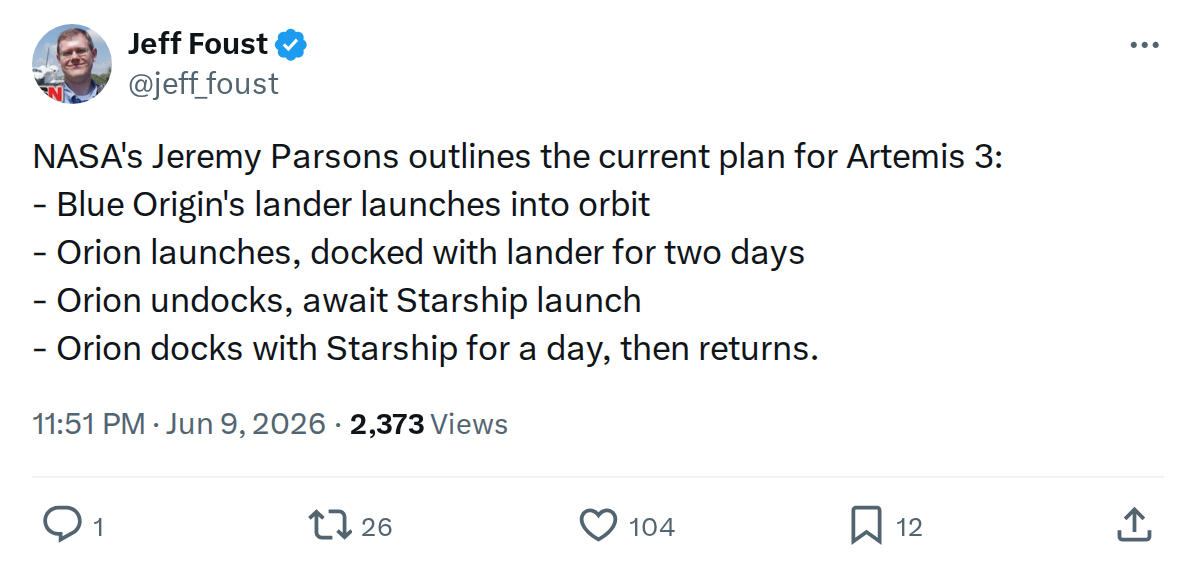
For Artemis III, according to background research, the mission has been re-scoped as a crewed orbital test rather than a lunar landing. NASA's Parsons described a multi-step sequence: Blue Origin's lander launches first and enters orbit, Orion launches and docks with it for roughly two days, Orion then undocks and waits, Starship launches separately, and finally Orion docks with Starship for about a day before returning to Earth. It's a choreography-heavy profile designed to validate rendezvous and docking operations with two different commercial landers in the same mission.

Artemis IV is where Starship's role takes a more ambitious turn. SpaceX's Jessica Jensen confirmed that the revised Starship HLS plan for that mission involves a Starship-Orion docking in low Earth orbit — not lunar orbit — with Starship then performing the trans-lunar injection (TLI) burn to carry the crew to low lunar orbit. That's a significant architectural shift: rather than Starship waiting in lunar orbit for Orion to arrive, the two vehicles link up in LEO and travel to the Moon together.

The two-mission picture that's emerging is one of deliberate risk reduction. Artemis III stress-tests the docking procedures and multi-vehicle coordination in Earth orbit before anyone commits to a lunar surface attempt. Artemis IV then takes the lessons learned and applies them to a full lunar mission with Starship doing the heavy lifting — literally — via the TLI burn. Whether the timeline holds for a mission NASA has targeted for the mid-to-late 2020s remains the bigger open question, but the technical architecture is coming into sharper focus. For more on SpaceX's broader launch program, see our SpaceX coverage.

Sarah focuses on Tesla Energy, SpaceX missions, and the broader Musk AI portfolio. Former data analyst in clean energy. Based in San Francisco.
Sources verified at publish time. Spotted an inaccuracy? Email editorial@basenor.com.