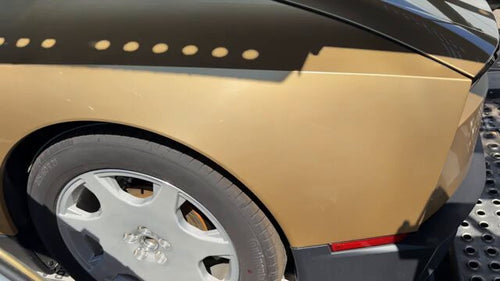
The News: A mirrorless Tesla Cybercab prototype has been spotted testing on public roads in Austin, Texas — again.
Why It Matters: With production reportedly set to begin at Gigafactory Texas in April 2026, these continued test sightings confirm the Cybercab is deep in real-world validation ahead of its commercial launch.
Source: @TeslaNewswire on X

The Cybercab Is Back on Austin Streets — Without Mirrors
Tesla's Cybercab prototype is making the rounds in Austin again, and the detail that keeps turning heads is the same one that's been there from the start: no side mirrors. This isn't a prototype oversight — it's a deliberate design choice that signals exactly how Tesla intends this vehicle to operate.
The Cybercab is built from the ground up for full autonomy. No steering wheel. No pedals. No mirrors. In their place: a suite of cameras, including dual windshield-mounted units, B-pillar cameras, a front bumper camera, and a rear-facing camera — all feeding into Tesla's Hardware 5 / AI 5 compute platform. The mirrors aren't missing. They were never part of the plan.

📊 Key Figures
| Spec | Detail |
|---|---|
| Starting Price | Under $30,000 |
| Seating | 2 passengers |
| Production Start | April 2026 (Gigafactory Texas) |
| Consumer Availability | Before end of 2026 (per Elon Musk) |
| Compute Platform | Hardware 5 / AI 5 |
| Charging | Inductive (wireless) |
| Structural Parts | ~80 (vs significantly more on Model Y) |
| Interior Screen | 20.5-inch central display |
Why Austin? Why Now?
Austin isn't a random test location. Gigafactory Texas — where the Cybercab is slated to enter production — is right there. Testing the vehicle on local roads makes logistical sense: engineering teams can iterate quickly, pull vehicles back to the factory for adjustments, and observe real-world performance in the same environment where the cars will be built.
The fact that these sightings are recurring also matters. Early prototype testing is typically tightly controlled and infrequent. Repeated public sightings suggest Tesla has moved into a more intensive validation phase — the kind of high-mileage, varied-condition testing that precedes a production launch. With April 2026 as the reported production start date, the timing lines up.
🔭 The BASENOR Take
Timeline: Production reportedly begins April 2026 at Gigafactory Texas. Consumer availability expected before end of 2026.
Impact Level: 🔴 High — This is Tesla's most consequential new product launch since the Model Y.
Confidence: Medium-High — Production timeline is based on Tesla's stated plans; real-world validation testing is confirmed by multiple sightings.
For Current Tesla Owners: The Cybercab doesn't replace your existing vehicle — it's a new category. Think of it less as a car you own and more as a service you'd use, or potentially deploy on Tesla's robotaxi network.
The mirrorless design is the single most important detail in every Cybercab sighting. It's not just aesthetic — it's a regulatory and technical statement. Operating a vehicle without mirrors on public roads requires specific exemptions in most U.S. states, which means Tesla is actively working through the legal framework alongside the engineering one. Every mile this prototype logs in Austin is data for both the autonomy stack and the regulatory case.
The under-$30,000 price point, if Tesla holds to it, would make the Cybercab the most affordable vehicle in the lineup by a significant margin. Combined with wireless charging, a radically simplified ~80-part structure, and Hardware 5 compute, this is a vehicle designed to be produced at scale and operated continuously — not parked in a driveway 95% of the time like a conventional car.
📰 Deep Dive
What separates the Cybercab from every other Tesla in the lineup isn't just the autonomy — it's the manufacturing philosophy behind it. Approximately 80 structural parts versus the considerably higher count on a Model Y points to a vehicle engineered for throughput. Fewer parts mean faster assembly, fewer failure points, and lower per-unit cost. That's how Tesla gets to sub-$30,000 pricing on a vehicle with cutting-edge autonomous hardware.
The Hardware 5 / AI 5 platform is also worth noting in context. Current Tesla vehicles ship with Hardware 4. The Cybercab leapfrogs to the next generation, which suggests Tesla is confident enough in HW5's readiness to launch an entirely new vehicle category on it — rather than retrofitting existing models first. For owners following our FSD coverage, this is a significant signal about where Tesla's autonomy compute roadmap is heading.
The 20.5-inch interior screen deserves a mention too. With no driver controls, the entire interior experience is passenger-facing. That screen becomes the primary interface for ride information, destination input, and potentially entertainment — a fundamentally different use case than the driver-centric displays in current Tesla models. It's a glimpse at what Tesla thinks the in-car experience looks like when the car is doing all the driving.
These Austin test sightings are the clearest signal yet that the Cybercab is on schedule. The question isn't whether it's coming — it's how quickly Tesla can scale production and navigate the regulatory approvals needed to put a no-mirror, no-pedal vehicle on roads across the country.

Marcus covers Tesla's software releases, FSD rollouts, and OTA changes. Background in automotive engineering. Based in Austin.
Sources verified at publish time. Spotted an inaccuracy? Email editorial@basenor.com.