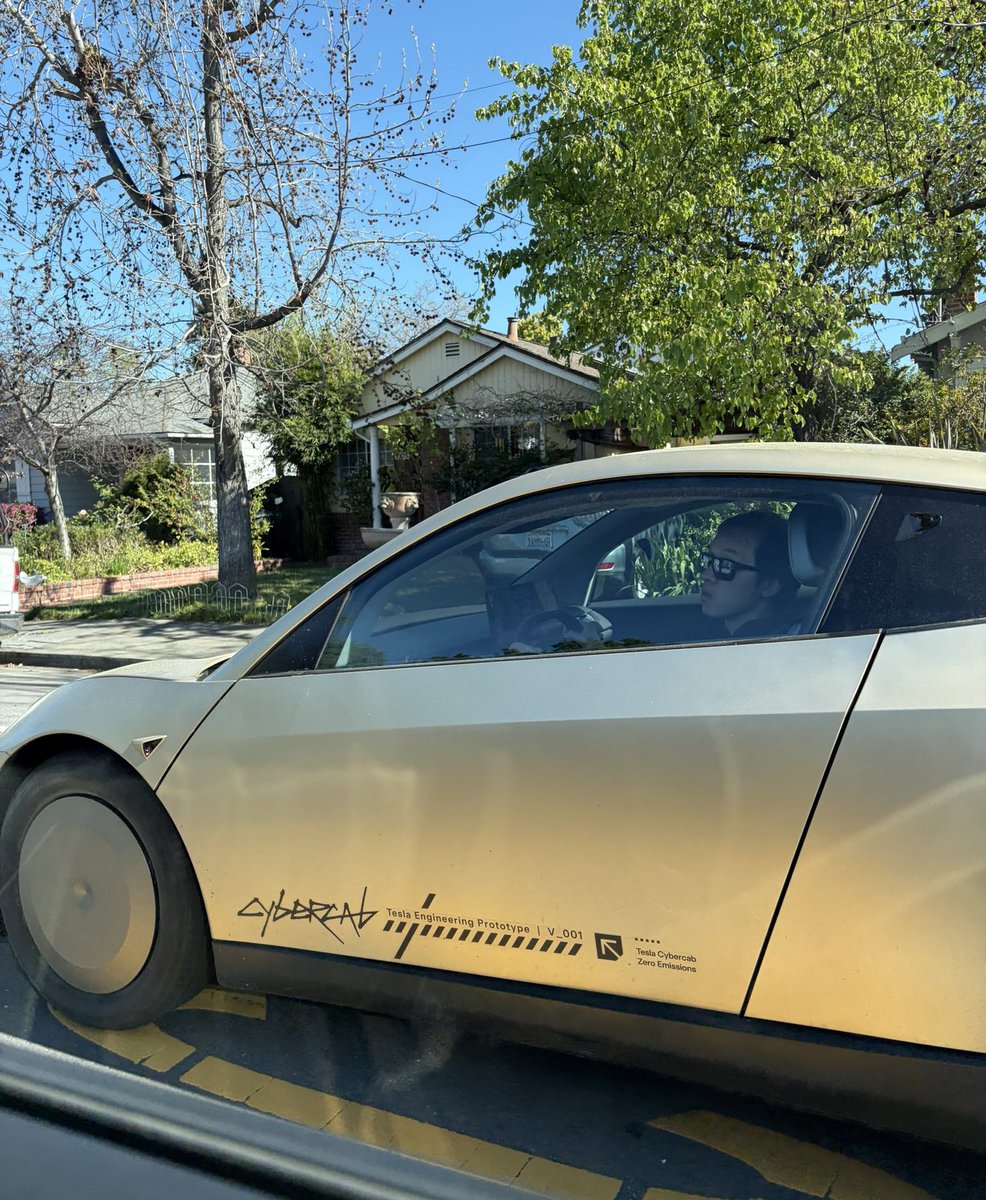
The News: A Tesla Cybercab prototype featuring a mirrorless exterior design but equipped with a steering wheel has been spotted undergoing active road testing.
Why It Matters: The sighting confirms Cybercab development is accelerating ahead of the planned April 2026 volume production start — and the steering-wheel detail reveals exactly how Tesla is navigating regulatory requirements during testing.
Source: @TeslaNewswire on X

Two Details That Tell the Whole Story
At first glance, a Cybercab with a steering wheel sounds like a contradiction. Tesla has been unambiguous: the production Cybercab will ship without a steering wheel, pedals, or side mirrors. Elon Musk has said it repeatedly. So what's going on here?
The answer lies in how Tesla actually develops and validates autonomous vehicles before they reach customers. According to Tesla VP of Vehicle Engineering Lars Moravy, Cybercabs equipped with steering wheels are part of a "remote controlled fleet" used strictly for testing purposes — and are explicitly "not for sale." These units allow engineers and safety drivers to intervene during public road testing, satisfying state and federal regulatory requirements that still mandate human override capability in most jurisdictions.
The mirrorless design on this same prototype is the more significant signal. It means Tesla is already testing the production-intent exterior — the camera-based surround vision system that replaces traditional side mirrors — under real-world conditions. Getting that system validated on public roads, in traffic, in varied lighting, is a prerequisite for any launch. Seeing it active now, with volume production targeted for April 2026, suggests the timeline is holding.
📊 Key Figures
| Metric | Value | Context |
|---|---|---|
| Volume Production Start | April 2026 | Gigafactory Texas |
| First Production Unit | Mid-Feb 2026 | Weeks ahead of schedule |
| Units on Gigafactory Grounds | 25 | Drone footage, early March 2026 |
| States With Active Road Testing | 5 | CA, TX, NY, IL, MA |
| Expected Battery Size | 35 kWh | ~200 mi / 320 km range |
| Target Price | Under $30,000 | Per Elon Musk |
| Passenger Capacity | 2 | Purpose-built autonomous design |
🔭 The BASENOR Take
Timeline: April 2026 volume production — currently on track, with first unit already built in February.
Impact Level: 🔴 High — This is Tesla's most consequential new vehicle launch since the Cybertruck.
Confidence: ⬛⬛⬛⬛⬜ High — Multiple independent sightings, drone footage, and official statements all corroborate active ramp.
The combination of details in this latest sighting is worth unpacking carefully. The mirrorless exterior isn't just a styling choice — it's a core part of the Cybercab's sensor architecture. Tesla's camera-based system needs to replace the spatial awareness that mirrors provide to a human driver. Testing it now, at scale, across five states and in winter conditions at Alaska proving grounds, is exactly the kind of validation data Tesla needs before a commercial launch.
The steering wheel presence, meanwhile, is a pragmatic concession to the current regulatory environment — not a design retreat. Most U.S. states still require a licensed operator capable of taking control during autonomous testing on public roads. Tesla has been explicit that these testing units will never reach customers in this configuration. Think of them as the scaffolding: necessary to build the structure, but not part of the finished product.
What's most telling about the current pace of activity is the sheer number of units now visible. Drone footage from early March captured 25 Cybercab units on Gigafactory Texas grounds alone. That's not prototype territory anymore — that's pre-production validation at meaningful scale. For context, Tesla typically uses this phase to stress-test manufacturing processes, identify assembly line bottlenecks, and build the initial inventory needed for a launch event or early deliveries.
For current Tesla owners watching this story, the Cybercab represents something bigger than a new model launch. At a target price under $30,000 — powered by FSD and designed for wireless inductive charging — it's the first Tesla built from the ground up around autonomy rather than retrofitted for it. Whether that translates into a personal purchase or access to a future robotaxi network, the vehicle taking shape on Texas roads right now will define what Tesla means for the next decade.
📰 Deep Dive
The steering-wheel-versus-no-steering-wheel narrative has dominated Cybercab coverage for months, often generating more heat than light. The reality is straightforward: Tesla is running two parallel fleets. Testing units carry steering wheels and pedals to comply with state-level autonomous vehicle regulations. Production-intent units — like the Palo Alto prototypes spotted in late February without a visible steering wheel — represent what paying customers will actually receive. Both can exist simultaneously without contradiction.
The mirrorless design is where the real engineering story lives. Camera-based vision systems that replace side mirrors must perform across a far wider range of conditions than human eyes and glass mirrors: direct sun glare, rain, snow, night driving, and rapid transitions between light environments. The fact that Tesla is logging public road miles on this system now, months before volume production, suggests confidence in the underlying hardware — though real-world validation data will ultimately determine whether the system meets the bar Tesla has set.
With 25 units already on site at Gigafactory Texas and the first production unit completed in mid-February, the April volume production target looks credible. The more meaningful question for Tesla owners and prospective buyers isn't whether the Cybercab launches on time — it's whether the FSD software powering it is ready to operate without human supervision at the level required for a commercial robotaxi service. Testing sightings answer the hardware question. The software question will be answered on the road.
🚕 Following the Robotaxi rollout? See every operating city, launch date and announced market in our Tesla Robotaxi Tracker.
Related Gear
Gear up your Tesla with tested, custom-fit BASENOR accessories — shop Tesla accessories →
Sources & reporting notes
The links below identify the material source records used for this report.
- @TeslaNewswire on X (2026-03-07T08:26:22.000Z) — Direct source
Source links are preserved as published or accessed. See our editorial standards and corrections policy.
The BASENOR Editorial Desk covers Tesla, SpaceX, and related technology, curating reporting from primary sources — official accounts, regulatory filings, and software release data. Every article passes source-record and fact-checking review before publication. About the newsroom.
This report was curated by the BASENOR Editorial Desk from the sources listed above. Read our editorial standards or email editorial@basenor.com to report an error.