Morgan Stanley has officially put a number on the most-watched private-turned-public company in the aerospace world. Analyst Adam Jonas initiated coverage on SpaceX for the first time with a $300 price target and a bull case of $600 per share — a figure that would translate to roughly an $8 trillion market capitalization. The projections, shared by Sawyer Merritt on X, forecast SpaceX generating $319 billion in revenue by 2030 and a staggering $3.3 trillion by 2040, with Starlink and terrestrial compute framed as the twin engines of that growth.
For anyone tracking the Musk ecosystem — from Tesla FSD to Starlink connectivity — this is one of the clearest signals yet of how Wall Street is starting to price the intersection of space, AI, and physical-world connectivity. Here's what the note actually says and why it matters.

The Headline Numbers
Jonas assigned SpaceX an "overweight" rating alongside the $300 base-case target, according to reporting from Seeking Alpha and GuruFocus corroborating the initiation. The $300 figure implies roughly 90% upside from the prior close, following SpaceX's IPO on Nasdaq in June 2026 that valued the company at approximately $2 trillion. The $600 bull case doubles that target and lands the company near an $8 trillion valuation — territory currently occupied by only a handful of the world's largest companies.
| Metric | Projection |
|---|---|
| Base-case price target | $300/share |
| Bull-case price target | $600/share |
| Bull-case market cap | ~$8 trillion |
| Revenue by 2030 | $319 billion |
| Revenue by 2040 | $3.3 trillion |
| Rating | Overweight |
It's worth noting the projections cited across coverage vary slightly — some reports peg the 2030 revenue figure closer to $330 billion and the 2040 estimate above $3.4 trillion, according to Seeking Alpha and GuruFocus. The exact decimals matter less than the shape of the thesis: Jonas is modeling exponential, not linear, growth.
Starlink as the "Every Device" Play
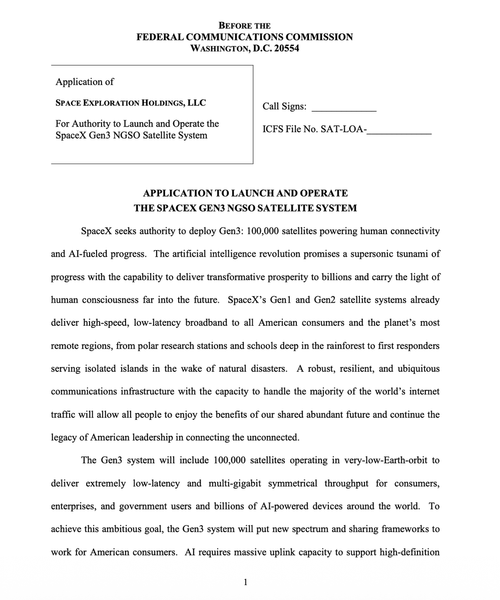
The most forward-looking part of Jonas's note centers on Starlink. Rather than framing the satellite network purely as a rural broadband product, he describes the long-term opportunity as connecting every data-transmitting device.

"The largest long-term Starlink opportunity? Every data-transmitting device: AVs, robots, drones, and more," Jonas wrote. "As AI penetrates deeper into the physical world, every AI-enabled 'node', robot or otherwise, becomes a potential connection opportunity."
This is the piece that directly overlaps with the broader Tesla-and-Optimus roadmap that our readers follow. Autonomous vehicles, humanoid robots, and drones all need persistent, low-latency connectivity — and Jonas's thesis is that Starlink is uniquely positioned to become the default backbone for that machine-to-machine traffic as physical AI scales. It reframes the total addressable market from "people without fiber" to "anything that thinks and moves."
The Underappreciated Compute Angle
The second pillar of the bullish case is one Wall Street has largely ignored: SpaceX's terrestrial compute capabilities. Jonas argues the company's cost structure and build speed on the ground are among its most misunderstood strengths.

"We believe SpaceX's cost and speed in terrestrial compute is one of the most underappreciated aspects of the company," Jonas wrote. "We also believe SpaceX is on a path to vertically integrate the bulk of value-added parts in a datacenter to sustain industry-leading cost."
That vertical-integration language will sound familiar to anyone who has followed Tesla's manufacturing playbook — owning the stack from raw components to finished product to compress cost and control quality. According to Morgan Stanley's broader thesis reported by Seeking Alpha, AI-related business is expected to become the dominant revenue driver by 2040, potentially surpassing both traditional rocket launches and Starlink services. AI-related revenue alone is projected to climb from around $3.2 billion in 2025 to roughly $190 billion by 2030, per that coverage — a jump that hinges heavily on the xAI relationship positioning SpaceX at the crossroads of aerospace and artificial intelligence.
The Risks Jonas Flagged
A $600 bull case is not a slam dunk, and the note doesn't pretend otherwise. According to the reporting around the initiation, Morgan Stanley called out several key risks: heavy dependence on founder Elon Musk, potential conflicts with Tesla-related ventures, regulatory and geopolitical exposure, and significant funding needs that could slow the deployment of new technologies. Those are meaningful caveats — especially the funding intensity required to build both a satellite constellation and a datacenter footprint simultaneously.
What It Means for the Tesla Ecosystem
For Tesla owners and investors, the read-through is subtle but real. Jonas's Starlink-as-connectivity-backbone thesis assumes a world thick with autonomous vehicles and robots — the exact future Tesla is building toward with FSD and Optimus. If SpaceX becomes the connective tissue for that machine layer, the two companies' fortunes become even more intertwined. The flip side is the "potential conflicts with Tesla-related ventures" risk Morgan Stanley itself named: shared leadership, shared capital priorities, and overlapping ambitions can cut both ways.
What to Watch Next
- Post-IPO trading range: Whether SPCX shares move toward the $300 base case or stall out will tell us how much the market buys Jonas's exponential model.
- xAI integration details: Concrete revenue disclosures tying SpaceX compute to AI workloads would validate the biggest swing factor in the 2040 forecast.
- Starlink direct-to-device milestones: Real deployments connecting AVs, drones, or robots — not just phones — would be the first proof point for the "every node" thesis.
- Follow-on analyst coverage: Whether other major banks initiate near Jonas's numbers or come in more conservative.
Frequently Asked Questions
What price target did Morgan Stanley set for SpaceX?
Morgan Stanley's Adam Jonas set a base-case price target of $300 per share and a bull-case target of $600 per share, the latter implying an approximately $8 trillion market capitalization. The firm assigned an "overweight" rating.
How much revenue does Morgan Stanley expect SpaceX to generate?
Jonas forecasts SpaceX revenue reaching $319 billion by 2030 and $3.3 trillion by 2040, according to figures shared by Sawyer Merritt. Some coverage cites slightly higher estimates near $330 billion for 2030 and above $3.4 trillion for 2040.
Why does Morgan Stanley think Starlink is so valuable?
Jonas argues Starlink's largest long-term opportunity is connecting every data-transmitting device — including autonomous vehicles, robots, and drones — as AI spreads into the physical world. Each AI-enabled node becomes a potential connection, dramatically expanding the addressable market beyond consumer broadband.
What are the main risks to the bullish case?
Morgan Stanley flagged dependence on Elon Musk, potential conflicts with Tesla-related ventures, regulatory and geopolitical exposure, and heavy funding needs that could slow technology deployment.
When did SpaceX go public?
SpaceX completed its IPO on Nasdaq in June 2026, with an initial market capitalization of roughly $2 trillion, according to background reporting around the Morgan Stanley initiation.
The takeaway: Wall Street is no longer valuing SpaceX as a launch company with a broadband side business. Jonas's note treats it as a physical-world AI infrastructure play — and that reframing, more than any single number, is what makes this initiation worth watching.

Sarah focuses on Tesla Energy, SpaceX missions, and the broader Musk AI portfolio. Former data analyst in clean energy. Based in San Francisco.
Sources verified at publish time. Spotted an inaccuracy? Email editorial@basenor.com.