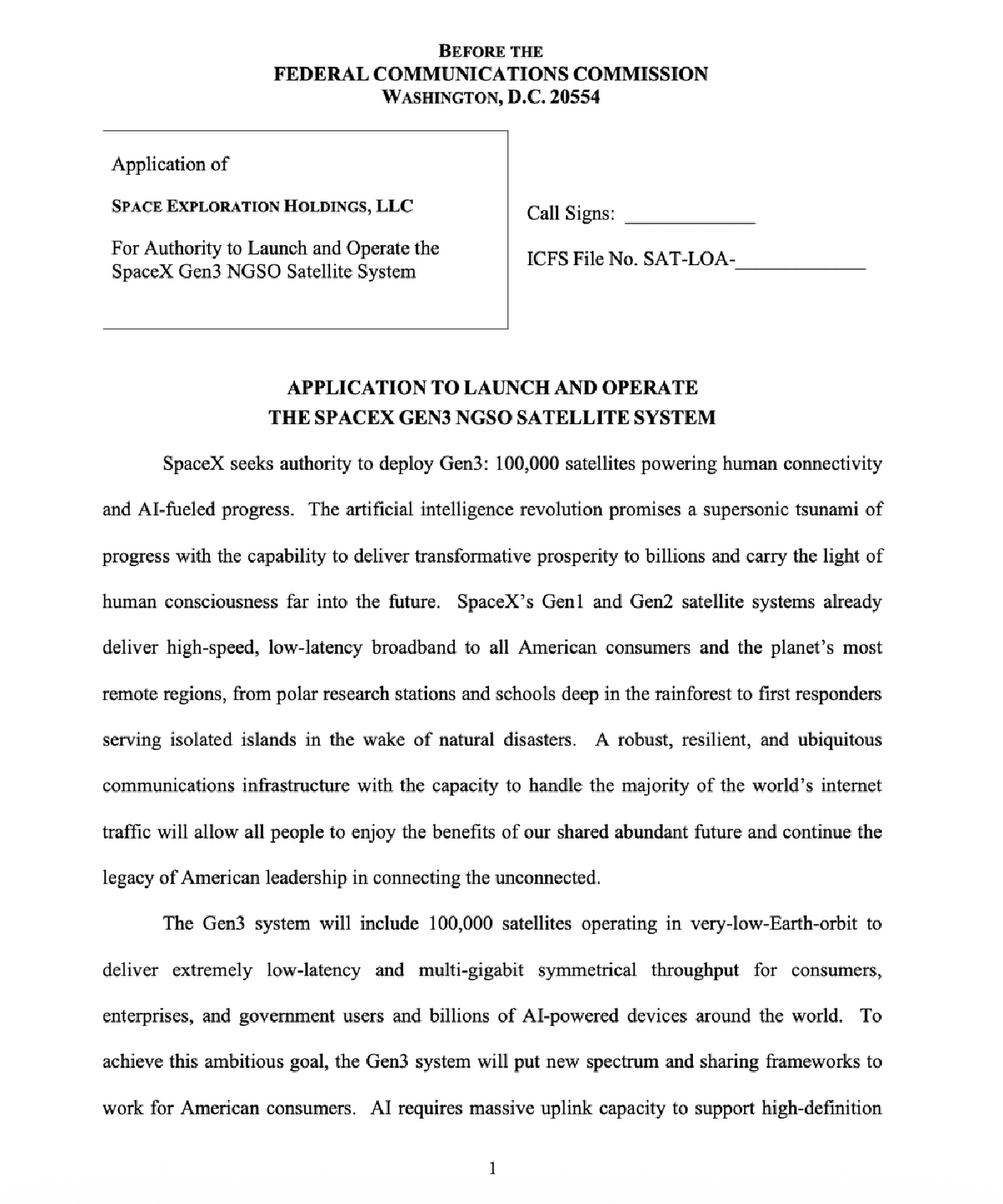
SpaceX has formally asked the U.S. Federal Communications Commission to authorize a third-generation Starlink constellation of 100,000 satellites, a scale that would dwarf every satellite network ever operated and reshape the ground rules of low-Earth-orbit broadband. The filing, submitted this week, frames the buildout as infrastructure for both human connectivity and what SpaceX calls the coming 'supersonic tsunami' of AI-driven progress.
The request marks the most ambitious orbital deployment ever proposed by a single company. For context, there are roughly 10,000 active satellites in orbit today across all operators combined — SpaceX is asking to launch ten times that number on its own.

What SpaceX Is Asking For
According to the filing surfaced by Sawyer Merritt on Monday, SpaceX is requesting FCC authorization for a Gen 3 system that would sit alongside — and eventually succeed — the existing Gen 1 and Gen 2 Starlink constellations. The stated purpose language in the application is unusually forward-looking, tying the network directly to the compute and bandwidth demands of large-scale AI systems rather than just consumer broadband.
The 100,000-satellite figure is not a soft target. It's the authorization ceiling SpaceX is seeking from regulators, which the company would then draw down against over years of launches. For comparison, the currently approved Gen 2 constellation tops out near 30,000 satellites, and SpaceX has flown roughly 8,000 Starlinks to date.
Why the AI Framing Matters
The pitch that Starlink is infrastructure for AI — not just rural broadband — is a strategic reframe worth taking seriously. Training and inference at frontier-model scale requires moving enormous data volumes between edge devices, data centers, and increasingly, autonomous systems (vehicles, drones, robots) operating far from fiber. A dense LEO mesh with laser inter-satellite links effectively becomes a global low-latency backbone that fiber can't reach.
That framing also positions Starlink adjacent to xAI, Tesla's Full Self-Driving fleet, and Optimus — all Musk-orbit projects that will generate and consume massive real-time data streams. A Gen 3 constellation designed with AI workloads in mind (rather than retrofitted for them) is a hedge on the direction the entire compute stack is moving.

The Regulatory Reality Check
An FCC filing is not an FCC approval. Gen 2 took years to work through, was partially granted, and remains contested by competitors including Amazon's Project Kuiper and Viasat, plus astronomy groups concerned about sky brightness and radio interference. A 100,000-satellite request will face all of those objections at higher intensity, plus new questions from NASA and the FAA about collision risk in an increasingly crowded LEO shell.
SpaceX's counter-argument, developed across previous filings, is that Starlink satellites operate at low altitudes where atmospheric drag deorbits failed hardware within roughly five years, and that the company's autonomous collision-avoidance system has a strong operational record. Expect that debate to intensify.
Launch Cadence Is the Bottleneck
The math on 100,000 satellites only works if Starship reaches high-cadence operational flight. Falcon 9 currently delivers Starlinks at roughly 20-23 satellites per launch. Starship, when operational, is designed to carry Gen 3 satellites — which are physically larger — in batches many times that size. Without Starship at scale, the 100,000 figure is aspirational; with Starship at scale, it becomes a straightforward multi-year build.
That dependency ties the FCC filing directly to the pace of Starship's development program at Starbase. Every successful Starship flight moves the Gen 3 timeline forward; every delay pushes it right.
What to Watch Next
The FCC will open a public comment period, during which competitors, foreign regulators, and industry groups will file objections and modification requests. Expect Amazon, Viasat, EchoStar, and international operators to weigh in. The commission's decision timeline on Gen 2 stretched over 18 months — a filing of this scope will likely take at least as long, with the possibility of a phased approval that authorizes an initial tranche before the full 100,000.
For now, the filing itself is the story: SpaceX has drawn a line in the regulatory sand at 100,000 satellites, positioned Starlink as AI-era infrastructure rather than rural broadband, and set the ceiling for the next decade of its space business. Whether the FCC follows the company that far will be one of the defining telecom decisions of the late 2020s.
🚀 Following the Starship program? See every test flight, official outcome and the next launch window in our SpaceX Starship Tracker.
Sources & reporting notes
The links below identify the material source records used for this report.
- @SawyerMerritt on X (2026-07-07T14:36:53.000Z) — Direct source
- @SawyerMerritt on X (2026-07-07T14:36:52.000Z) — Direct source
Source links are preserved as published or accessed. See our editorial standards and corrections policy.
The BASENOR Editorial Desk covers Tesla, SpaceX, and related technology, curating reporting from primary sources — official accounts, regulatory filings, and software release data. Every article passes source-record and fact-checking review before publication. About the newsroom.
This report was curated by the BASENOR Editorial Desk from the sources listed above. Read our editorial standards or email editorial@basenor.com to report an error.