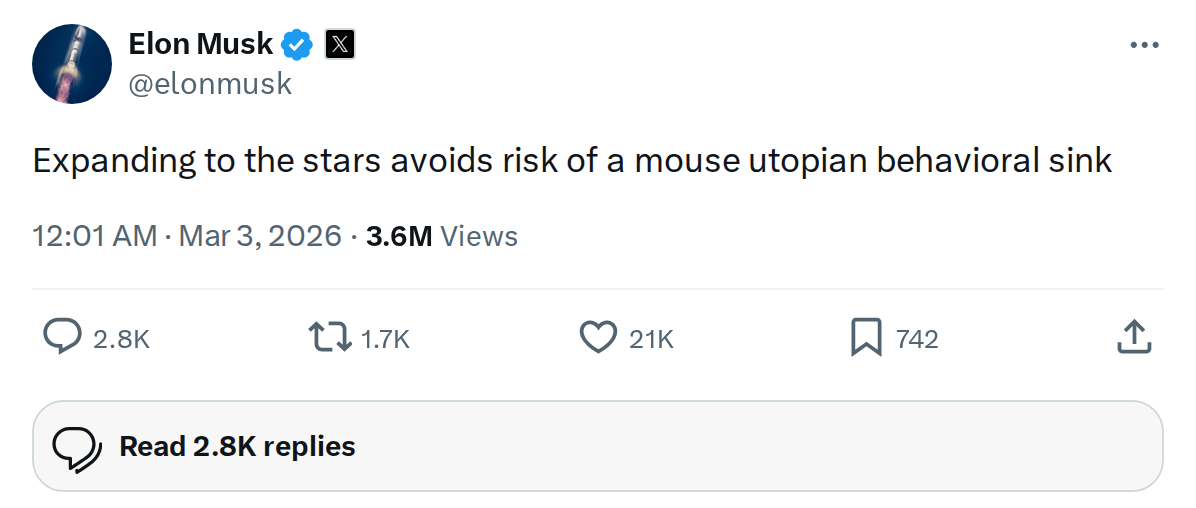
The News: Elon Musk publicly reaffirmed that expanding humanity to space is the primary safeguard against a civilizational "behavioral sink" — a collapse of social structures caused by overcrowding and stagnation on a single planet.
Why It Matters: This isn't just philosophy — Musk is actively redirecting SpaceX's near-term roadmap, prioritizing a Moon base before Mars, with Starship V3 development accelerating to make it happen.
Source: @elonmusk on X — March 2, 2026
Musk Reaffirms SpaceX Mission: Expand to Stars or Risk Civilizational Collapse
Elon Musk has once again placed SpaceX's multi-planetary mission front and center — and this time, the framing is starker than ever. In a post on March 2, 2026, Musk warned that humanity risks falling into a "mouse utopian behavioral sink" if it remains confined to a single planet. It's a reference with deep scientific roots, and Musk is using it to justify one of the most ambitious — and accelerating — space programs in history.

What Is a 'Behavioral Sink' — and Why Does Musk Keep Citing It?
The term "behavioral sink" originates from ethologist John B. Calhoun's famous mouse population experiments in the 1960s. When mice were given unlimited food but finite space, population density eventually triggered a cascade of social breakdown: aggression, withdrawal, reproductive failure, and ultimately population collapse — even before resources ran out. The lesson: confinement itself is the crisis, not scarcity.
Musk has long drawn a direct parallel to humanity. A civilization that fills its planet without expanding outward, in his view, risks the same fate — not through starvation or war necessarily, but through a quieter unraveling of social cohesion, innovation, and the drive that pushes civilization forward. Expansion, in this framing, isn't optional. It's biological imperative dressed in rocket fuel.
📊 Key Figures
| Metric | Value | Context |
|---|---|---|
| Moon launch cadence (target) | Every 10 days | vs. Mars every 26 months |
| Moon transit time | ~2 days | vs. Mars ~6 months |
| Mars city timeline | 5–7 years | From Feb 2026 baseline |
| Starship uncrewed Mars missions | 2026 | Followed by crewed flights ~2028 |
| @elonmusk post engagement | 3.5M views | 20.8K likes · 1.5K RTs |
The Strategic Pivot: Moon First, Mars Second
What makes this moment different from Musk's previous philosophical statements is the concrete strategy shift behind it. As of February 9, 2026, Musk announced that SpaceX is temporarily redirecting its near-term focus toward establishing a self-sustaining city on the Moon — before Mars. The reasoning is purely pragmatic: the Moon can be reached every 10 days with a two-day transit, while Mars only aligns favorably every 26 months with a six-month journey each way.
"The overriding priority is securing the future of civilization and the Moon is faster," Musk stated at the time. In other words, the Moon becomes the proving ground — a faster iteration loop for the life support systems, construction techniques, and supply chains that will ultimately need to work on Mars. Think of it as a staging base for the species.
Mars, meanwhile, hasn't been abandoned. Musk has indicated that building a city there begins within five to seven years from the February 2026 baseline, with uncrewed Starship missions to the red planet still on track for 2026, and crewed flights targeting approximately 2028, according to Space.com reporting.
Starship V3: The Hardware Behind the Vision
None of this happens without the vehicle to carry it out. On February 27, 2026 — just days before this latest post — Musk announced that Starship V3 SN1 had moved to ground tests, and expressed high confidence in the V3 design achieving full reusability. That's the critical enabling factor for both Moon and Mars economics: a fully reusable Starship brings the cost per kilogram to orbit down to levels that make city-scale logistics possible.
Musk also clarified the tower-catch plan for Starship's upper stage, noting it will only be attempted after two perfect soft ocean landings — a methodical risk-management approach that signals SpaceX is optimizing for reliability, not spectacle, at this stage. For our SpaceX coverage, that's a meaningful indicator of program maturity.
🔭 The BASENOR Take
Timeline: Immediate — this reflects active SpaceX mission posture as of March 2026
Impact Level: 🌍 Civilizational — long arc, but near-term milestones are concrete
Confidence: High — aligns with Musk's consistent multi-year messaging and SpaceX's current hardware roadmap
Analysis: Musk's "behavioral sink" framing isn't new — but the fact that he's repeating it while Starship V3 is in ground tests and Moon mission planning is active signals that this is no longer abstract philosophy. The infrastructure decisions being made at SpaceX today are direct expressions of this thesis. The Moon-first pivot is the most strategically significant update: it compresses the iteration timeline dramatically and could yield a permanent human presence beyond Earth within this decade. For the broader Tesla and SpaceX ecosystem, this matters because both companies share engineering talent, manufacturing philosophy, and — critically — the same existential rationale from their founder.
📰 Deep Dive
Strip away the philosophical language and Musk's "behavioral sink" warning is really a systems argument: closed systems degrade. Whether it's a mouse colony in a lab or a civilization on a pale blue dot, the dynamic is the same — finite space plus growing complexity eventually produces dysfunction. The cure isn't behavioral; it's structural. You have to open the system.
What's striking about this moment is the convergence of rhetoric and hardware. Musk has made these arguments for over a decade, but in March 2026, SpaceX has a V3 Starship in ground tests, a Moon-first strategic posture, and a Mars mission timeline with specific years attached. The vision is collapsing into a schedule.
For observers of both SpaceX and Tesla, the underlying logic is consistent across both companies: avoid single points of failure. Tesla's product diversification — energy storage, vehicles, robotics — mirrors the same redundancy thinking Musk applies to planetary civilization. It's not coincidence. It's the same founder running the same mental model across multiple domains simultaneously.
Whether the timelines hold is always the open question with Musk. But the direction — and the urgency — has never been clearer. The stars, he argues, are not the destination. They're the insurance policy.
🚀 Following the Starship program? See every test flight, official outcome and the next launch window in our SpaceX Starship Tracker.
Sources & reporting notes
The links below identify the material source records used for this report.
- @elonmusk on X (2026-03-02T16:01:37.000Z) — Direct source
Source links are preserved as published or accessed. See our editorial standards and corrections policy.
The BASENOR Editorial Desk covers Tesla, SpaceX, and related technology, curating reporting from primary sources — official accounts, regulatory filings, and software release data. Every article passes source-record and fact-checking review before publication. About the newsroom.
This report was curated by the BASENOR Editorial Desk from the sources listed above. Read our editorial standards or email editorial@basenor.com to report an error.