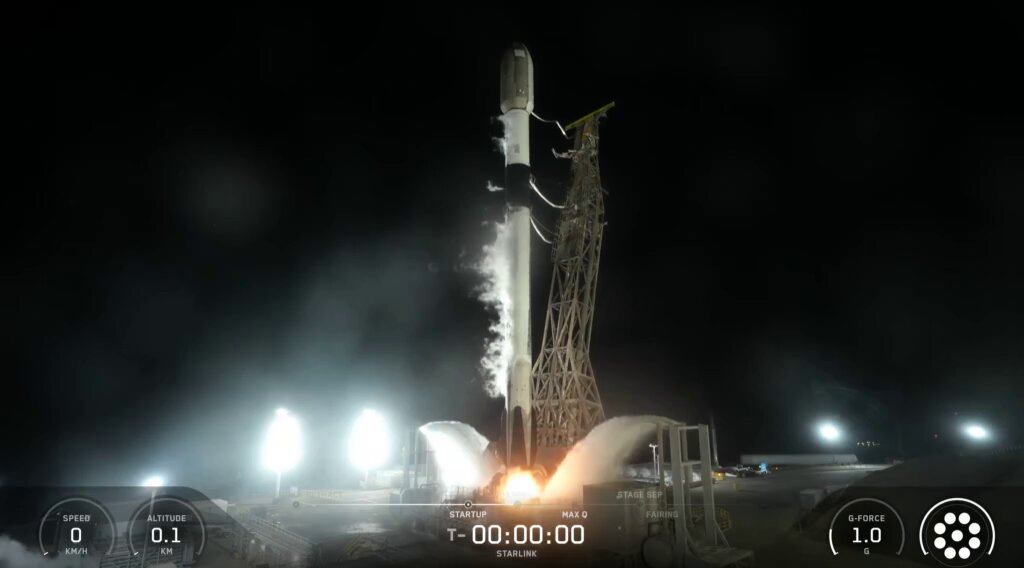
The News: SpaceX successfully launched 25 Starlink V2 Mini satellites to orbit from Vandenberg Space Force Base, with booster B1082 completing its 20th flight and sticking yet another landing on the drone ship Of Course I Still Love You.
Why It Matters: A 20-flight booster is extraordinary — it signals that SpaceX's reusable rocket program has moved from impressive demonstration to industrial-scale routine. Every successful mission expands the Starlink constellation that powers Tesla vehicles' connectivity and future autonomous features.
Sources: @SpaceX · @NASASpaceflight
SpaceX Launches 25 Starlink Satellites on Booster B1082's Historic 20th Flight
SpaceX marked another milestone in its relentless launch cadence early Sunday morning, sending 25 Starlink V2 Mini satellites into orbit from Space Launch Complex 4 East (SLC-4E) at Vandenberg Space Force Base in California. The mission, designated Starlink Group 17-23, lifted off at 2:10 a.m. PST — and everything went exactly to plan.
The headline number: this was the 20th flight of Falcon 9 booster B1082. That's not a typo. The same booster core that first flew in January 2024 has now been launched, recovered, refurbished, and relaunched twenty times — a pace that would have seemed like science fiction when SpaceX first attempted booster landings a decade ago.

📊 Key Figures
| Metric | Value | Context |
|---|---|---|
| Satellites Launched | 25 | Starlink V2 Mini |
| Booster | B1082 | First flew Jan 2024 |
| Booster Flight Number | 20th | Career high milestone |
| Launch Site | SLC-4E | Vandenberg SFB, CA |
| Landing Zone | OCISLY | Pacific Ocean drone ship |
| Mission Designation | Starlink 17-23 | Shell 17, plane 23 |
Launch and Landing: By the Numbers
NASASpaceflight confirmed liftoff at 10:11 UTC, with the mission unfolding from SLC-4E — Vandenberg's primary Falcon 9 pad. Booster B1082 has had an impressive career: before this mission, it had previously supported USSF-62, OneWeb Launch 20, NROL-145, and a string of 15 earlier Starlink deployments. That diversity of payloads — military, commercial, and SpaceX's own constellation — underscores just how battle-tested this particular core has become.

Roughly eight minutes after launch, B1082 executed a successful return burn and touched down on the drone ship Of Course I Still Love You in the Pacific Ocean — prompting NASASpaceflight's characteristically understated confirmation: "And another happy landing." That's the kind of comment you only get when landing an orbital-class rocket booster starts feeling routine.

🔭 The BASENOR Take
Timeline: Booster B1082 first flew in January 2024. It has now completed 20 missions in roughly 26 months — averaging under six weeks between flights.
Impact Level: 🟡 Medium — Incremental constellation expansion with a notable reusability milestone.
Confidence: ✅ High — Mission confirmed by SpaceX and independently verified by NASASpaceflight.
Analysis: Twenty flights from a single booster represents a genuine engineering landmark. When SpaceX introduced reusability, the question was always how many times a booster could realistically fly before reliability degraded. B1082 is one of several cores now pushing past 20 flights with no signs of slowing — which means the economics of Starlink launches keep improving. Lower launch costs translate directly into SpaceX's ability to grow the constellation faster, which ultimately benefits anyone relying on Starlink connectivity, including Tesla owners using the in-car hotspot or waiting on future vehicle-to-satellite features.
📰 Deep Dive
The 20-flight milestone for B1082 is worth pausing on. SpaceX's original stated goal for booster reusability was 10 flights without refurbishment — a target that seemed ambitious at the time. The program has since blown past that bar repeatedly. What's notable about B1082 in particular is the breadth of its mission portfolio: it has carried national security payloads for the U.S. military (USSF-62, NROL-145), commercial communications satellites for OneWeb, and now 16 Starlink batches in total. A booster trusted with classified government payloads and then immediately turned around for commercial use is a strong signal about how far SpaceX's quality and inspection processes have matured.
For Starlink subscribers — and Tesla owners who use Starlink-backed connectivity — each new batch of V2 Mini satellites adds capacity to the network. The V2 Mini design offers significantly higher throughput per satellite compared to the original V1 hardware, meaning the network gets meaningfully faster and more resilient with each launch, not just larger. Shell 17 specifically targets mid-inclination coverage, filling gaps that earlier polar and near-polar shells left underserved.
SpaceX's West Coast cadence from Vandenberg continues to complement the East Coast and Florida operations at Cape Canaveral, allowing the company to maintain an extraordinarily high annual launch rate. The pace shows no sign of slowing — and for owners of connected vehicles depending on always-on satellite infrastructure, that steady drumbeat of launches is exactly what you want to see. For more on the broader SpaceX story, follow our SpaceX coverage.
Sources & reporting notes
The links below identify the material source records used for this report.
- @SpaceX on X (2026-03-01T10:03:24.000Z) — Direct source
- @NASASpaceflight on X (2026-03-01T10:11:44.000Z) — Direct source
- @NASASpaceflight on X (2026-03-01T10:19:49.000Z) — Direct source
Source links are preserved as published or accessed. See our editorial standards and corrections policy.
The BASENOR Editorial Desk covers Tesla, SpaceX, and related technology, curating reporting from primary sources — official accounts, regulatory filings, and software release data. Every article passes source-record and fact-checking review before publication. About the newsroom.
This report was curated by the BASENOR Editorial Desk from the sources listed above. Read our editorial standards or email editorial@basenor.com to report an error.