📌 UPDATE — March 31, 2026
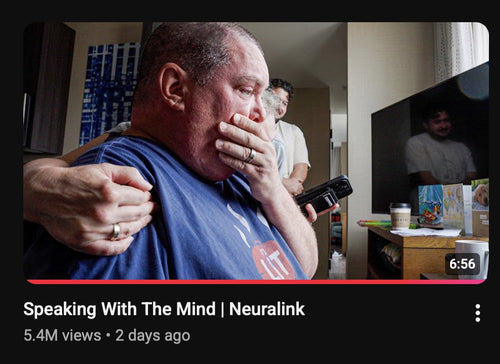
Neuralink has shared a new video featuring Kenneth and his wife Cheryl, offering a personal look at the emotional impact of the VOICE trial. Cheryl described the prospect of hearing Kenneth speak again as "mind blowing" after four years of silence — underscoring just how transformative BCI-assisted communication can be for families, not just patients. Neuralink confirmed the team is actively working to restore Kenneth's ability to communicate using his original voice, a notable detail that goes beyond simple text-to-speech synthesis. As always, Neuralink notes that its devices remain investigational and are not yet FDA-approved or commercially available.

📌 UPDATE — March 31, 2026
Elon Musk has officially confirmed on X that Neuralink's VOICE trial is enabling people with ALS to speak again, sharing video evidence of the milestone. In a series of tweets posted today, Musk amplified the achievement with a direct statement: "Neuralink enables people with ALS to speak again." The posts collectively garnered hundreds of thousands of views within minutes, signaling broad public attention to this clinical breakthrough.
@elonmusk · March 31, 2026
"Neuralink enables people with ALS to speak again"

👍 1,842 🔁 278 👁️ 131,704
@elonmusk · March 31, 2026

👍 3,330 🔁 357 👁️ 235,359
📌 UPDATE — March 24, 2026
Elon Musk has publicly confirmed that Neuralink is actively restoring speech to individuals who have lost the ability to speak, lending high-profile official weight to the progress already seen in the VOICE trial. Musk shared a video on X highlighting the breakthrough, which has drawn nearly 1.8 million views — signaling growing mainstream awareness of the technology. The post serves as the most direct public acknowledgment yet from Neuralink's leadership that the VOICE trial is producing real-world results beyond the initial case study of patient Kenneth.
@elonmusk · March 24, 2026"Neuralink is restoring speech to those who have lost the ability to speak"
 ❤️ 15,208 | 🔁 2,057 | 👁️ 1.79M
30-Second Brief
The News: Neuralink has spotlighted ALS patient Kenneth in its VOICE clinical trial, demonstrating how a brain-computer interface (BCI) can translate thought into speech to restore communication autonomy.
Why It Matters: This is the clearest public window yet into Neuralink's speech-restoration program — a trial that holds direct implications for millions living with ALS, stroke, spinal cord injury, and other neurological conditions.
Sources: @neuralink (Tweet 1) · @neuralink (Tweet 2)
Neuralink's VOICE Trial Gives an ALS Patient His Voice Back — Here's Where the Technology Stands
By BASENOR Editorial · March 24, 2026
ALS is relentless. It strips away movement, then breath, then voice — often leaving cognition fully intact while the body becomes a prison. Neuralink's VOICE clinical trial is a direct assault on that progression. Today, the company shared the story of Kenneth, an ALS patient using a brain-computer interface to translate his thoughts into speech, offering one of the most concrete public demonstrations yet of where this technology stands.

What Is the VOICE Clinical Trial?
VOICE (study identifier NCT07224256) is an Early Feasibility Study designed to evaluate the safety and initial efficacy of Neuralink's N1 Implant and R1 Systems for restoring communication in people with severe, irreversible speech impairment caused by neurological conditions affecting central speech pathways. Eligible conditions include ALS, stroke, spinal cord injury, cerebral palsy, and multiple sclerosis.
The core technology works by recording neural signals associated with the intent to speak, then decoding those signals in real time and converting them into synthesized speech output. In Kenneth's case, ALS has progressively eliminated his ability to produce speech physically — but his brain still generates the commands. The implant intercepts those commands before they reach a body that can no longer execute them.
Neuralink's Link device has received FDA Breakthrough Device Designation specifically for restoring communication in patients with severe speech impairment — a designation that recognizes the device's potential to offer more effective treatment than currently available options and accelerates the FDA review process.
📊 Key Figures
| Metric | Value | Context |
|---|---|---|
| Total trial participants (as of Jan 2026) | 21 | Across PRIME + VOICE studies |
| VOICE study implant recipients (min.) | 2 | As of January 2026 |
| FDA designation | Breakthrough Device | For severe speech impairment |
| High-volume production target | 2026 | Per Elon Musk, January 2026 |
| VOICE study last updated (ClinicalTrials.gov) | Nov 4, 2025 | NCT07224256 |
Kenneth and the Broader Patient Picture
Kenneth is the latest patient Neuralink has chosen to spotlight publicly. His story follows that of Bradford G. Smith, Neuralink's third PRIME Study participant and the first ALS patient to receive the implant — who has used the system to control a computer cursor with his thoughts, enabling him to type and communicate using a synthesized version of his own voice reconstructed via AI from old recordings. Smith described the experience as giving him "freedom, hope, and faster communication."
The VOICE trial represents a step beyond cursor control. Where PRIME focused on motor restoration (controlling a cursor or device), VOICE is explicitly targeting speech output — decoding the neural intent to speak and converting it directly into audible language. That is a meaningfully harder problem: speech involves dozens of muscles firing in precise sequence at high speed, and the decoding model must account for phoneme-level nuance, not just directional intent.

Neuralink Is Actively Recruiting — Patients and Engineers
Alongside Kenneth's story, Neuralink made two direct calls to action: join the patient registry if you or someone you know may qualify, and apply for open engineering roles if you want to build this technology. Both links appeared in the company's follow-up tweet.
📋 How to Get Involved
Patient Registry: If you or a family member has ALS, stroke, spinal cord injury, cerebral palsy, or MS with severe speech impairment, Neuralink's patient registry is the first step toward potential trial eligibility. Visit neuralink.com for registry details.
Careers: Neuralink is hiring across neuroscience, software, robotics, and clinical operations to scale the VOICE program.
Note: Neuralink devices are investigational and are not commercially available or FDA approved.
🔭 The BASENOR Take
| Timeline | Early feasibility stage. High-volume device production targeted for 2026. |
| Impact Level | 🔴 High — Direct quality-of-life restoration for neurological disease patients |
| Confidence | Medium — Early feasibility data; commercial approval pathway remains long |
The significance of today's update is less about a single patient and more about what it signals for Neuralink's clinical momentum. The company now has at least two VOICE study participants implanted, a Breakthrough Device Designation from the FDA, and a stated plan to move toward high-volume production this year. Each of those milestones is a prerequisite for the next.
The harder question is the decoding accuracy. Cursor control — what PRIME demonstrated — requires relatively coarse neural signal interpretation. Speech synthesis requires the system to reliably distinguish between phonemes in real time, handle natural variation in neural firing patterns across sessions, and produce output that is both intelligible and fast enough to feel like genuine communication rather than a laborious workaround. Neuralink hasn't published peer-reviewed accuracy data for the VOICE system yet, and that data will be the real test of whether this becomes a transformative clinical tool or a promising but limited proof of concept.
What's clear is that the competitive and scientific pressure is real. Other BCI research groups have demonstrated rudimentary speech decoding in academic settings. Neuralink's advantage — if it materializes — will be the combination of implant miniaturization, wireless data transmission, and AI-driven voice synthesis that can reconstruct a patient's own voice from prior recordings. Bradford Smith's experience already showed that last piece working. Kenneth's story suggests the full pipeline is being tested in a second patient with ALS.
For the Tesla and Elon Musk ecosystem broadly, this is a reminder that the most consequential technology Musk's companies are developing may not be autonomous vehicles or reusable rockets — it may be giving people back the ability to speak.
Sources & reporting notes
The links below identify the material source records used for this report.
- @neuralink on X (2026-03-24T17:03:25.000Z) — Direct source
- @neuralink on X (2026-03-24T17:03:26.000Z) — Direct source
- @elonmusk on X (2026-03-24T18:18:16.000Z) — Direct source
- @elonmusk on X (2026-03-31T17:55:31.000Z) — Direct source
- @elonmusk on X (2026-03-31T17:52:24.000Z) — Direct source
- @elonmusk on X (2026-03-31T17:49:38.000Z) — Direct source
- @neuralink on X (2026-03-31T17:33:03.000Z) — Direct source
- @neuralink on X (2026-03-31T17:33:02.000Z) — Direct source
Source links are preserved as published or accessed. See our editorial standards and corrections policy.
The BASENOR Editorial Desk covers Tesla, SpaceX, and related technology, curating reporting from primary sources — official accounts, regulatory filings, and software release data. Every article passes source-record and fact-checking review before publication. About the newsroom.
This report was curated by the BASENOR Editorial Desk from the sources listed above. Read our editorial standards or email editorial@basenor.com to report an error.