📌 UPDATE — March 24, 2026
New context has emerged putting the sheer scale of Tesla's Terafab into perspective: at 100 million square feet of floor space, the facility would be equivalent to 15 Pentagons in area. Tesla enthusiast and analyst @ray4tesla is calling it a future "8th wonder of the world" upon completion — a bold claim that underscores just how unprecedented this manufacturing megaproject truly is. No other single factory in history has been planned at this scale, reinforcing Tesla's long-term vision to vertically integrate AI chip production, robotics, and vehicle manufacturing under one roof.

30-Second Brief
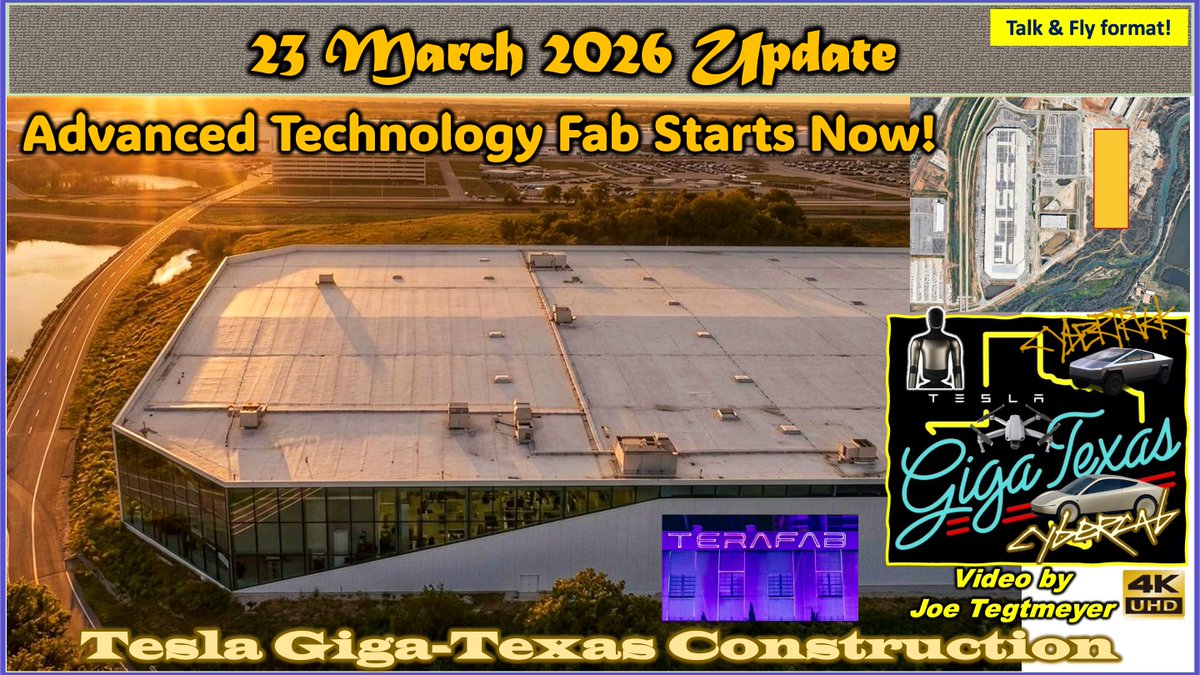
The News: Drone footage from Joe Tegtmeyer confirms massive construction activity at Giga Texas's North Campus, directly tied to the Terafab — Tesla's joint chip fabrication facility with SpaceX and xAI announced just two days ago.
Why It Matters: The Terafab is the backbone of Tesla's next-generation AI ambitions — producing chips for FSD, Cybercab, and Optimus. Ground-level construction progress means this $20–25B project is moving fast, not just on paper.
Source: @JoeTegtmeyer on X
Giga Texas Terafab Construction Is Already Moving — Drone Footage Shows What's Coming
Just 48 hours after Elon Musk officially announced the Terafab project in Austin, drone footage is already confirming that this isn't a distant concept — construction crews are on the ground and moving fast. Joe Tegtmeyer, the most reliable eyes on Giga Texas, returned from a week away at the Chattanooga Charge event to find a dramatically changed North Campus.


📊 Key Figures
| Metric | Value | Context |
|---|---|---|
| Estimated Investment | $20–25B | Joint: Tesla, SpaceX, xAI |
| Annual Chip Output Target | 100–200B chips | AI + memory chips combined |
| Monthly Wafer Target | 1M wafers/month | vs TSMC's 140K/month (2nm, end-2026) |
| Process Node | 2nm | Cutting-edge as of 2026 |
| New Building Space (planned) | 5.2M+ sq ft | Expands campus to ~15M sq ft total |
| AI5 Chip Small-Batch Production | Late 2026 | Volume production in 2027 |
| Computing Output Goal | 1 terawatt/year | Claimed unique worldwide capability |
What Exactly Is the Terafab?
Announced on March 21, 2026, the Terafab is a joint venture between Tesla, SpaceX, and xAI — and it's being built right on the North Campus of Giga Texas. The ambition is genuinely unprecedented: integrate every stage of semiconductor production under one roof. That means chip design, lithography, fabrication, memory production, advanced packaging, and testing — all in Austin, all in-house.
Musk's stated motivation is supply chain control. Tesla's roadmap for FSD, Cybercab, and Optimus requires a volume of AI chips that existing external suppliers — including TSMC — cannot reliably deliver at the scale or timeline needed. The Terafab is Tesla's answer to that constraint: own the supply chain, own the output.
The facility will produce two primary chip families. First, terrestrial inference chips for FSD, the Cybercab robotaxi program, and Optimus humanoid robots — with the AI5 (fifth-generation AI chip) expected to be among the first products off the line. Second, high-power, radiation-hardened D3 processors designed for space applications, intended for SpaceX and xAI's space-based data center ambitions.
What the Drone Footage Actually Tells Us
Tegtmeyer's video is significant not for any single dramatic reveal, but for the pace it implies. He was away for only a week — attending the Chattanooga Charge event in Tennessee — and returned to find the North Campus visibly transformed. That rate of change on a site of this scale is notable.
According to permit filings, Tesla plans to add over 5.2 million square feet of new building space to the Giga Texas campus by end of 2026, which would bring the total campus footprint to approximately 15 million square feet. For context, the existing Giga Texas facility is already one of the largest buildings by footprint in the world. What's being built north of it is, in practical terms, a second mega-campus.
Major structural work on the North Campus is expected to conclude in late 2026, with equipment installation to follow. Small-batch production of the AI5 chip is targeted for late 2026, with volume production in 2027 — the same year Tesla is targeting full-scale Optimus V4 production at 10 million units per year.
🔭 The BASENOR Take
The Terafab is the most consequential infrastructure project Tesla has announced since the original Gigafactory Nevada. But unlike battery cell production — which has a relatively mature supply chain — semiconductor fabrication at this scale is genuinely uncharted territory for any automotive company. The ambition to out-produce TSMC on 2nm wafers is extraordinary, and the timeline is aggressive.
For Tesla owners, the near-term relevance is FSD. The AI5 chip is the next major hardware leap for Full Self-Driving capability, and Terafab is the facility that will eventually produce it at volume. If the construction timeline holds and small-batch AI5 production begins in late 2026, owners purchasing new vehicles in 2027 could be the first to benefit from domestically-fabbed AI hardware — potentially with meaningfully better FSD performance than today's hardware.
The Cybercab program is equally dependent on this facility. A robotaxi fleet at any meaningful scale requires AI chips by the billions. Without Terafab — or something like it — the Cybercab timeline simply doesn't work. The fact that ground is already being broken, just two days after the official announcement, signals that this project has been in planning for considerably longer than the public reveal suggests. That's a good sign for execution. For more on the self-driving side of this story, see our FSD coverage.
📰 Deep Dive
The Terafab announcement has been framed primarily as a chip story, but it's equally a manufacturing philosophy story. Tesla has spent the last decade vertically integrating everything it could — motors, battery packs, seats, software. Semiconductors were the one major input it couldn't fully control. The Terafab closes that gap, at least in theory.
What makes the drone footage meaningful right now is timing. Semiconductor fabs are among the most complex construction projects on earth — cleanroom environments require extraordinary precision, and equipment lead times for lithography machines alone can run 12–18 months. The fact that site preparation is already underway suggests Tesla placed orders and began permitting well before the public announcement. That's not unusual for a company of this scale, but it does suggest the 2026 small-batch production target is not aspirational — it's planned.
The joint venture structure — Tesla, SpaceX, and xAI sharing the facility — is also worth noting. It distributes the capital burden of a $20–25B investment across three entities with aligned but distinct chip needs. SpaceX's D3 radiation-hardened processors for space data centers have very different requirements than Tesla's inference chips for FSD. Running both under one roof requires sophisticated fab management, but it also means the facility's output can be optimized across multiple product lines simultaneously, improving utilization economics.
For Tesla owners watching the long game: every major capability on Tesla's roadmap — FSD v5 and beyond, Cybercab at scale, Optimus at 10 million units per year — runs through this facility. Tegtmeyer's footage is a reminder that the future being described in press releases is being built with actual concrete and steel, right now, in Austin.
🚕 Following the Robotaxi rollout? See every operating city, launch date and announced market in our Tesla Robotaxi Tracker.
🤖 Tracking Tesla's humanoid robot? See every Optimus production milestone and appearance in our Tesla Optimus Tracker.
Related Gear
Gear up your Tesla with tested, custom-fit BASENOR accessories — shop Tesla accessories →
Sources & reporting notes
The links below identify the material source records used for this report.
- @JoeTegtmeyer on X (2026-03-23T21:19:45.000Z) — Direct source
- @JoeTegtmeyer on X (2026-03-23T21:19:35.000Z) — Direct source
- @ray4tesla on X (2026-03-23T23:52:45.000Z) — Direct source
Source links are preserved as published or accessed. See our editorial standards and corrections policy.
The BASENOR Editorial Desk covers Tesla, SpaceX, and related technology, curating reporting from primary sources — official accounts, regulatory filings, and software release data. Every article passes source-record and fact-checking review before publication. About the newsroom.
This report was curated by the BASENOR Editorial Desk from the sources listed above. Read our editorial standards or email editorial@basenor.com to report an error.