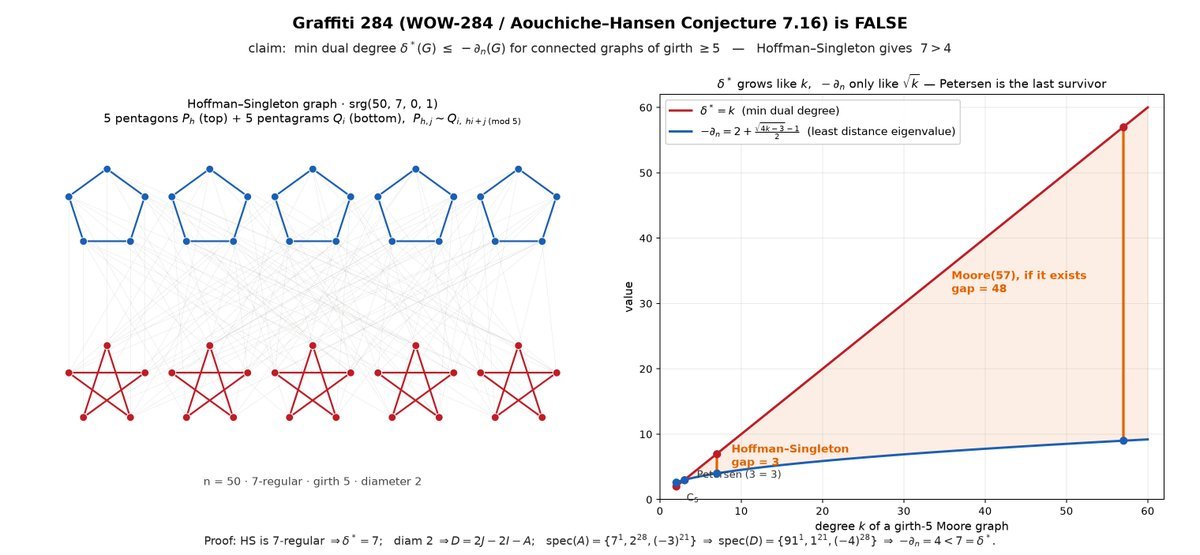
Elon Musk says xAI's Grok 4.5 has resolved a graph theory conjecture that mathematicians left open for roughly three decades — a claim, if it holds up under peer review, that would place the model among a small handful of AI systems credited with contributing an original mathematical result. In back-to-back posts early Thursday, Musk paired the breakthrough announcement with a candid performance update: Grok 4.5 is 'not quite as good as Fable,' but it's fast, cheap, and good enough to ship.
The dual message — a headline research win alongside a pragmatic positioning statement — captures where xAI's flagship model sits right now: technically ambitious, competitively priced, and still measured against a benchmark internal to the company's own roadmap.

The Math Breakthrough, Explained
According to background reporting on the announcement, Grok 4.5 constructed an explicit counterexample to a long-standing question about the hypercontractivity of the Poisson semigroup — specifically on the 4-sphere. Previous work had established that the property held for dimensions up to three and failed by dimension thirteen, leaving everything in between an open question. Grok 4.5's counterexample reportedly demonstrates that the failure begins as early as dimension four, closing a gap that had persisted for about 30 years.
The finding was first publicized on X on July 10, 2026, and according to public reporting, a mathematician involved in earlier work on the problem has since confirmed the example. Important caveat: at the time of this writing, there is no linked peer-reviewed paper or independent formal verification. In pure math, an unpublished counterexample confirmed by one researcher is a promising signal, not a settled result. Expect a preprint to follow if the claim withstands scrutiny.
The broader significance is less about this single conjecture and more about the pattern. Frontier AI models are increasingly being used not just to summarize known mathematics but to search the space of possible counterexamples and constructions — tasks that require sustained symbolic reasoning rather than pattern-matching. If Grok 4.5's contribution is verified, it joins a short but growing list of AI-assisted mathematical results.
The Performance Reality Check
Roughly ten minutes after the breakthrough post, Musk followed up with a more measured statement about Grok 4.5's general capabilities.

'Fable' appears to be an internal xAI reference point — likely a larger or more expensive model in development — rather than a public competitor. Musk's framing is telling: Grok 4.5 is being positioned as the workhorse, not the ceiling. Fast, cost-effective, and 'gets the job done' is the language of a product optimized for API volume and agentic workloads, not for chart-topping benchmark scores.
Key Figures Behind Grok 4.5
According to public documentation of the July 8, 2026 release, Grok 4.5 is xAI's first model built specifically for coding and agentic tasks. The technical specifications published around launch help explain Musk's speed and cost claims:
| Metric | Value |
|---|---|
| Foundation model | V9 (1.5T parameters) |
| Context window | 500,000 tokens |
| Knowledge cutoff | February 1, 2026 |
| Serving speed | ~80 tokens/second |
| Input pricing | $2.00 / 1M tokens |
| Output pricing | $6.00 / 1M tokens |
| Cached input discount | 75% off ($0.50 / 1M) |
| Training hardware | Nvidia GB300 GPUs (tens of thousands) |
Two details in that table matter more than they might appear. First, the 1.5-trillion-parameter V9 foundation represents roughly a threefold scale-up from the V8 series that powered Grok 4.3, according to background reporting. Second, the model was co-trained with Cursor using real developer session data — a signal that xAI is targeting the coding assistant market directly, where inference speed and price per token dictate which model developers actually use day-to-day.
Musk also suggested in earlier commentary that the 80-tokens-per-second serving rate could more than double once xAI deploys its internally developed C/C++ inference stack. If that materializes, Grok 4.5's cost-per-useful-answer would improve materially without any change to the underlying weights.
What This Means for the Broader AI Race
For the AI industry, the graph theory result — if verified — is the more interesting story. Frontier labs have been quietly using their models to probe open mathematical questions for over a year, and every credible result compresses the timeline on which serious researchers will need to treat AI as a legitimate collaborator rather than a novelty. A confirmed 30-year-old conjecture would be a meaningful data point in that shift.
For xAI specifically, the two-post sequence reads as a deliberate strategy: lead with a research narrative that demonstrates ceiling, then follow with a product narrative that demonstrates floor. It's the same playbook used successfully by other frontier labs — headline capability from the top model, volume revenue from the workhorse. Grok 4.5 is clearly meant to be the workhorse.
What to Watch Next
Three signals will determine whether this week's announcement holds up:
- A preprint on arXiv. Without a written proof or explicit counterexample construction that other mathematicians can verify, the conjecture claim remains provisional.
- Independent replication. Can another lab's model — or a human mathematician working from Grok 4.5's output — reproduce the counterexample from scratch?
- The 'Fable' reveal. Musk has now publicly referenced an internal model that outperforms Grok 4.5. Whether Fable becomes a product, a research demo, or quietly disappears will say a lot about xAI's roadmap for the second half of 2026.
For now, Grok 4.5 is what xAI is shipping — fast, priced for volume, and, if the math holds up, capable of contributions that older benchmarks were never designed to measure.
Sources & reporting notes
The links below identify the material source records used for this report.
- @elonmusk on X (2026-07-23T05:38:54.000Z) — Direct source
- @elonmusk on X (2026-07-23T05:50:02.000Z) — Direct source
Source links are preserved as published or accessed. See our editorial standards and corrections policy.
The BASENOR Editorial Desk covers Tesla, SpaceX, and related technology, curating reporting from primary sources — official accounts, regulatory filings, and software release data. Every article passes source-record and fact-checking review before publication. About the newsroom.
This report was curated by the BASENOR Editorial Desk from the sources listed above. Read our editorial standards or email editorial@basenor.com to report an error.