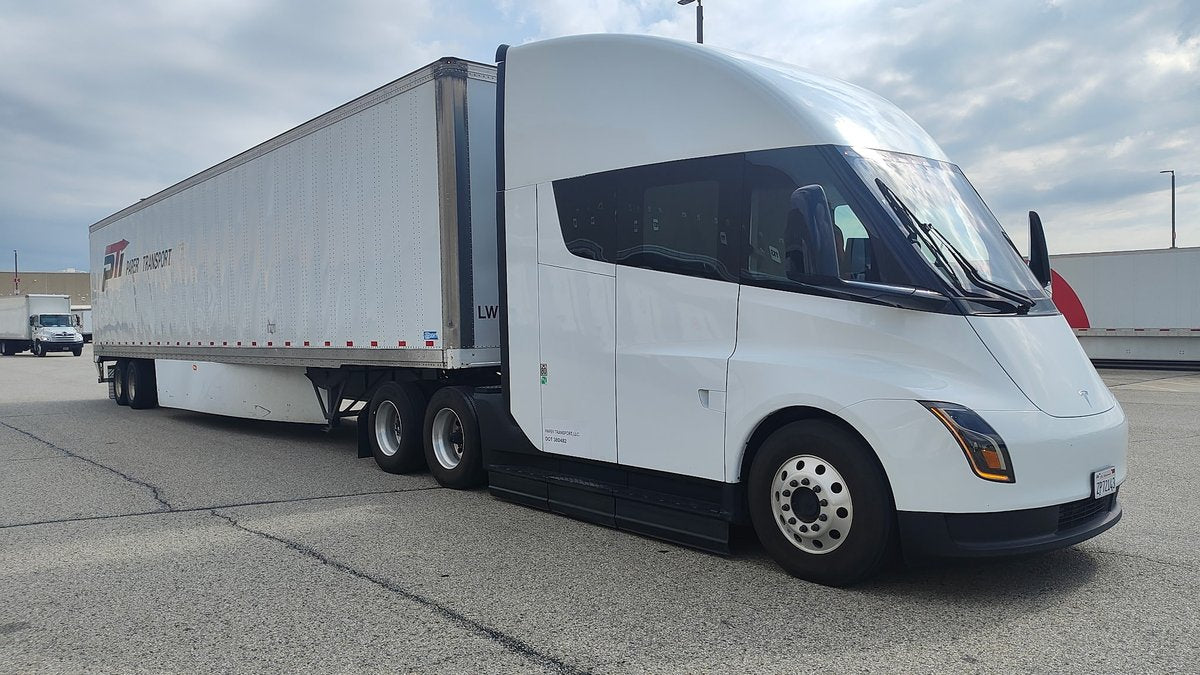
Paper Transport (PTI), a Wisconsin-based truckload carrier, has announced a formal partnership with Tesla to evaluate the Tesla Semi Long Range in dedicated operations within the Chicago market. The announcement, made July 13, 2026, marks another step in the Tesla Semi's commercial expansion as volume production ramps at Gigafactory Nevada — and signals that regional freight corridors are emerging as the truck's natural proving ground.

Why Chicago, and Why Now
The Chicago market is a deliberate choice. Dedicated freight operations in dense metro corridors offer something Tesla needs from early commercial partners: predictable routes, consistent daily mileage, and controlled charging infrastructure. PTI's VP of Maintenance Bryan Ellen cited exactly this logic in the announcement, expressing enthusiasm for leveraging Tesla's technology within those parameters.
For the Tesla Semi Long Range, those conditions are close to ideal. According to Tesla's specifications, the truck delivers approximately 500 miles of range when fully loaded at 82,000 lbs gross combined weight — enough to cover most regional dedicated runs without mid-shift charging. When charging is required, the Semi's MCS 3.2 standard supports peak charging at 1.2 MW, recovering roughly 60% of range in 30 minutes. For a carrier running predictable loops out of a Chicago depot, that math works.
PTI CEO Tyler Ellison framed the partnership as an expansion of the company's sustainable transportation portfolio — language that suggests this isn't a one-truck curiosity but a deliberate fleet strategy evaluation. The structure of the pilot, focused on dedicated operations rather than irregular long-haul, is consistent with how most carriers have approached early Tesla Semi deployments: start where the variables are controllable, then expand.
The Semi's Commercial Moment
The timing of this partnership matters. Tesla began volume production of the Semi on April 29, 2026, at Gigafactory Nevada, with the facility designed for up to 50,000 trucks annually. That shift from limited early deliveries to volume production means carriers can now realistically plan fleet-scale evaluations rather than waiting on allocation. PTI's announcement is one of the cleaner signals yet that commercial freight operators are treating the Semi as a production-ready platform rather than a prototype.
The truck's specs support that confidence. The tri-motor powertrain delivers up to 800 kW of drive power. The 822 kWh battery pack uses 4680 cells rated for 1 million miles of use — a figure that matters enormously for fleet total cost of ownership calculations. Energy consumption sits at 1.7 kWh per mile under load, and an integrated ePTO provides up to 25 kW for auxiliary equipment, addressing one of the practical concerns fleet operators raise about electric work trucks.
What the Evaluation Will Actually Test
Pilot programs like this one serve a specific purpose: they generate real-world operational data that press releases and spec sheets cannot. PTI will be watching charging infrastructure reliability, driver adaptation, maintenance intervals, and actual energy costs against diesel benchmarks on routes they already know well. Chicago's climate — including winter conditions that stress battery performance — will add a layer of real-world validation that controlled testing cannot replicate.
The outcome of evaluations like PTI's will carry weight beyond the two companies involved. Fleet operators across the dedicated and regional truckload segment are watching early adopters closely. A successful Chicago pilot gives procurement teams at other carriers a data point they can take to internal stakeholders. A troubled one surfaces the operational gaps Tesla still needs to close.
With volume production now running and commercial partnerships accelerating, the Tesla Semi is entering the phase where its reputation will be built not in product reveals, but in dispatch logs and fuel cost comparisons. PTI's Chicago evaluation is exactly the kind of unglamorous, data-driven test that determines whether an electric truck becomes a fleet staple or a footnote.
Related Gear
Gear up your Tesla with tested, custom-fit BASENOR accessories — shop Tesla accessories →
Sources & reporting notes
The links below identify the material source records used for this report.
- @SawyerMerritt on X (2026-07-13T14:31:45.000Z) — Direct source
Source links are preserved as published or accessed. See our editorial standards and corrections policy.
The BASENOR Editorial Desk covers Tesla, SpaceX, and related technology, curating reporting from primary sources — official accounts, regulatory filings, and software release data. Every article passes source-record and fact-checking review before publication. About the newsroom.
This report was curated by the BASENOR Editorial Desk from the sources listed above. Read our editorial standards or email editorial@basenor.com to report an error.