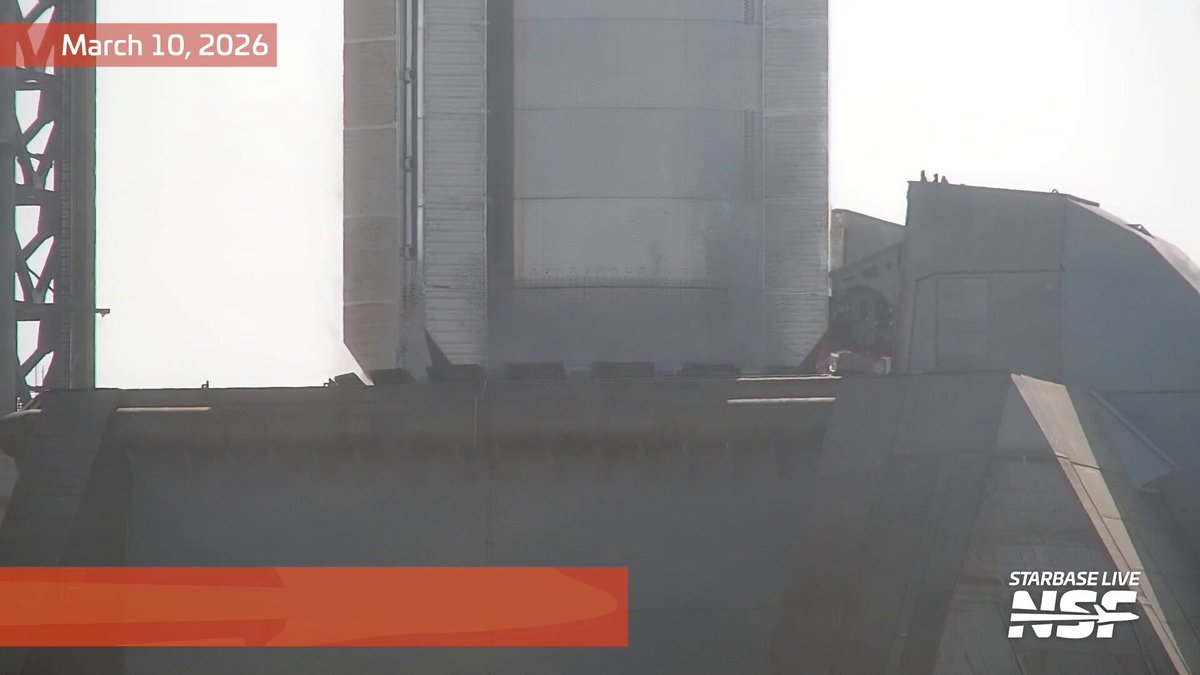
The News: SpaceX's Booster 19 — the first Block 3 Super Heavy booster — is performing exceptionally well during its initial pad testing campaign on the newly commissioned Orbital Launch Pad 2 at Starbase, Texas.
Why It Matters: This is a double milestone: the first Block 3 booster ever tested, on a brand-new launch pad — setting the stage for Starship Flight 12 and the debut firing of Raptor 3 engines on a flight-intent vehicle.
Source: @NASASpaceflight on X

Two Firsts at Once: Block 3 Booster Meets Brand-New Pad
SpaceX doesn't do incremental. Booster 19 isn't just another Super Heavy — it's the first Block 3 (V3) configuration to reach the launch site, and it's being tested on Orbital Launch Pad 2, itself a brand-new facility that had never hosted a flight vehicle until now. According to NASASpaceflight, B19 is performing exceptionally during this initial campaign — strong language from a publication that typically errs on the side of caution.
The significance here is layered. Every new pad has unknowns: plumbing, ground support equipment, deluge systems, data connections. The fact that Pad 2 is already delivering clean test results — and that B19 is responding well — suggests SpaceX's construction and commissioning teams executed at a high level.
📊 Key Figures
| Metric | Value | Context |
|---|---|---|
| Booster Generation | Block 3 (V3) | First of its kind at Starbase |
| Raptor 3 Thrust (per engine) | ~280 tonnes | ~22% more than Raptor 2 |
| Engines Installed (initial) | 10 Raptor 3 | Partial install for static fire campaign |
| Cryo Proof Tests Completed | Feb 1–7, 2026 | Ambient, partial, and full cryo tests passed |
| Pad 2 Rollout Date | March 7, 2026 | First flight vehicle on Pad 2 ever |
| Booster Construction Time | 27 days | Fastest Super Heavy stacked to date |
| Estimated Flight 12 Window | Early–mid April 2026 | Per Elon Musk; no official date confirmed |
What Makes Block 3 Different
The Block 3 designation isn't cosmetic. Booster 19 was stacked in just 27 days — the fastest Super Heavy assembly on record — suggesting SpaceX has dramatically streamlined its manufacturing process. It arrived at Pad 2 with a partial installation of 10 Raptor 3 engines for the upcoming static fire, which will be a historic first: the first time Raptor 3 engines fire on a flight-intent vehicle.
Raptor 3 is a meaningful leap. Each engine is expected to produce approximately 280 tonnes of thrust, roughly 22% more than the Raptor 2 engines used on previous Starship flights. On a full booster complement, that adds up to a substantial increase in total liftoff thrust — which matters for payload capacity and the margins needed to execute booster catch maneuvers reliably.
Ship 39 Is Ready Too
B19 isn't operating in isolation. Its paired upper stage, Ship 39 — the first V3 Starship — completed its three-round cryogenic proof test series by March 5, 2026, with SpaceX officially confirming the results on March 8. Ship 39 also introduces hardware changes: redesigned catch pins mounted higher on the nosecone and an added docking port, both pointing toward an expanding mission profile beyond simple point-to-point testing.
With both halves of the integrated vehicle now through their structural validation campaigns, the critical path to Flight 12 runs squarely through the B19 static fire.
Pad 2: A Second Launch Capability Changes Everything
Pad 2's commissioning is arguably as significant as the booster itself. A second orbital launch pad at Starbase means SpaceX can maintain launch cadence even when one pad requires maintenance or refurbishment after a flight. The water-cooled top deck was tested in mid-February 2026, followed by a full deluge system test during the week of February 24 — both passed. Flight 12 will be the inaugural integrated launch attempt from this pad, making it a test of infrastructure as much as hardware.
🔭 The BASENOR Take
Timeline: Static fire imminent → Flight 12 targeting early-to-mid April 2026 (Elon Musk estimate, unconfirmed officially)
Impact Level: 🔴 High — Block 3 hardware and Pad 2 represent the next generation of Starship infrastructure
Confidence: ⭐⭐⭐⭐ High — cryo tests confirmed complete; static fire is the remaining gating milestone before stacking and launch
The pace here is worth underscoring. B19 was stacked in 27 days. Ship 39 cleared cryo testing within weeks. Pad 2 went from deluge testing to hosting a flight vehicle in under a month. SpaceX is compressing timelines that would have seemed aggressive even a year ago.
For the broader Starship program, a clean static fire on B19 would unlock the first Raptor 3 performance data on a real flight vehicle — data that feeds directly into engine certification, thrust modeling, and the reliability calculations SpaceX needs before it can commit to higher-stakes missions. Every successful test here shortens the distance to operational Starship flights.
📰 Deep Dive
What's easy to miss in the day-to-day testing updates is how much infrastructure work is running in parallel. Pad 2 isn't just a copy of Pad 1 — it represents a refined design informed by everything SpaceX learned from the first 11 flights. The fact that it passed its commissioning tests cleanly and is now hosting B19 without reported anomalies suggests the lessons from earlier flights have been effectively incorporated into the ground systems.
The Raptor 3 static fire will be the real headline when it happens. A 22% thrust increase per engine isn't just a number — it changes the vehicle's performance envelope in ways that compound across the entire mission profile. More thrust means more margin for booster return burns, more payload to orbit, and more flexibility in trajectory design. If the static fire confirms the expected performance figures, it validates the entire Block 3 design philosophy in one test.
Elon Musk's early-to-mid April window for Flight 12 is ambitious but not implausible given the current pace. The remaining steps — completing the static fire, finishing engine installation, stacking Ship 39 on B19, and completing integrated testing — are all well-understood operations at this point. The question is whether any anomaly surfaces during the static fire that requires hardware changes. If B19 fires cleanly, April becomes very realistic. For anyone following the SpaceX coverage closely, this is the moment the program has been building toward since Flight 11.
🚀 Following the Starship program? See every test flight, official outcome and the next launch window in our SpaceX Starship Tracker.
Sources & reporting notes
The links below identify the material source records used for this report.
- @NASASpaceflight on X (2026-03-13T00:39:06.000Z) — Direct source
Source links are preserved as published or accessed. See our editorial standards and corrections policy.
The BASENOR Editorial Desk covers Tesla, SpaceX, and related technology, curating reporting from primary sources — official accounts, regulatory filings, and software release data. Every article passes source-record and fact-checking review before publication. About the newsroom.
This report was curated by the BASENOR Editorial Desk from the sources listed above. Read our editorial standards or email editorial@basenor.com to report an error.