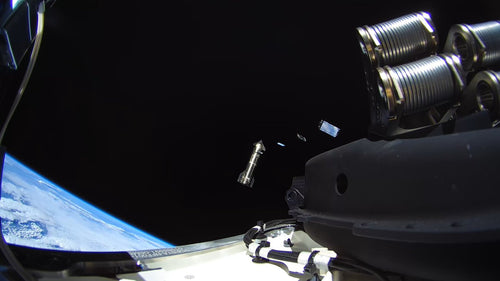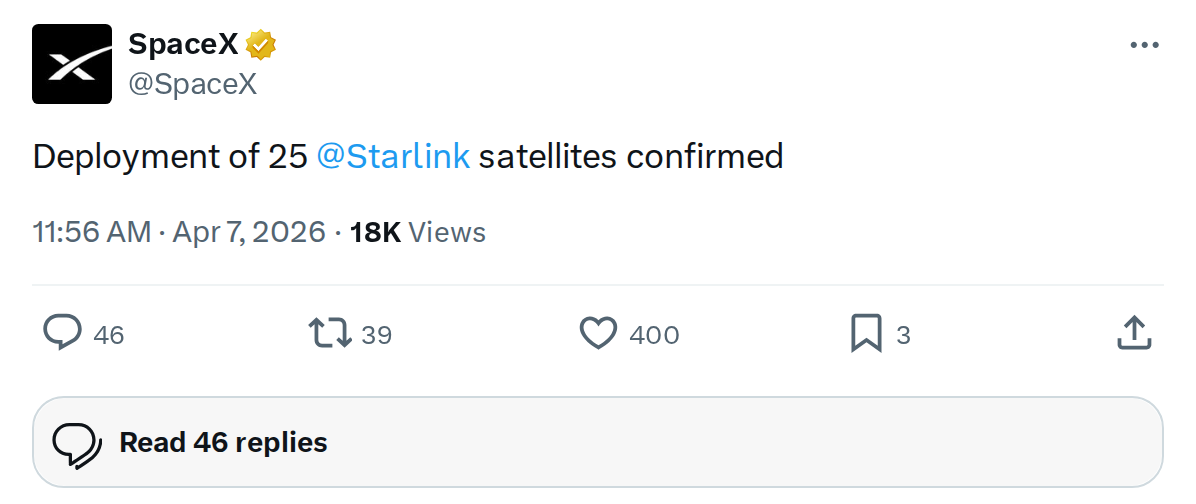
The News: SpaceX has confirmed the successful deployment of 25 Starlink satellites as part of the Starlink 17-35 mission, launched aboard a Falcon 9 from Vandenberg Space Force Base.
Why It Matters: Each new batch of Starlink satellites expands the constellation's capacity and coverage — directly improving the reliability of Starlink-powered connectivity services worldwide, including Tesla's vehicle Wi-Fi and future connectivity integrations.
Source: @SpaceX on X
Another 25 Satellites in Orbit
SpaceX confirmed deployment of 25 Starlink satellites in the early hours of April 7, 2026, completing the Starlink 17-35 mission. The Falcon 9 lifted off from Space Launch Complex 4 East (SLC-4E) at Vandenberg Space Force Base in California on April 6 at 7:50:39 p.m. PDT — one day later than the originally targeted April 5 launch window.

The satellites deployed are Starlink V2 Mini Optimized — the current-generation hardware SpaceX has been steadily placing into orbit to boost throughput and reduce latency across the constellation. Notably, the first-stage booster used for this mission was making its debut flight, with the rocket's first stage targeting a landing on the droneship Of Course I Still Love You, stationed in the Pacific Ocean.
📊 Key Figures
| Metric | Detail |
|---|---|
| Mission Designation | Starlink 17-35 |
| Satellites Deployed | 25 (V2 Mini Optimized) |
| Launch Vehicle | Falcon 9 |
| Launch Site | SLC-4E, Vandenberg SFB |
| Launch Time | 7:50:39 p.m. PDT, April 6 |
| Booster Flight | Debut (first flight) |
| Booster Landing Target | Of Course I Still Love You (Pacific) |
🔭 The BASENOR Take
Timeline: Deployment confirmed ~8 hours after liftoff, April 7, 2026
Impact Level: Incremental — steady constellation growth
Confidence: High — confirmed directly by @SpaceX
This is routine cadence for SpaceX, but routine doesn't mean unimportant. The Starlink 17-35 mission is part of SpaceX's relentless pace of constellation-building — a pace that no other operator in the world can match. Using a brand-new booster on a Starlink mission is also worth noting: it signals SpaceX has enough booster inventory to assign fresh hardware to what is now a near-weekly launch cadence.
For Tesla owners specifically, the relevance of Starlink's growth is real. Tesla vehicles use Starlink as a backbone for over-the-air update delivery in remote areas, and the company's Semi and fleet products are positioned to leverage direct Starlink connectivity. A denser, more capable constellation means faster OTA downloads, better in-car streaming quality, and more reliable connectivity for owners in rural or underserved regions. For our full SpaceX coverage, check the dedicated tag page.
The V2 Mini Optimized hardware matters here too. These satellites carry significantly more bandwidth capacity than the original V1 hardware, meaning each new batch added to the constellation contributes more usable throughput than earlier missions did on a per-satellite basis. SpaceX is not just adding numbers — it's adding quality.
With the first-stage booster making its debut on this mission, SpaceX also continues to prove the reliability of its reusability program. A new booster being trusted on a live payload mission — rather than a test flight — underscores how mature and operationally confident the Falcon 9 program has become. The landing on Of Course I Still Love You in the Pacific would mark yet another recovery in a now-routine sequence that continues to drive down launch costs across the board.
Sources & reporting notes
The links below identify the material source records used for this report.
- @SpaceX on X (2026-04-07T03:56:35.000Z) — Direct source
Source links are preserved as published or accessed. See our editorial standards and corrections policy.
The BASENOR Editorial Desk covers Tesla, SpaceX, and related technology, curating reporting from primary sources — official accounts, regulatory filings, and software release data. Every article passes source-record and fact-checking review before publication. About the newsroom.
This report was curated by the BASENOR Editorial Desk from the sources listed above. Read our editorial standards or email editorial@basenor.com to report an error.