📌 UPDATE — April 13, 2026
Both Booster 19 and Ship 39 are now actively undergoing full engine testing at their respective sites — Pad 2 and Massey's Test Site. According to NASASpaceflight, the hardware is working through the standard pre-flight test sequence, with full static fire milestones for each vehicle still ahead. Successful completion of these static fires will be a key gate before SpaceX can set a firm launch date for IFT-12.

📡 @NASASpaceflight · Apr 13, 2026
📌 UPDATE — April 12, 2026
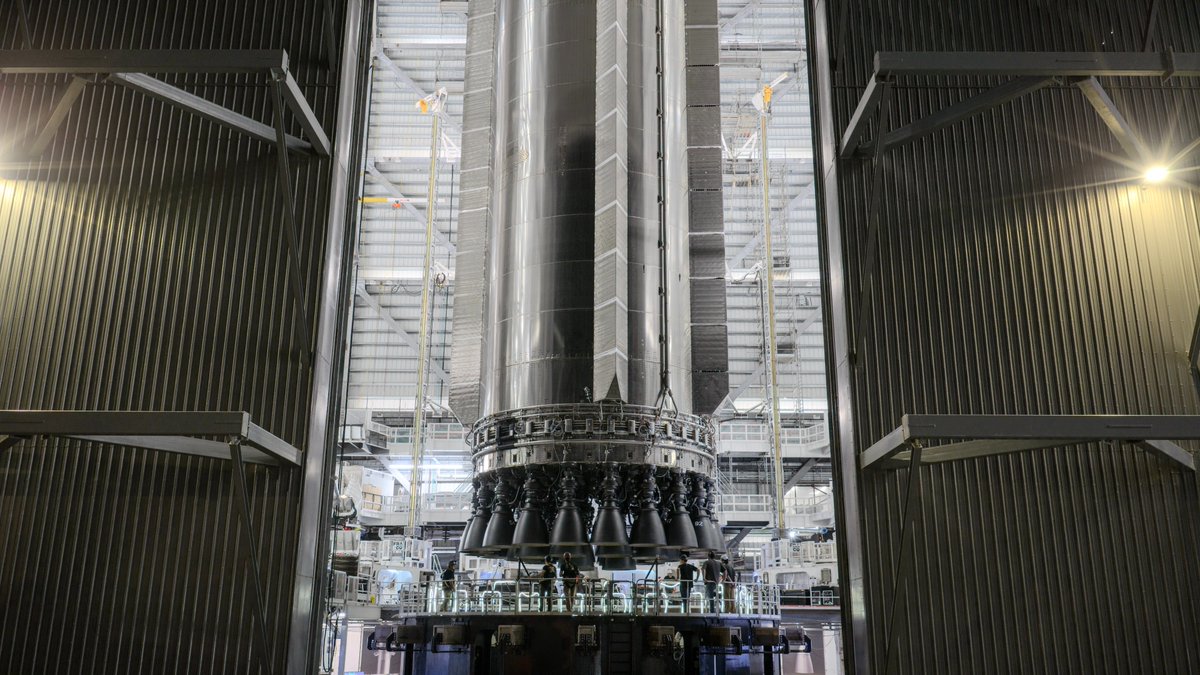
SpaceX has rolled the Starship and Super Heavy stack out to continue preflight testing, marking a concrete step forward in IFT-12 preparations. The move was confirmed directly by SpaceX on X early April 12 UTC, suggesting the program is progressing on schedule toward the previously reported May launch window. No new launch date has been officially announced, but rollout to the pad for preflight operations is typically one of the final milestones before a static fire and flight readiness review.
@SpaceX · Apr 12, 2026"Starship and Super Heavy move out to continue preflight testing"
📌 UPDATE — April 11, 2026
IFT-12 prep is accelerating: Booster 19 was lifted and stacked atop Pad 2's Orbital Launch Mount at Starbase today, confirmed by multiple observers on the ground. Crucially, all 33 engines installed on Booster 19 are Raptor 3 units — making this the first fully Raptor 3-equipped Super Heavy booster to reach the launch mount. NASASpaceflight captured close-up imagery allowing individual engine numbers to be identified, underscoring the hardware's readiness for upcoming ground testing and eventual flight.
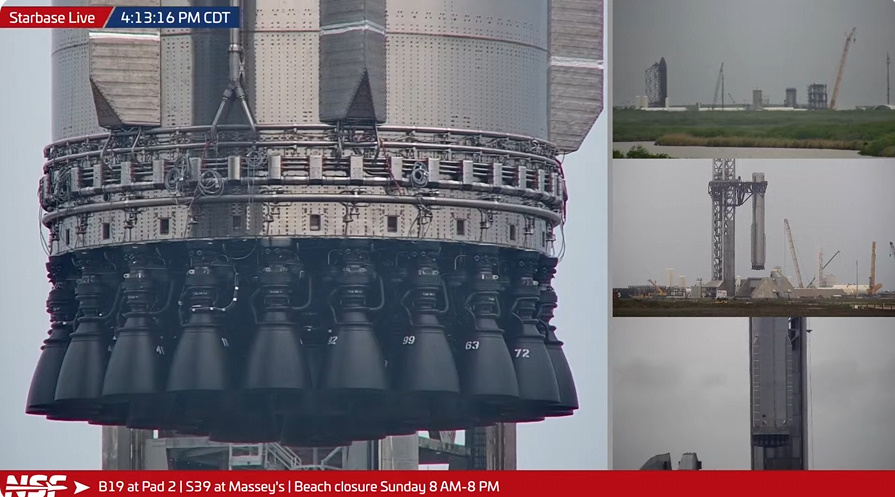
📸 Via @NASASpaceflight & @CSI_Starbase / LabPadre — April 11, 2026
📌 UPDATE — April 11, 2026
IFT-12 preparations are visibly accelerating: Booster 19 rolled down Highway 4 to Pad 2 at Starbase today, heading into a critical pre-flight test campaign that includes a full 33-engine static fire — the first public look at Raptor 3 engines firing together at scale. The rollout was captured live by NASASpaceflight, confirming the hardware is in active test flow rather than still in the build phase. If the static fire goes cleanly, it would clear one of the last major milestones before an integrated stack attempt and push IFT-12 firmly into the May 2026 window outlined in our original coverage.

📹 Booster 19 rolling down Highway 4 to Pad 2 — via @NASASpaceflight
The News: NSF's Max Evans has dropped a fresh Starship program update as IFT-12 slips to early-to-mid May 2026, carrying the debut V3 configuration with Raptor 3 engines.
Why It Matters: Starship is the backbone of SpaceX's Starlink V3 satellite deployment and NASA's Artemis lunar lander — delays ripple across multiple programs Tesla owners and the broader space community are watching closely.
Source: @NASASpaceflight on X

Where Starship Stands Right Now
NASASpaceflight's Max Evans — one of the most reliable voices covering the Starbase facility — has published a new program update as SpaceX navigates a pivotal stretch for the Starship program. The headline: IFT-12, the 12th integrated flight test, has slipped from its earlier April target to early-to-mid May 2026. Two compounding factors are driving that delay.
First, the aftermath of Starship Flight 11 (IFT-11, which flew October 13, 2025) triggered an FAA mishap investigation after an anomaly was recorded around April 2, 2026. FAA sign-off is a hard gate — SpaceX cannot fly until that investigation closes. Second, a Rapid Unscheduled Disassembly (RUD) of a Starship component was observed at Starbase on April 6, 2026 — just one day before this update. The cause has not been confirmed publicly, but the timing adds further uncertainty to the schedule.
📊 Key Figures
| Metric | Detail |
|---|---|
| Next Flight | IFT-12 — early to mid May 2026 |
| Previous Target | Early April 2026 |
| Configuration | Starship V3 — maiden flight |
| Stack Height | 123 m (403 ft) — taller Block versions planned |
| Engine Upgrade | Raptor 3 — first flight test |
| IFT-11 Anomaly Date | ~April 2, 2026 (FAA investigation open) |
| April 6 Incident | RUD of Starship component at Starbase — cause unconfirmed |
What Makes V3 a Genuine Step Change
IFT-12 is not just another test flight — it is the debut of the Starship V3 configuration, and the upgrades are substantive. The Super Heavy booster and Starship upper stage are both taller than their predecessors, with increased propellant capacity that directly translates to greater payload potential. More significantly, V3 introduces the Raptor 3 engine, SpaceX's latest iteration of its methane-fueled powerplant, which is expected to deliver higher thrust and improved reliability over Raptor 2.
SpaceX has also stated that IFT-12 will test upgraded launch tower systems — part of the ongoing refinement of the mechazilla catch mechanism that successfully retrieved the Super Heavy booster in earlier flights. For IFT-12, SpaceX intends to attempt a soft ocean landing for the upper stage rather than a tower catch, keeping risk proportionate to the maiden V3 flight.
🔭 The BASENOR Take
Timeline: IFT-12 targeting early-to-mid May 2026 — contingent on FAA investigation closure and resolution of the April 6 Starbase incident.
Impact Level: HIGH — V3 is a foundational milestone for Starlink V3 satellite deployment cadence and NASA Artemis lunar lander timelines.
Confidence on May Window: MODERATE — FAA investigation pace is the primary wildcard. The April 6 RUD adds a secondary unknown.
The April 6 RUD at Starbase deserves attention. SpaceX has not confirmed what component was involved or whether it affects IFT-12 hardware directly. Historically, Starbase incidents of this nature have ranged from ground support equipment failures to propellant loading anomalies — not all of them flight-critical. Until SpaceX or NSF clarifies the specifics, it is premature to call this a program-altering event, but it is a variable that did not exist 48 hours ago.
📰 Deep Dive
The broader context here matters. Starship is not operating in isolation — it is the critical path for multiple SpaceX programs that intersect directly with Tesla's ecosystem. Starlink's next-generation V3 satellites require Starship's payload capacity to reach orbit; those satellites underpin the direct-to-cell service that Tesla vehicles are increasingly expected to leverage for connectivity. Every month of Starship delay is a month of deferred Starlink V3 capacity.
The FAA investigation into IFT-11's anomaly is the most concrete near-term obstacle. The FAA's mishap investigation process requires SpaceX to identify root cause, implement corrective action, and receive agency sign-off before the next flight license is issued. Based on the cadence of previous investigations — IFT-3 through IFT-9 each required varying investigation periods — a May clearance is achievable but not guaranteed if the root cause analysis surfaces systemic issues with the V3 hardware stack.
Raptor 3's debut on IFT-12 is arguably the most technically significant element of this flight. SpaceX has been tight-lipped on specific performance numbers for Raptor 3, but the engine is understood to deliver meaningfully higher thrust-to-weight ratios than Raptor 2 while simplifying the external plumbing that has historically been a maintenance challenge. A successful Raptor 3 validation on IFT-12 would accelerate SpaceX's ability to increase flight cadence — which is ultimately the metric that determines how quickly Starship becomes operationally useful rather than experimentally interesting. For our full SpaceX coverage, including previous Starship flight analyses, check the archive.
The May window, if met, would put IFT-12 roughly seven months after IFT-11 — a longer gap than SpaceX has publicly targeted for its rapid iteration cadence. The pressure to close that gap is real, but SpaceX's track record shows the team prioritizes getting the configuration right over hitting an arbitrary calendar date. Watch for FAA investigation closure as the clearest leading indicator that IFT-12 is genuinely imminent.
🚀 Following the Starship program? See every test flight, official outcome and the next launch window in our SpaceX Starship Tracker.
Sources & reporting notes
The links below identify the material source records used for this report.
- @NASASpaceflight on X (2026-04-07T01:46:10.000Z) — Direct source
- @NASASpaceflight on X (2026-04-11T15:52:44.000Z) — Direct source
- @NASASpaceflight on X (2026-04-11T15:28:45.000Z) — Direct source
- @NASASpaceflight on X (2026-04-11T21:13:47.000Z) — Direct source
- @NASASpaceflight on X (2026-04-11T21:08:08.000Z) — Direct source
- @CSI_Starbase on X (2026-04-11T21:14:08.000Z) — Direct source
- @NASASpaceflight on X (2026-04-11T21:25:35.000Z) — Direct source
- @SpaceX on X (2026-04-12T03:21:37.000Z) — Direct source
- @NASASpaceflight on X (2026-04-13T00:39:32.000Z) — Direct source
Source links are preserved as published or accessed. See our editorial standards and corrections policy.
The BASENOR Editorial Desk covers Tesla, SpaceX, and related technology, curating reporting from primary sources — official accounts, regulatory filings, and software release data. Every article passes source-record and fact-checking review before publication. About the newsroom.
This report was curated by the BASENOR Editorial Desk from the sources listed above. Read our editorial standards or email editorial@basenor.com to report an error.