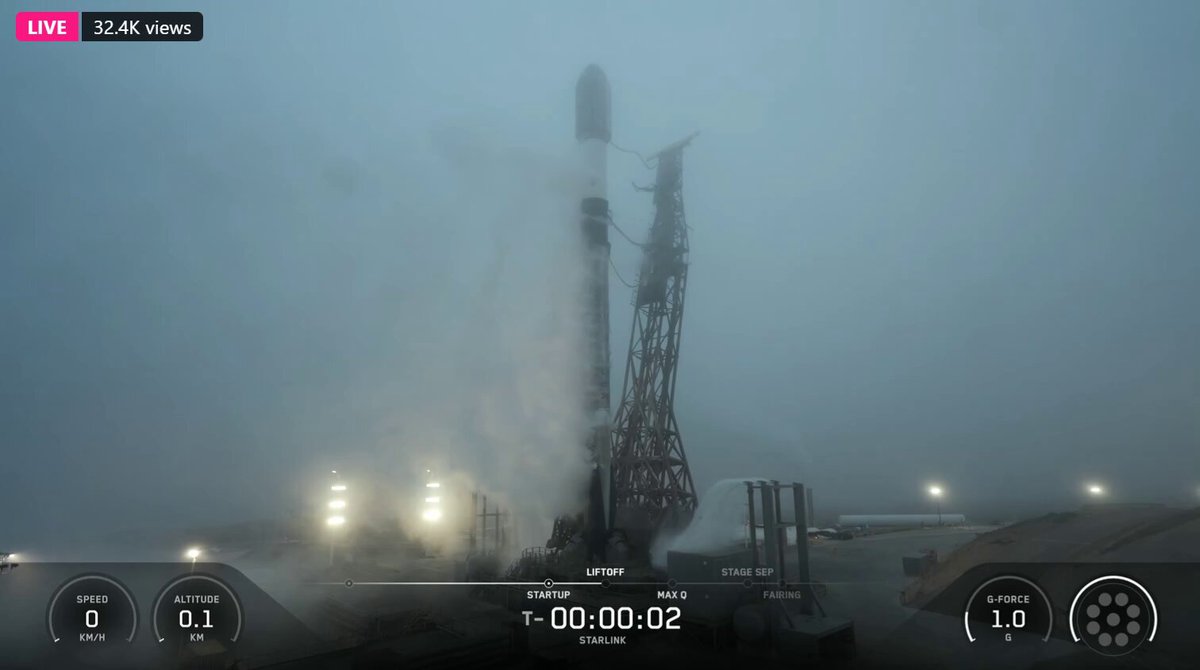
SpaceX's Falcon 9 booster B1071 added another chapter to its record book early Saturday, lifting off from Vandenberg Space Force Base on its 35th mission and sticking the landing once again — cementing its status as one of the most-flown orbital boosters in history. The payload: 24 Starlink V2 Mini Optimized satellites bound for the growing Starlink Group 17-48 shell.

The Numbers Behind the Mission
Liftoff occurred at 8:02 p.m. PDT on July 10 (03:02 UTC July 11) from Space Launch Complex 4 East at Vandenberg Space Force Base in California. Approximately eight minutes after launch, B1071 touched down on the drone ship Of Course I Still Love You, stationed in the Pacific Ocean — its 35th successful recovery.
| Detail | Value |
|---|---|
| Booster | Falcon 9 B1071 (flight 35) |
| Mission | Starlink Group 17-48 |
| Launch Site | SLC-4E, Vandenberg Space Force Base |
| Launch Time | 8:02 p.m. PDT / 03:02 UTC (July 11) |
| Payload | 24 Starlink V2 Mini Optimized satellites |
| Landing Zone | Of Course I Still Love You (Pacific Ocean) |

Why 35 Flights Matters
When SpaceX first introduced the concept of a reusable orbital booster, the working assumption across the industry was that refurbishment costs would erode most of the economic benefit after a handful of flights. B1071's 35-flight record challenges that assumption directly. Each additional flight on the same hardware reduces the per-launch amortized cost of the booster — the single most expensive component of a Falcon 9 mission — and compresses the turnaround time that determines how many launches SpaceX can execute in a calendar year.
The V2 Mini Optimized satellites aboard this mission represent the current generation of Starlink hardware, offering higher throughput than earlier variants. Stacking that payload improvement on top of a battle-tested booster underscores how SpaceX is simultaneously advancing both the launch vehicle and the constellation it serves.
Editor's View
Thirty-five flights on a single booster would have been considered science fiction a decade ago. Today it's a routine Friday night out of Vandenberg. The real story isn't just the number — it's the operational cadence that number enables. As long as B1071 keeps landing cleanly, SpaceX has every incentive to keep flying it, and each successful recovery raises the question of where the practical ceiling actually sits. There's no obvious engineering answer yet, which makes every subsequent mission worth watching.
Sources & reporting notes
The links below identify the material source records used for this report.
- @NASASpaceflight on X (2026-07-11T03:10:55.000Z) — Direct source
- @NASASpaceflight on X (2026-07-11T03:02:55.000Z) — Direct source
Source links are preserved as published or accessed. See our editorial standards and corrections policy.
The BASENOR Editorial Desk covers Tesla, SpaceX, and related technology, curating reporting from primary sources — official accounts, regulatory filings, and software release data. Every article passes source-record and fact-checking review before publication. About the newsroom.
This report was curated by the BASENOR Editorial Desk from the sources listed above. Read our editorial standards or email editorial@basenor.com to report an error.