📌 UPDATE — July 11, 2026
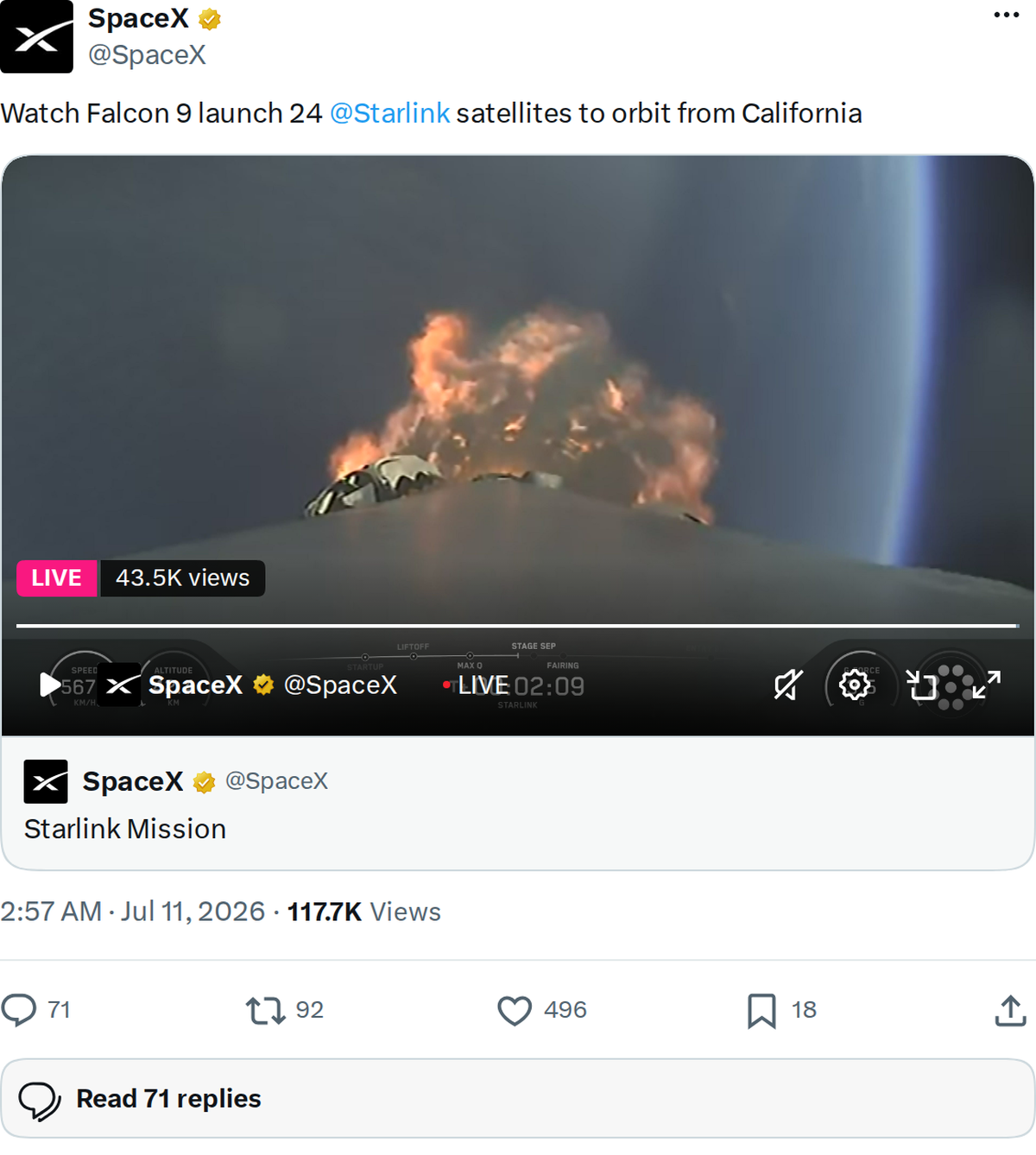
SpaceX has since launched Starlink Group 17-48 from Vandenberg at 0300 UTC on July 11, adding yet another batch of satellites to the growing constellation. According to space-tracker Jonathan McDowell (@planet4589), this launch pushed the total number of cataloged orbital objects to 69,998 — just two shy of 70,000. McDowell noted that the rollover to catalog number 100,000 was expected later the same day, a milestone reflecting the extraordinary pace at which SpaceX is expanding its Starlink network.

SpaceX launched another batch of 24 Starlink satellites into low Earth orbit from Vandenberg Space Force Base in California on July 1, 2026, marking yet another step in the company's relentless push to blanket the globe in high-speed internet coverage. The mission, designated Starlink Group 17-46, lifted off at 7:58 p.m. PDT from Space Launch Complex 4 East — and by all accounts, it went exactly to plan.

Mission Recap
Booster 1100 — on its seventh flight — powered the rocket off the pad and, roughly eight minutes later, stuck its landing on the droneship Of Course I Still Love You in the Pacific Ocean. Satellite deployment was confirmed approximately one hour after liftoff, with all 24 spacecraft successfully released into their target low Earth orbit.
According to Space.com, this mission was SpaceX's 77th Falcon 9 launch of 2026, or its 78th overall orbital launch of the year when counting one Falcon Heavy flight. That pace — roughly one launch every three to four days — underscores just how industrialized SpaceX's launch operations have become. Vandenberg's SLC-4E pad, which handles westward polar and sun-synchronous trajectories, continues to be one of the busiest orbital launch sites on Earth.
Where the Constellation Stands
| Metric | Value |
|---|---|
| Active Starlink satellites (as of July 2, 2026) | 10,700+ |
| Satellites on this mission | 24 |
| Booster (B1100) flight count | 7th |
| SpaceX Falcon 9 launches in 2026 | 77 |
| Total orbital launches in 2026 (incl. Falcon Heavy) | 78 |
| Launch site | SLC-4E, Vandenberg SFB, CA |
| Booster landing zone | OCISLY droneship, Pacific Ocean |
Crossing the 10,700 active-satellite threshold is a milestone worth pausing on. When Starlink launched its first batch in May 2019, analysts debated whether a few hundred satellites would be enough to deliver viable broadband. Today, the constellation is more than an order of magnitude larger, and SpaceX shows no sign of slowing. The company has FCC authorization to operate tens of thousands of satellites across multiple orbital shells, and it is adding capacity faster than any competitor has managed to deploy a first-generation network.
For Tesla owners specifically, the Starlink expansion has a direct downstream effect: the same satellite infrastructure underpins Tesla's in-car Starlink connectivity option, available on vehicles equipped with the hardware. A denser, more capable constellation translates to better coverage in rural and remote areas where traditional LTE networks fall short — exactly the conditions where Tesla owners on long road trips or in off-grid locations feel the gap most acutely. For more on SpaceX's ongoing launch cadence and what it means for connectivity, see our SpaceX coverage.
With 78 orbital launches already logged through early July, SpaceX is on track to comfortably surpass its 2025 annual record. The next Starlink missions are expected to continue at the same cadence, with both Vandenberg and Cape Canaveral pads cycling through boosters that are now routinely flying their seventh, eighth, and ninth flights — a reusability benchmark that would have seemed implausible just five years ago.
Sources & reporting notes
The links below identify the material source records used for this report.
- @SpaceX on X (2026-07-11T02:57:36.000Z) — Direct source
- @planet4589 on X (2026-07-11T06:55:35.000Z) — Direct source
- @planet4589 on X (2026-07-11T06:58:00.000Z) — Direct source
Source links are preserved as published or accessed. See our editorial standards and corrections policy.
The BASENOR Editorial Desk covers Tesla, SpaceX, and related technology, curating reporting from primary sources — official accounts, regulatory filings, and software release data. Every article passes source-record and fact-checking review before publication. About the newsroom.
This report was curated by the BASENOR Editorial Desk from the sources listed above. Read our editorial standards or email editorial@basenor.com to report an error.