📌 UPDATE — July 17, 2026
Elon Musk confirmed overnight that Starlink V3 satellites will increase space-based bandwidth by approximately two orders of magnitude — that's roughly a 100× improvement over current capacity. The statement came via a post on X and represents the most concrete performance claim SpaceX has attached to the V3 generation to date. A 100× bandwidth leap would dramatically expand subscriber capacity and throughput potential, particularly for high-density markets and enterprise/mobility customers where congestion has been a persistent bottleneck. No specific timeline for full constellation buildout was provided alongside the announcement.

📌 UPDATE — July 17, 2026
SpaceX has disclosed a key technical detail about Starlink V3: the satellites' phased arrays are powered by upgraded modem chips delivering a ~64x increase in throughput per chip compared to previous generations. SpaceX says this leap allows the constellation to more efficiently serve customers simultaneously across both densely and sparsely populated regions, and to adapt beam patterns dynamically. The chip-level upgrade is a core reason V3 can scale capacity so dramatically without a proportional increase in satellite count. This detail was shared directly by SpaceX and surfaced by @SawyerMerritt on X.

📌 UPDATE — July 16, 2026
SpaceX confirmed today that each Starlink V3 satellite carries six 400 Gbps space lasers, forming a petabit-class laser mesh network capable of routing high-bandwidth traffic between any two points on Earth with redundant paths. A batch of 20 V3 satellites launched on a brief flight test, with only ~20 minutes to complete activation and connection checks before atmospheric reentry. Starlink also revealed that Starlink Mini Lasers will provide high-bandwidth connectivity to NASA's Orion spacecraft during the Artemis III crewed lunar mission — marking a significant expansion of V3's role beyond consumer internet.


📌 UPDATE — July 16, 2026
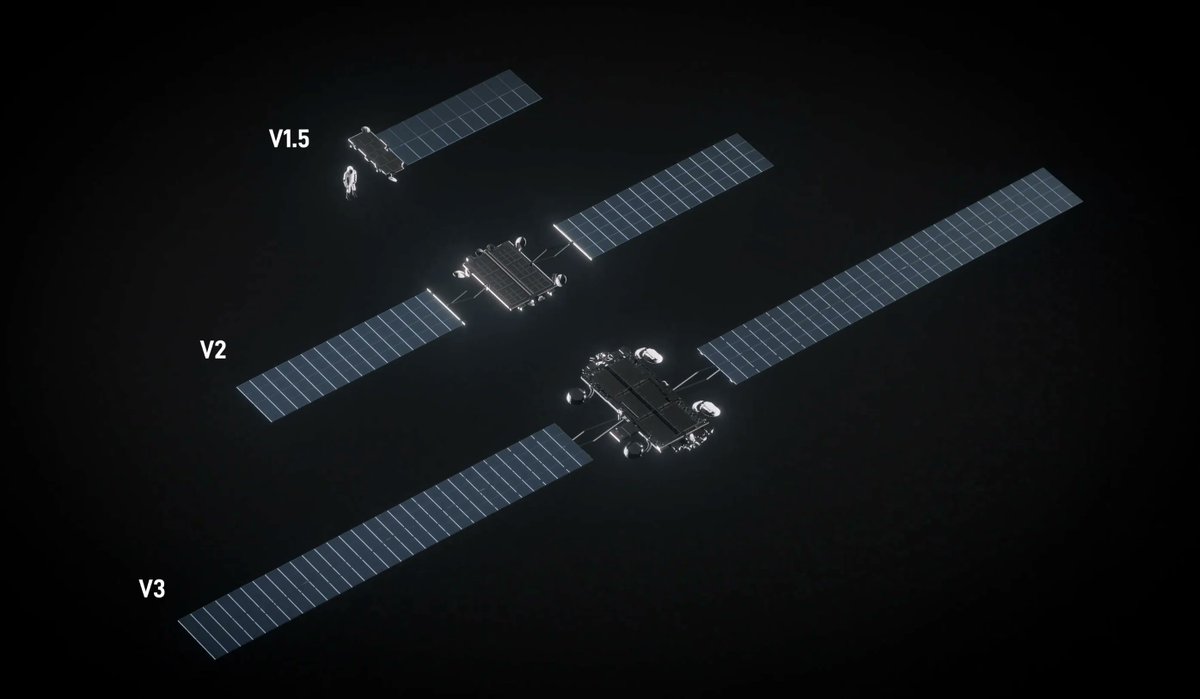
SpaceX has launched a dedicated website for Starlink V3, publishing the most detailed specs yet on the next-generation satellite. V3 delivers 1 Tbps of downlink capacity — roughly 10× the throughput of V2 — and 160 Gbps of uplink capacity, a 22× improvement. The constellation will also feature 2,048 downlink beams per satellite, dramatically increasing frequency reuse and coverage density. SpaceX simultaneously released new official renderings of the V3 hardware.

| Metric | V2 | V3 | Improvement |
|---|---|---|---|
| Downlink Capacity | ~100 Gbps | 1 Tbps | ~10× |
| Uplink Capacity | ~7 Gbps | 160 Gbps | ~22× |
| Downlink Beams | — | 2,048 | — |
SpaceX is about to move beyond testing — the first real Starlink V3 satellite deployment is set for the upcoming Starship Flight 13, a milestone highlighted in a post from Whole Mars Catalog that's drawing significant attention in the space community. The third-generation constellation represents a meaningful leap over the V2 satellites currently serving millions of subscribers worldwide, and the implications stretch from raw download speeds to how Starship fits into SpaceX's long-term launch cadence.

What exactly are Starlink V3 satellites?
V3 — also referred to internally as Gen3 — is SpaceX's third-generation Starlink hardware. These satellites are substantially larger and more capable than the V2 Mini units currently forming the backbone of the constellation. They are designed to be launched exclusively by Starship, not Falcon 9, which is why their deployment has been tied to Starship's development timeline. The jump from V2 to V3 is expected to bring significantly higher throughput per satellite, improved inter-satellite laser links, and better coverage geometry at higher latitudes.
Haven't we already seen V3 hardware in orbit?
Yes, but in a limited test capacity. According to previous SpaceX announcements, Starship's debut payload flight on May 22, 2026 carried 20 dummy Starlink satellites along with two modified observation satellites — nicknamed 'Dodger Dogs' — specifically to evaluate V3 components in the orbital environment. What's coming next is a step beyond that: real V3 satellites rather than engineering test articles — though Flight 13 flies a suborbital profile, so this first batch is expected to reenter rather than join the live constellation. Operational deployments into the working network would follow on later orbital missions.
Why does this matter for current Starlink subscribers?
The short answer: more capacity. Each V3 satellite is expected to carry a meaningfully larger share of network traffic than a V2 unit, which means as the V3 layer builds out, congestion in densely served areas should ease and peak speeds should climb. Subscribers in regions currently served by older V1 hardware stand to see the most dramatic improvements as the constellation transitions. The timeline for that transition depends entirely on how quickly Starship can fly and how many V3 units SpaceX can manufacture at Starbase.
How does Starship factor into the V3 rollout?
V3 satellites are too large to fit in Falcon 9's payload fairing in meaningful quantities — Starship's cavernous payload bay is essentially a prerequisite for mass V3 deployment. SpaceX has scheduled the thirteenth Starship test flight to carry the first batch of real V3 satellites, per the company's pre-flight mission overview. That means every successful Starship mission from here forward is also a Starlink capacity event, not just a launch milestone. The two programs are now tightly coupled in a way they weren't during the V1 and V2 rollouts.
Does this affect Starlink's competitive position against other LEO providers?
Significantly. Competing low-earth-orbit internet constellations are still scaling their first-generation hardware. A fully deployed V3 layer would give Starlink a per-satellite throughput advantage that would be difficult for rivals to match without their own next-generation hardware — hardware most are years away from fielding at scale. For enterprise and maritime customers in particular, the V3 network's improved capacity and link stability could widen the performance gap that already makes Starlink the default choice in those segments.
The pace of V3 deployment will be one of the clearest indicators of how reliably Starship can operate as a commercial launch vehicle. Watch the Starship flight manifest closely — each mission is now doing double duty for SpaceX's two most strategically important programs. For our broader SpaceX coverage, including Starship flight updates and Starlink milestones, check the dedicated tag.
🚀 Following the Starship program? See every test flight, official outcome and the next launch window in our SpaceX Starship Tracker.
Sources & reporting notes
The links below identify the material source records used for this report.
- @wholemars on X (2026-07-12T02:34:51.000Z) — Direct source
Source links are preserved as published or accessed. See our editorial standards and corrections policy.
The BASENOR Editorial Desk covers Tesla, SpaceX, and related technology, curating reporting from primary sources — official accounts, regulatory filings, and software release data. Every article passes source-record and fact-checking review before publication. About the newsroom.
This report was curated by the BASENOR Editorial Desk from the sources listed above. Read our editorial standards or email editorial@basenor.com to report an error.