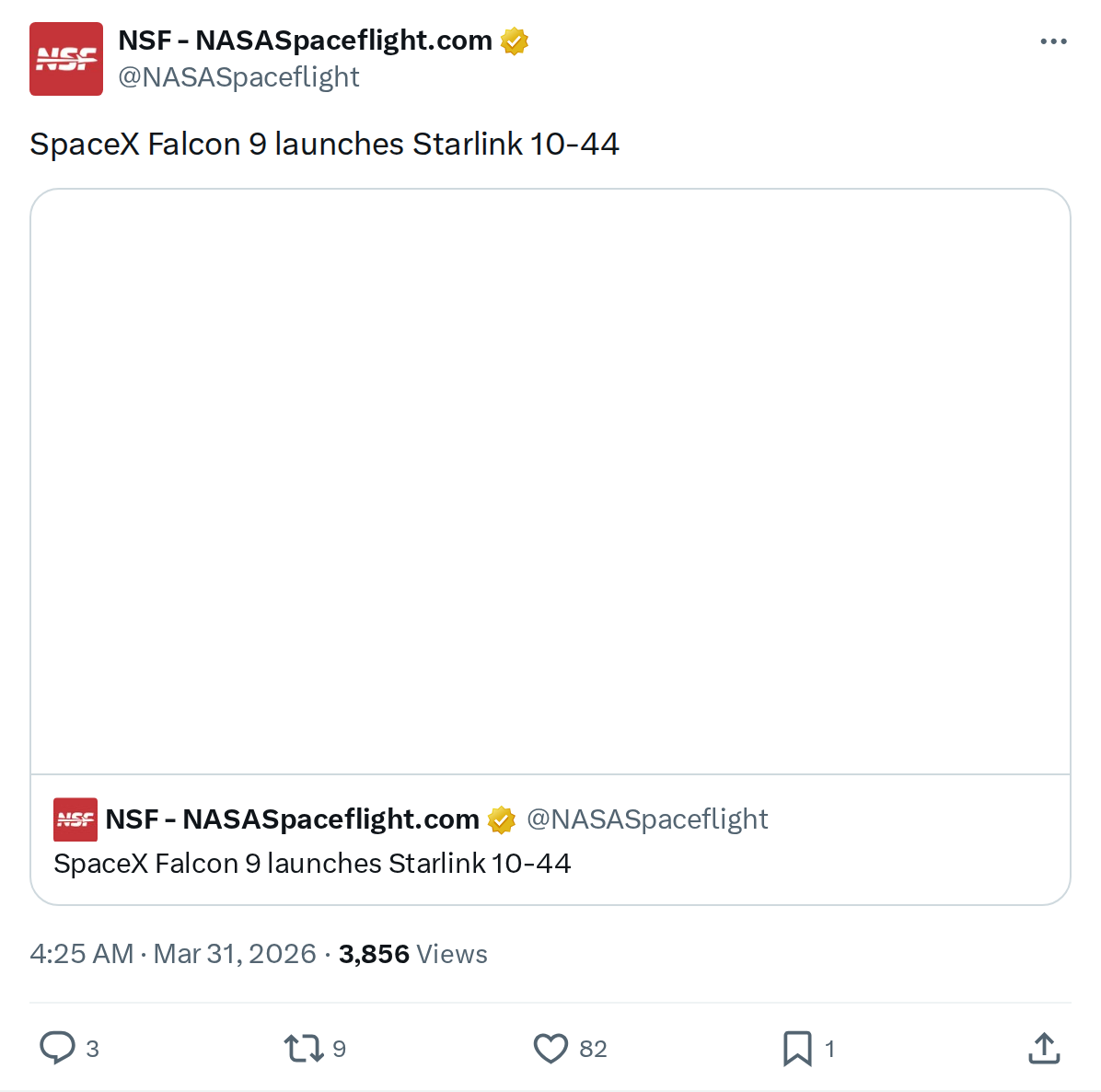
The News: SpaceX successfully launched a Falcon 9 rocket carrying 29 Starlink V2 Mini Optimized satellites on the Starlink 10-44 mission from Cape Canaveral, Florida.
Why It Matters: Every Starlink mission expands the constellation's capacity and coverage — directly improving speeds and reliability for Tesla owners using Starlink for home internet or in-vehicle connectivity.
Source: @NASASpaceflight on X
SpaceX Launches Starlink 10-44: Booster B1067 Completes Its 34th Flight
SpaceX has added another chapter to its relentless Starlink build-out. The Falcon 9 carrying the Starlink 10-44 payload lifted off from Space Launch Complex 40 (SLC-40) at Cape Canaveral Space Force Station, Florida, on March 30, 2026. On board: 29 Starlink V2 Mini Optimized satellites, destined to bolster the already-massive low-Earth orbit internet constellation.

This mission had a bumpy road to the pad — it was delayed from March 26, 27, and 29 before finally getting a green light today. Weather played its usual Florida role, with forecasters tracking cumulus clouds and surface electric field conditions before settling on a 70% favorable forecast at launch time.
📊 Key Figures
| Metric | Value | Context |
|---|---|---|
| Satellites Deployed | 29 | V2 Mini Optimized variant |
| Booster | B1067 | 34th flight for this booster |
| Launch Site | SLC-40, Cape Canaveral | Florida, USA |
| Booster Landing Target | JRTI (Just Read the Instructions) | Atlantic Ocean droneship |
| Launch Delays | 3 | Scrubbed Mar 26, 27, 29 |
| Weather Probability | 70% favorable | At launch window open |
The Workhorse That Keeps Coming Back
Booster B1067 is one of SpaceX's most-flown first stages, and its 34th flight underscores just how far reusable rocketry has come. Landing on the drone ship Just Read the Instructions in the Atlantic, B1067 will be recovered, inspected, and almost certainly readied for flight number 35. The cadence at which SpaceX is turning around these boosters — and the sheer number of missions they're stacking — is something no other launch provider on Earth is matching right now.
The V2 Mini Optimized satellites aboard this mission represent SpaceX's current-generation hardware. Compared to the original V1 satellites, the V2 Mini design carries significantly more capacity per unit, meaning each launch adds more throughput to the network than earlier missions did. For Starlink subscribers — including Tesla owners using Starlink at home — that translates to more headroom as the user base grows.
🔭 The BASENOR Take
Timeline: March 30, 2026 — Launch confirmed by @NASASpaceflight
Impact Level: Medium — incremental constellation growth, meaningful for network performance
Confidence: High — mission details sourced from verified launch tracking databases
Analysis: Starlink 10-44 is not a headline-grabbing milestone on its own, but it is exactly the kind of steady, relentless execution that has made Starlink the world's largest satellite internet constellation. SpaceX's ability to absorb three scrub days and still launch within the same week — with a booster on its 34th flight — is a logistics achievement that competitors are years away from replicating. For Tesla owners, the practical upshot is simple: more satellites means more capacity, which means better performance whether you're streaming in a rural area or relying on Starlink as your primary home connection.
📰 Deep Dive
The Starlink constellation has long passed the threshold of basic global coverage, and missions like 10-44 are now about densification — adding more satellites to existing orbital shells to increase capacity in high-demand regions. The V2 Mini Optimized variant is particularly significant here. SpaceX has been quiet about the exact throughput improvements over V1 hardware, but independent analysts have noted that each V2 Mini carries roughly four times the capacity of an original Starlink satellite. Twenty-nine of them in a single launch is a substantial network upgrade in a single afternoon.
Booster B1067's story is worth pausing on. It first flew in April 2021 and has since supported missions ranging from NASA crew rotations to Starlink batches. At 34 flights, it is approaching the upper echelon of SpaceX's reuse records. The fact that SpaceX is comfortable flying a booster this many times — and that the hardware keeps performing — is a direct validation of the engineering margins built into the Falcon 9 Block 5 design. Every successful landing and reuse drives down the marginal cost of access to orbit, which is the economic engine behind Starlink's aggressive expansion.
Three scrubs in four days is a reminder that even the world's most prolific launch provider is still at the mercy of Florida weather and technical readiness windows. The final 70% favorable forecast was enough to proceed, and the mission appears to have gone smoothly. For those tracking SpaceX's overall launch cadence in 2026, Starlink missions continue to dominate the manifest — a reflection of how central the constellation is to SpaceX's revenue and long-term ambitions. Follow our SpaceX coverage for ongoing mission updates.
Sources & reporting notes
The links below identify the material source records used for this report.
- @NASASpaceflight on X (2026-03-30T20:25:22.000Z) — Direct source
Source links are preserved as published or accessed. See our editorial standards and corrections policy.
The BASENOR Editorial Desk covers Tesla, SpaceX, and related technology, curating reporting from primary sources — official accounts, regulatory filings, and software release data. Every article passes source-record and fact-checking review before publication. About the newsroom.
This report was curated by the BASENOR Editorial Desk from the sources listed above. Read our editorial standards or email editorial@basenor.com to report an error.