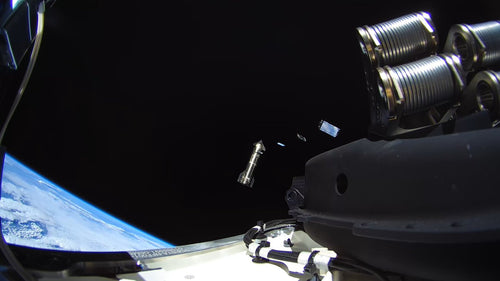
The News: SpaceX successfully launched a Falcon 9 rocket carrying 29 Starlink v2 Mini satellites on the Starlink 10-46 mission from Cape Canaveral, Florida.
Why It Matters: Each Starlink batch brings the constellation closer to global saturation — meaning faster speeds and better reliability for Tesla owners using Starlink for home internet or in-vehicle connectivity.
Source: @NASASpaceflight on X
Another Batch, Another Step Toward Full Coverage
At 10:26 AM UTC on March 17, 2026, a SpaceX Falcon 9 Block 5 rocket lifted off from Space Launch Complex 40 (SLC-40) at Cape Canaveral Space Force Station, Florida, carrying 29 Starlink v2 Mini satellites into low Earth orbit. The mission — designated Starlink Group 10-46 — is the latest in SpaceX's relentless cadence of constellation-building flights.

NASASpaceflight provided live coverage of the event, streaming the launch across both X and YouTube — a signal of just how routine, yet still watchable, these missions have become.

📊 Key Figures
| Metric | Detail |
|---|---|
| Launch Time | March 17, 2026 — 10:26 AM UTC |
| Launch Site | SLC-40, Cape Canaveral Space Force Station, FL |
| Rocket | Falcon 9 Block 5 — Booster B1090 (11th flight) |
| Payload | 29 Starlink v2 Mini satellites |
| Target Orbit | LEO — 53.16° inclination |
| Booster Landing | Droneship A Shortfall of Gravitas — Atlantic Ocean |
The Booster Story: B1090 Flies Again
One of the quieter but more impressive stats from this mission: booster B1090 completed its 11th flight. That level of reusability — once considered an engineering moonshot — is now standard operating procedure for SpaceX. Each successful recovery and re-flight drives down the cost per kilogram to orbit, which is ultimately what makes the economics of a 12,000+ satellite constellation viable.
The booster targeted a landing on the droneship A Shortfall of Gravitas in the Atlantic Ocean, continuing SpaceX's near-perfect recovery record in recent years.
🔭 The BASENOR Take
Timeline: Ongoing — SpaceX is maintaining a high-cadence launch schedule throughout 2026.
Impact Level: Moderate — incremental constellation growth with compounding long-term benefits.
Confidence: High — mission confirmed by NASASpaceflight live coverage and verified launch data.
Starlink 10-46 is not a headline-grabbing mission on its own. But that's precisely the point. SpaceX has industrialized orbital deployment to a degree no other launch provider has matched — and the cumulative effect of missions like this one is a satellite internet service that keeps getting faster, more resilient, and more geographically complete.
For Tesla owners, the relevance is direct. Tesla's in-vehicle connectivity — including over-the-air software updates, navigation data, and the Tesla app's remote features — relies on robust cellular and satellite infrastructure. As Starlink's constellation density increases, SpaceX's ability to offer direct-to-device connectivity (already in beta on some mobile carriers) edges closer to becoming a meaningful backup layer for connected vehicles in low-coverage areas.
The v2 Mini satellites being deployed on this mission carry significantly more capacity than earlier generations, with each satellite capable of delivering multiple times the throughput of the original v1 hardware. Twenty-nine more of these in orbit is a tangible network upgrade, not just a number on a manifest. For more on SpaceX's broader mission cadence, see our SpaceX coverage.
Sources & reporting notes
The links below identify the material source records used for this report.
- @NASASpaceflight on X (2026-03-17T12:15:56.000Z) — Direct source
- @NASASpaceflight on X (2026-03-17T12:27:14.000Z) — Direct source
Source links are preserved as published or accessed. See our editorial standards and corrections policy.
The BASENOR Editorial Desk covers Tesla, SpaceX, and related technology, curating reporting from primary sources — official accounts, regulatory filings, and software release data. Every article passes source-record and fact-checking review before publication. About the newsroom.
This report was curated by the BASENOR Editorial Desk from the sources listed above. Read our editorial standards or email editorial@basenor.com to report an error.