📌 UPDATE — March 20, 2026
SpaceX has now launched the latest batch: Starlink Group 17-15 lifted off from SLC-4E at Vandenberg Space Force Base, California, carrying 25 Starlink satellites atop a Falcon 9 rocket. The booster used was B1100 on its 4th flight, noted by NASASpaceflight as "a youngster" — indicating SpaceX continues to rotate newer boosters into the fleet even as veteran cores rack up double-digit missions. The launch was confirmed at approximately 21:53 UTC and streamed live by SpaceX.

This mission further narrows the gap to the 10,000 active satellite milestone discussed in the original article below. The Group 17 designation confirms continued buildout of the constellation's shell 17 orbital plane, bolstering coverage in polar and high-latitude regions served from Vandenberg's sun-synchronous trajectory corridor.
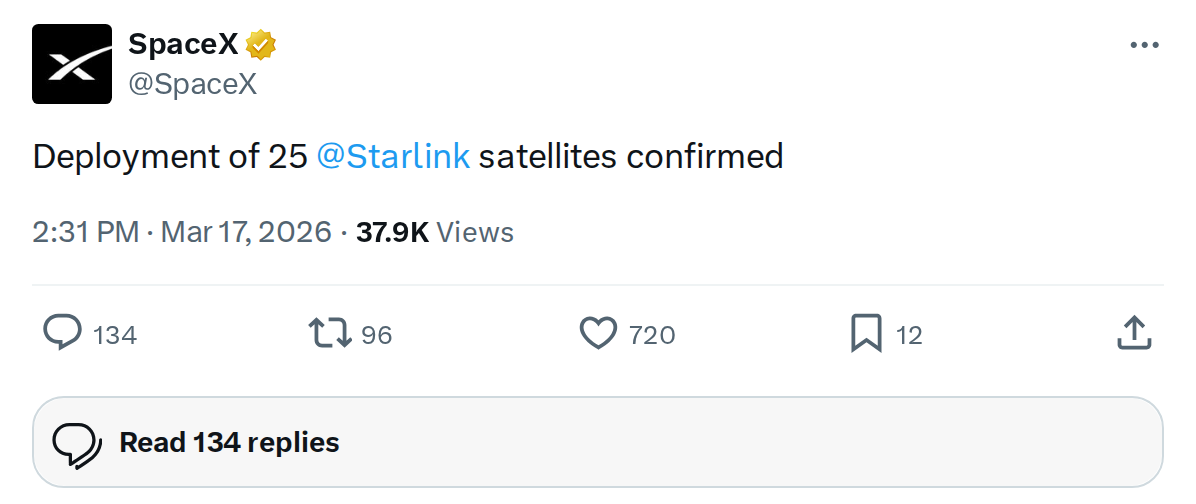
The News: SpaceX has confirmed the successful deployment of 25 Starlink satellites, continuing the rapid expansion of the world's largest commercial satellite constellation.
Why It Matters: With the Starlink constellation now approaching 10,000 active satellites, global broadband coverage — including Tesla's in-car connectivity backbone — grows more robust with every launch.
Source: @SpaceX on X

📊 Key Figures
| Metric | Value | Context |
|---|---|---|
| Satellites in orbit (total) | 9,996 | As of Mar 15, 2026 |
| Actively working satellites | 9,986 | 99.9% operational rate |
| Total spacecraft ever launched | 11,542 | Includes deorbited units |
| This batch (Group 17-31) | 25 satellites | Launched Mar 13 from Vandenberg |
| Booster reuse (this mission) | 32nd flight | Landed on OCISLY droneship |
What Just Happened — And What's Coming Next
SpaceX launched 25 Starlink satellites (Group 17-31) on March 13, 2026, at 7:57 a.m. PT from Space Launch Complex 4 East at Vandenberg Space Force Base in California. The Falcon 9 first-stage booster — on its remarkable 32nd flight — landed successfully on the Of Course I Still Love You droneship in the Pacific Ocean.
The very next day, March 14, a second Falcon 9 carried 29 Starlink units (Group 10-48) into orbit from Cape Canaveral Space Force Station in Florida, with its booster touching down on the Just Read the Instructions droneship in the Atlantic. Two launches in two days is now routine for SpaceX — a cadence that would have seemed extraordinary just a few years ago.
The milestone everyone is watching: the Starlink constellation stood at 9,996 satellites in orbit as of March 15. A scheduled launch on March 17 carrying another 25 satellites (Group 17-24) is expected to push the total past 10,000 satellites in orbit — a number that would have been science fiction a decade ago.
🛰️ Constellation Progress Toward 10,000
99.96% of the way to the 10,000-satellite milestone • Source: keeptrack.space, as of Mar 15, 2026
🔭 The BASENOR Take
The 10,000-satellite threshold isn't just a round number for press releases. More orbital coverage means denser satellite grids over any given region, which translates directly into lower latency, higher throughput, and fewer dead zones — particularly at high latitudes where ground-based infrastructure is sparse.
For Tesla owners, this matters in a few concrete ways. Tesla's vehicles rely on cellular and Wi-Fi connectivity for over-the-air software updates, navigation data, Sentry Mode cloud uploads, and the Tesla app. While Tesla doesn't exclusively use Starlink for in-car connectivity today, SpaceX and Tesla share the same parent ecosystem under Elon Musk, and the long-term integration trajectory is clear. A stronger, denser Starlink constellation is infrastructure that the broader Tesla platform will increasingly lean on.
The booster reuse story is equally significant. A Falcon 9 first stage completing its 32nd flight — and landing successfully — is a testament to the manufacturing and operational discipline that has made this launch cadence possible. Reusability is what keeps the cost-per-satellite low enough to sustain this pace of deployment. SpaceX is essentially building a global utility, and they're doing it at a speed no government space agency has matched.
📰 Deep Dive
Context matters when evaluating SpaceX's current pace. Two orbital launches in 48 hours — each recovering the booster — represents a logistics and engineering throughput that the industry is still catching up to understand. The Of Course I Still Love You and Just Read the Instructions droneships were each deployed to opposite coasts, enabling simultaneous launch readiness from both Vandenberg and Cape Canaveral. This dual-coast infrastructure is a deliberate design choice that lets SpaceX maximize launch windows regardless of weather or range availability.
The 10,000-satellite milestone, expected to be crossed with the Group 17-24 launch on March 17, is a psychological and commercial inflection point. Starlink's FCC license authorizes up to 12,000 satellites in the initial constellation, with applications pending for tens of thousands more in supplemental shells. At the current deployment rate, SpaceX is not just filling a license — it's building competitive moat. Every satellite added makes the network more resilient, more capable, and harder for any competitor to match on timeline.
For the broader SpaceX coverage from BASENOR, the pattern here is consistent: each confirmed deployment confirmation from @SpaceX is brief, almost understated. "Deployment of 25 Starlink satellites confirmed" is four words of operational routine for a company that has normalized what was once extraordinary. That normalization is itself the story — and it has long-term implications for every connected device in the Tesla ecosystem. For more on SpaceX's trajectory, follow our SpaceX coverage.
Sources & reporting notes
The links below identify the material source records used for this report.
- @SpaceX on X (2026-03-17T06:31:44.000Z) — Direct source
- @NASASpaceflight on X (2026-03-20T21:53:11.000Z) — Direct source
- @NASASpaceflight on X (2026-03-20T21:19:49.000Z) — Direct source
- @SpaceX on X (2026-03-20T21:43:25.000Z) — Direct source
Source links are preserved as published or accessed. See our editorial standards and corrections policy.
The BASENOR Editorial Desk covers Tesla, SpaceX, and related technology, curating reporting from primary sources — official accounts, regulatory filings, and software release data. Every article passes source-record and fact-checking review before publication. About the newsroom.
This report was curated by the BASENOR Editorial Desk from the sources listed above. Read our editorial standards or email editorial@basenor.com to report an error.