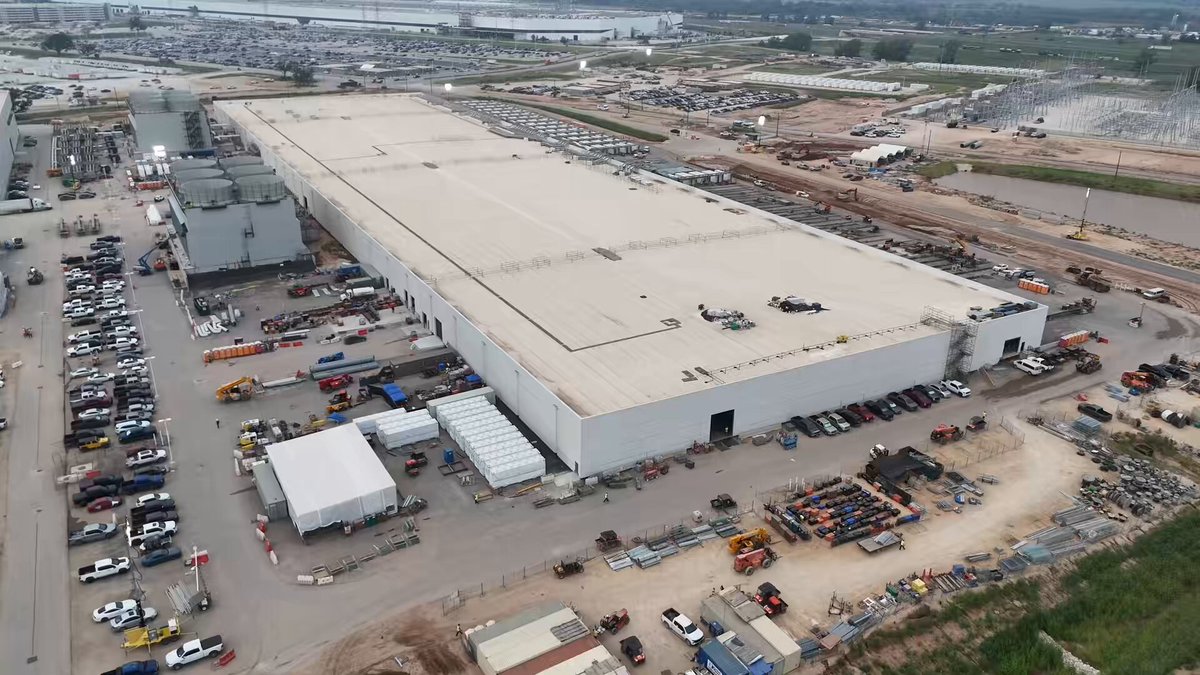
Tesla's AI infrastructure buildout at Giga Texas is moving faster than most people realize. New aerial footage from drone journalist Joe Tegtmeyer shows Cortex 2.0 — the dedicated AI training facility for the Optimus robot and potentially FSD — actively under construction, with Megapacks and cooling systems already being installed on-site. The scale of what's taking shape on the North Campus is hard to overstate.

What Cortex 2.0 Actually Is
Cortex 2.0 is Tesla's second-generation AI supercomputing cluster, purpose-built to train the neural networks that will power the Optimus humanoid robot. Think of it as the brain factory — the place where Optimus learns to see, move, and reason before any of that intelligence gets deployed into physical hardware.
FSD training may also benefit from the facility's compute, though Optimus appears to be the primary driver. Elon Musk confirmed Cortex 2.0's timelines and progress back in March 2026, and the first 250 MW phase reportedly came online in April. What Tegtmeyer's footage captures is the second phase of that buildout still actively taking shape.
The Numbers Behind the Build
The full Cortex 2.0 cluster is designed to reach 500 MW of total power capacity — enough to run approximately 100,000 Nvidia H100 and H200 GPUs at full load. According to prior reporting, the facility already houses over 230,000 H100-equivalent GPUs as of mid-June, with the complete 500 MW buildout expected by mid-2026.
Energy storage is scaling in parallel. Permits filed in May 2026 show plans to roughly double the original Megapack footprint from around 130 units to approximately 250 — a full buildout that would provide roughly 975 MWh of on-site storage. Tegtmeyer's flyover confirms about half of those Megapacks are already installed, with cooling systems following close behind.
Cortex 2.0 — Key Figures
| Total Power Capacity | 500 MW (full buildout) |
| Phase 1 Online | April 2026 (250 MW) |
| GPUs (H100-equivalent) | 230,000+ as of June 2026 |
| Megapack Target | ~250 units (~975 MWh) |
| Primary Purpose | Optimus AI training / FSD |
The Bigger Picture on the North Campus
Cortex 2.0 doesn't sit in isolation. It's part of a dense cluster of interconnected facilities taking shape on Giga Texas's North Campus. Directly adjacent is a dedicated Optimus production factory — a structure that had reached a four-floor steel superstructure by June 17 — designed for an eventual long-term output of 10 million Optimus units per year, with high-volume production slated to begin in Summer 2027.
Alongside that sits Terafab, the AI chip fabrication facility announced by Elon Musk in March 2026 as a joint venture involving Tesla, SpaceX, and xAI. Terafab is targeting over one terawatt of annual AI compute capacity, with initial tool installation for its Phase 1 scheduled for Q3 2026 and first silicon production targeted for early 2027. The AI5 inference chip — designed specifically for Optimus — completed its tape-out in April 2026 and is expected to be among the first products off the Terafab line.
Taken together, the North Campus expansion is projected to add over 5.2 million square feet of new industrial space by the end of 2026. That's not incremental growth — it's the physical foundation for a robotics and AI business that Tesla is betting will eventually dwarf its car business.
Editor's View
What makes Cortex 2.0 significant isn't just the raw compute numbers — it's the vertical integration story. Tesla is building the factory to make the robots, the chip fab to power them, and now the AI training cluster to teach them. If that flywheel spins up as planned, the competitive moat becomes very difficult to replicate. The question is whether the 2027 production timelines hold, and whether Optimus can actually perform useful work at scale — something no aerial footage can answer yet.
🤖 Tracking Tesla's humanoid robot? See every Optimus production milestone and appearance in our Tesla Optimus Tracker.
Related Gear
Gear up your Tesla with tested, custom-fit BASENOR accessories — shop Tesla accessories →
Sources & reporting notes
The links below identify the material source records used for this report.
- @JoeTegtmeyer on X (2026-06-19T15:34:00.000Z) — Direct source
Source links are preserved as published or accessed. See our editorial standards and corrections policy.
The BASENOR Editorial Desk covers Tesla, SpaceX, and related technology, curating reporting from primary sources — official accounts, regulatory filings, and software release data. Every article passes source-record and fact-checking review before publication. About the newsroom.
This report was curated by the BASENOR Editorial Desk from the sources listed above. Read our editorial standards or email editorial@basenor.com to report an error.