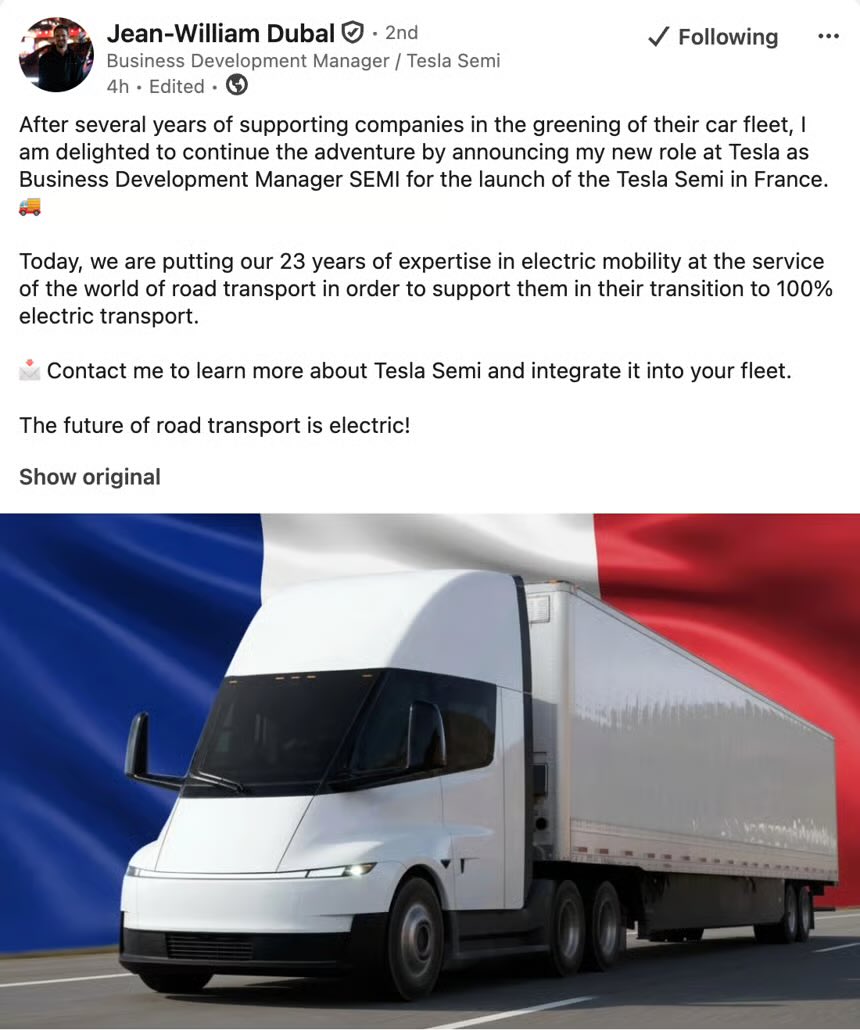
Tesla is quietly assembling the commercial infrastructure needed to sell its Semi truck in Europe, and the latest hiring move makes the 2027 target feel less like a projection and more like a plan. The company has brought on Jean-William Dubal as Business Development Manager for France — a role squarely focused on landing fleet customers before the truck even arrives on European soil.

How We Got Here
The Semi's European story has been building steadily throughout 2025 and 2026. Tesla hired Usuf Schermo as Head of Business Development for the EMEA region back in April 2025 — the first concrete sign that Europe was more than a footnote in the Semi program. Then in June 2026, a Business Development Manager listing appeared for Parsdorf, near Munich, focused on securing fleet customers, managing truck configurations, and overseeing charging infrastructure for German-market operators. A supporting Fleet Coordinator role in Munich followed, dedicated to managing demonstration vehicles.
The France hire fits the same pattern: Tesla is not waiting for trucks to roll off a European production line before building its sales pipeline. It is seeding market development teams country by country, well ahead of first deliveries.
The manufacturing foundation is also now in place. Volume production of the Tesla Semi officially began on April 29, 2026, at a dedicated facility adjacent to Gigafactory Nevada, with an annual capacity target of 50,000 units. That shift from prototype deliveries to volume manufacturing is what makes the European timeline credible — Tesla has something to actually ship.
What European Operators Are Looking At
Tesla has listed Standard Range specifications for several European markets, including the official UK site. The numbers are worth understanding for any fleet operator evaluating the truck against diesel alternatives.
| Specification | Value |
|---|---|
| Range (Standard Range) | ~550 km |
| Energy Consumption | 1.0 kWh/km |
| Gross Combination Weight Rating | 40 tonnes |
| Curb Weight | 9,100 kg |
| Drive Power | Up to 800 kW (three rear motors) |
| Peak Charging Rate (MCS) | 1.2 MW |
| Charge Recovery (30 min) | Up to 60% range |
| Electric Power Take-Off (ePTO) | Up to 25 kW |
The 40-tonne GCWR is significant: it aligns precisely with the standard European limit for articulated trucks, meaning the Semi fits within existing regulatory frameworks without special permits. The 550 km range on the Standard Range variant covers most regional distribution routes common in France, Germany, and the UK without requiring an en-route charge — the primary objection fleet managers have historically raised about electric trucks.
European pricing has not been announced. For context, US market pricing currently stands at approximately $260,000 for the Standard Range and $300,000 for the Long Range — figures that represent a substantial premium over the $150,000–$180,000 projections Tesla made at the 2017 unveil. European prices will likely carry additional import and regulatory costs on top of that baseline.
Why France, and Why Now
France is a logical early target. It is one of Europe's largest road freight markets, with strong government incentives for fleet electrification under the country's decarbonization commitments. French logistics operators — particularly in food distribution and retail supply chains — run dense regional networks that map well to the Semi's range envelope.
The timing of the Dubal hire also reflects how Tesla typically approaches new market launches: the commercial team arrives 12–18 months before first deliveries to build the order book, establish charging infrastructure partnerships, and run demonstration programs. If the 2027 launch target holds, hiring now is exactly on schedule.
Semi Program Director Dan Priestley confirmed the 2027 European timeline in May 2026, echoing Elon Musk's February statement that the truck would come to Europe "hopefully next year." With volume manufacturing now running in Nevada and country-level sales teams being assembled across France and Germany, the infrastructure for that commitment is taking shape faster than the original Semi timeline — famously delayed by years — might suggest.
The open question is charging. MCS (Megawatt Charging System) infrastructure in Europe remains sparse, and Tesla has not yet detailed a Semi-specific charging network buildout equivalent to what it has planned for North America. That gap is likely what the Munich-based Fleet Coordinator role — focused on demonstration vehicles — is partly designed to address: getting trucks in front of fleet operators while the charging network catches up.
Related Gear
Gear up your Tesla with tested, custom-fit BASENOR accessories — shop Tesla accessories →
Sources & reporting notes
The links below identify the material source records used for this report.
- @TeslaNewswire on X (2026-08-04T16:37:23.000Z) — Direct source
Source links are preserved as published or accessed. See our editorial standards and corrections policy.
The BASENOR Editorial Desk covers Tesla, SpaceX, and related technology, curating reporting from primary sources — official accounts, regulatory filings, and software release data. Every article passes source-record and fact-checking review before publication. About the newsroom.
This report was curated by the BASENOR Editorial Desk from the sources listed above. Read our editorial standards or email editorial@basenor.com to report an error.