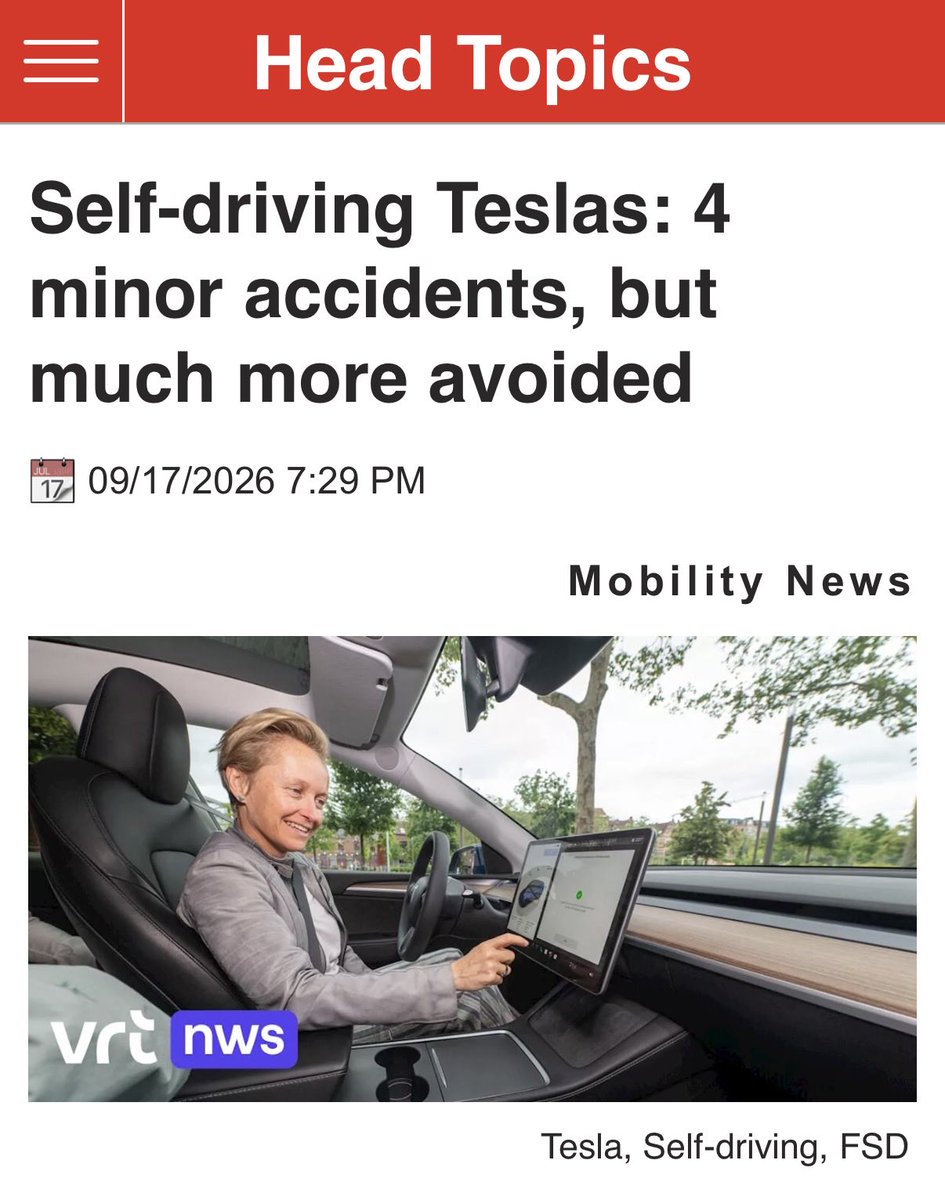
Belgium has quietly become one of the most data-rich testing grounds for Tesla's Full Self-Driving (Supervised) system in Europe — and the early safety numbers are hard to ignore. Flemish Transport Minister Annick De Ridder has confirmed that between June 11 and August 31, 2026, FSD (Supervised) demonstrated a crash risk 9.6 times lower than manual driving on non-highway roads, and approximately 30% lower overall. The data covers 24.6 million kilometers (~15.3 million miles) accumulated since the system received official approval for Belgian public roads.

What the Belgian Data Actually Shows
FSD (Supervised) received its approval for use on Belgian public roads on June 10, 2026, following 5,000 km of supervised testing in Flanders. The roughly 11-week window from June 11 to August 31 produced a meaningful dataset — and the split between highway and non-highway performance is the most telling detail.
The 9.6x improvement on non-highway roads is the headline figure, and it makes intuitive sense: urban and suburban driving — intersections, cyclists, pedestrians, unpredictable merges — is where human error concentrates. Highways are more structured, and the gap there narrows to roughly 30% in FSD's favor. That's still a meaningful edge, but the off-highway number is the one that matters for real-world urban deployment policy.
According to Minister De Ridder, there were four minor accidents involving FSD-equipped Teslas during this period. Notably, one of those four was subsequently clarified as driver error: the human manually took over and struck a stationary vehicle at low speed. That reclassification matters — it means the FSD system's actual incident record during this window is even cleaner than the headline accident count suggests.

The Broader European Picture
Belgium's numbers don't exist in isolation. Across five European countries where FSD (Supervised) is approved — the Netherlands, Lithuania, Estonia, Denmark, and Belgium — Tesla has accumulated over 100 million kilometers (63 million miles) of customer driving between April 10 and August 24, 2026. According to that dataset, FSD was involved in 4.1 times fewer collisions than manually driven Tesla vehicles across the same fleet.
An earlier interim cut of that data, covering April 10 to July 26 across 65 million kilometers, put the figure at 5.2 times fewer collisions. The slight compression from 5.2x to 4.1x as the dataset grew is worth noting — it suggests the system's safety advantage is real but may moderate as it encounters a wider variety of edge cases and road conditions at scale. That's not a red flag; it's what honest data accumulation looks like.
The highway performance across those five EU countries during the earlier window was particularly striking: FSD logged 41.9 million kilometers on highways with zero reported collisions. On non-highway roads over the same period, there were six collisions across 23.8 million kilometers.
| Dataset | Coverage | FSD vs Manual |
|---|---|---|
| Belgium — off-highway | Jun 11 – Aug 31, 2026 | 9.6× fewer crashes |
| Belgium — overall | Jun 11 – Aug 31, 2026 | ~30% fewer crashes |
| 5 EU countries — overall | Apr 10 – Aug 24, 2026 (100M+ km) | 4.1× fewer collisions |
| 5 EU countries — highways | Apr 10 – Jul 26, 2026 (41.9M km) | 0 collisions reported |
Why Government-Sourced Data Changes the Conversation
Tesla has published its own safety reports for years, and critics have consistently — and reasonably — pointed out the conflict of interest in a company grading its own homework. What makes the Belgian data different is the source: a government minister citing figures in an official capacity. That doesn't make the numbers beyond scrutiny, but it does shift the evidentiary weight considerably. When a transport minister stands behind safety statistics, the political and legal exposure for inaccuracy is real.
The framing also matters for European regulatory momentum. FSD (Supervised) is currently approved in five EU countries. Each data report from a government official makes it harder for other member states to maintain a blanket prohibition on the grounds of unproven safety. Belgium's 9.6x off-highway figure, in particular, is the kind of number that tends to show up in regulatory briefings.
For owners already using FSD in approved European markets, the data reinforces what many have experienced anecdotally. For those in countries still waiting on approval, Belgium's 11-week dataset is now part of the public record — and it's a compelling one. Follow our FSD coverage as the European rollout continues to expand.
Related Gear
Gear up your Tesla with tested, custom-fit BASENOR accessories — shop Tesla accessories →
Sources & reporting notes
The links below identify the material source records used for this report.
- @TeslaNewswire on X (2026-09-18T18:55:40.000Z) — Direct source
Source links are preserved as published or accessed. See our editorial standards and corrections policy.
The BASENOR Editorial Desk covers Tesla, SpaceX, and related technology, curating reporting from primary sources — official accounts, regulatory filings, and software release data. Every article passes source-record and fact-checking review before publication. About the newsroom.
This report was curated by the BASENOR Editorial Desk from the sources listed above. Read our editorial standards or email editorial@basenor.com to report an error.