

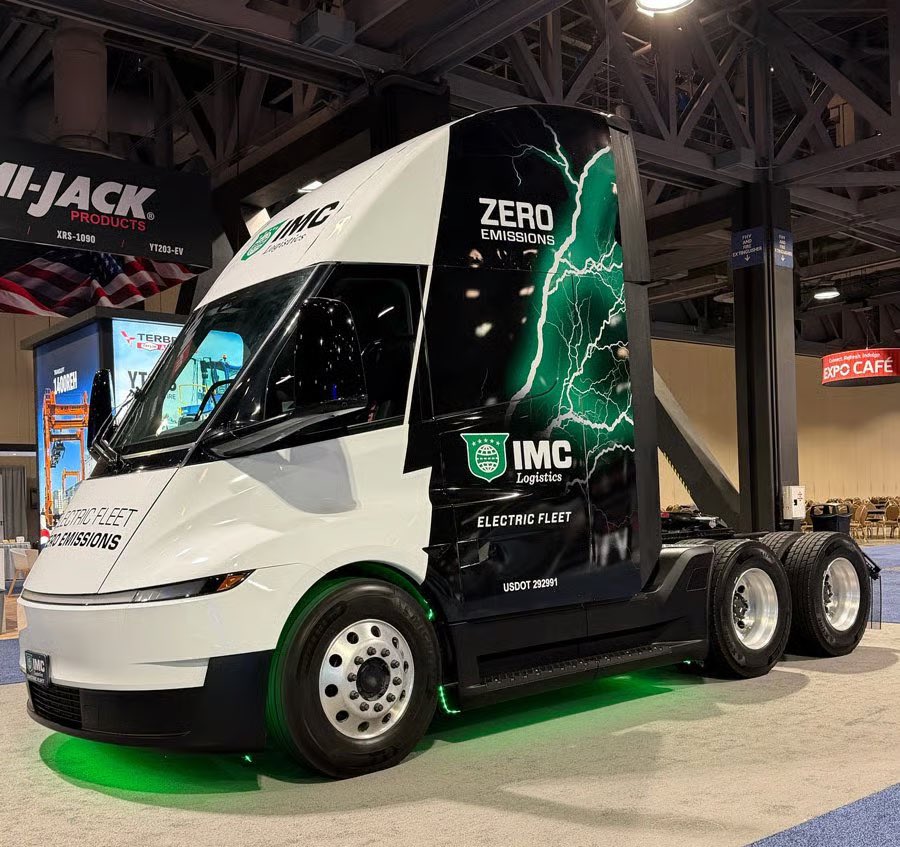
IMC Logistics is expanding its California fleet with 50 Tesla Semis, covering both local port drayage and longer inland routes. The order spans both Standard Range and Long Range variants — a split deployment that reflects the practical reality of drayage operations, where short-haul and longer-haul needs coexist on the same network. Here's what we know about the deal and what it signals for commercial EV adoption.

What exactly is IMC Logistics ordering?
According to reporting by The Tesla Newswire, IMC Logistics is adding 50 Tesla Semis to its California operations. The fleet will be split between Standard Range units for local port drayage work and Long Range units for routes connecting Southern California to inland destinations. IMC has previously tested Tesla Semi trucks, so this order represents a scale-up from pilot to operational deployment.
What's the difference between the Standard Range and Long Range Semi, and why does the split matter?
The Standard Range Semi carries a 548 kWh battery pack and delivers approximately 325 miles of range at full 82,000 lb gross combined weight. The Long Range variant steps up to an 822 kWh pack with roughly 500 miles of range. Both use three independent rear motors producing up to 800 kW of drive power and support MCS 3.2 charging via Tesla Megachargers, which can recover up to 60% of range in 30 minutes. For port drayage — short, repetitive runs between a port and a nearby rail yard or distribution center — the Standard Range unit is more than sufficient and likely lighter on upfront cost. The Long Range variant becomes necessary once routes push past 300 miles, which is exactly the profile of Southern California-to-inland corridors like the Inland Empire.
Is this IMC's first move into zero-emission trucking?
No. IMC Logistics has been building toward a zero-emission California fleet for several years. According to public records, the company previously purchased 50 hydrogen fuel cell tractors — with early deliveries expected in 2024 — targeting longer-range routes where hydrogen's fast refueling offered an advantage. IMC has also deployed Volvo battery-electric trucks in Southern California with support from California's HVIP grant program. The company's stated goal is to replace all diesel tractors in its California operations by 2028. The Tesla Semi order fits squarely within that roadmap.
How does this order fit into the broader Tesla Semi commercial rollout?
Volume production of the Tesla Semi began on April 29, 2026, at a dedicated 1.7 million square foot Gigafactory in Nevada, with an annual production target of 50,000 units. Tesla's official Semi launch event is scheduled for September 24, 2026 — just days from now. IMC's 50-unit order is one of several large California-focused deployments taking shape around that launch window. Forum Mobility has contracted for over 330 Semis to operate at public Megacharging depots across the state, and WattEV has ordered 370 units with initial deliveries of 50 trucks expected in 2026. Swedish operator Einride has placed an order for 500 Semis, with roughly 75 units targeted for deployment by year-end. Taken together, these orders suggest California's freight sector is treating the Semi's volume production ramp as a genuine inflection point, not a wait-and-see moment.
What does this mean for California's port drayage sector specifically?
Port drayage is one of the most targeted segments for zero-emission mandates in California. The state's Advanced Clean Fleets regulation puts pressure on drayage operators to transition away from diesel, and the short, predictable route profiles of port work make battery-electric trucks a practical fit — trucks return to a depot nightly, which simplifies charging logistics considerably. IMC's decision to use Standard Range Semis for this work, rather than hydrogen or a competing platform, is a meaningful data point. It suggests the Semi's range, charging speed, and total cost of operation are clearing the bar for real commercial use, not just press-release pilots.
With Tesla's official Semi launch arriving on September 24 and production now running at scale in Nevada, IMC's 50-unit order is a sign that the commercial freight market isn't waiting for the fanfare — the transition is already underway.
Related Gear
Gear up your Tesla with tested, custom-fit BASENOR accessories — shop Tesla accessories →
Sources & reporting notes
The links below identify the material source records used for this report.
- @TeslaNewswire on X (2026-09-18T16:23:29.000Z) — Direct source
Source links are preserved as published or accessed. See our editorial standards and corrections policy.
The BASENOR Editorial Desk covers Tesla, SpaceX, and related technology, curating reporting from primary sources — official accounts, regulatory filings, and software release data. Every article passes source-record and fact-checking review before publication. About the newsroom.
This report was curated by the BASENOR Editorial Desk from the sources listed above. Read our editorial standards or email editorial@basenor.com to report an error.






